Estimated reading time: 6 minutes
If you spend any time reading gemstone descriptions, you’ll eventually come across the word cleavage. It is one of those terms that sounds a bit dramatic, but in gemology it has a very specific and very practical meaning.
Cleavage is not about how a gemstone looks. It is about how it breaks, and for jewelers that can make a big difference.
Jump to:
What does cleavage mean in gemstones?
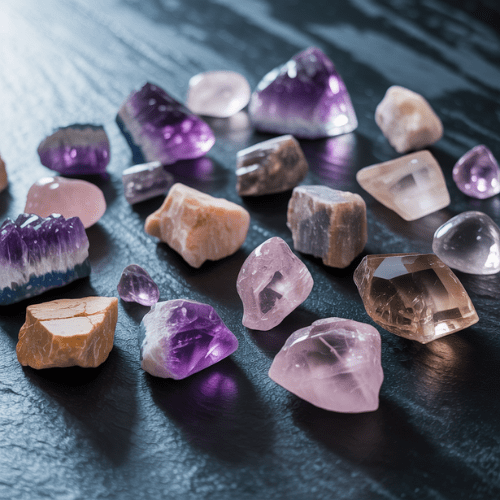
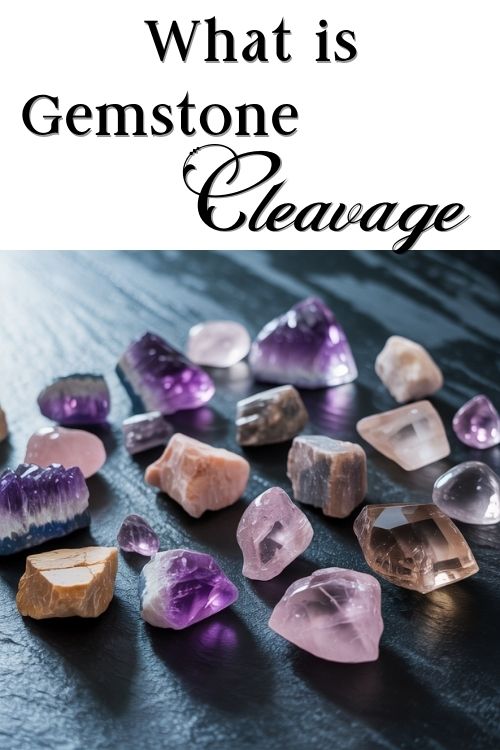
Inside every crystal, atoms are arranged in repeating patterns. In some directions, the bonds between those atoms are slightly weaker. If the stone is struck or put under pressure in just the right way, it can split cleanly along those week lines. This ability to predictably split (or not split) is known as cleavage.
A helpful way to picture it is to think about wood. It is much easier to split a log along the grain than across it. Cleavage works in a similar way, but on a microscopic scale inside the crystal structure. With each cleavage plane having a specific orientation, much like the grain within wood. This means a stone may be very tough in one direction but surprisingly fragile in another.
When a gemstone breaks along a cleavage plane, the surface is usually smooth, flat, and quite reflective. This is different from fracture, which is an irregular break that does not follow any natural internal planes.
The main categories of cleavage
Gemologists describe cleavage based on how easy it is to cause and how clean the resulting break is. This helps us understand how a stone is likely to behave during cutting, setting and wear.
Perfect
At one end of the scale is perfect cleavage. In this case, the stone will split very easily along its cleavage plane if struck in the right direction. The break is smooth, flat, and clean. Diamonds and topaz are classic examples. They can be very durable in some directions, but surprisingly vulnerable in others.
Good
Next is good cleavage. The stone will still break along its cleavage plane fairly easily, but it usually takes a bit more force or a more precise angle. The resulting break is still quite clean, though not as flawless as with perfect cleavage.
Distinct
With distinct cleavage, things become less predictable. The cleavage planes are noticeable, but they compete with fracture. The stone might split along the cleavage plane, or it might break irregularly instead. You cannot rely on it behaving one way or the other.
Poor
Moving further along, we come to poor cleavage. Here, the cleavage planes do exist, but they are quite weak. It takes significant force to activate them, and the stone is more likely to fracture in an irregular way instead of splitting cleanly.
Imperfect & Indistinct
Then there is imperfect and indistinct cleavage. Technically these are two separate types of cleavage, but they behave so similarly I’ve grouped them together. In these stones, cleavage is barely expressed at all. It is very difficult to cause a clean split, and breakage is usually messy and irregular. Quartz is a good example, which is one of the reasons it is so popular in jewellery.
None
Finally, some gemstones have no cleavage at all. This means there are no natural internal planes along which the stone prefers to split. Instead, when they break, they do so by fracturing in an irregular, often curved pattern. Stones with no cleavage are generally easier to cut because they are less prone to break, and they tend to be tougher in everyday wear. Garnet is a classic example, which is one reason it performs so well in rings and other frequently worn jewellery.
Why does cleavage matter to a jeweler?
Cleavage is not just a technical gemology term that lives in textbooks. It has very real consequences for how a stone is cut, set, and worn.
When a gem cutter works with a piece of rough, they pay close attention to the direction of the cleavage planes. If those planes are ignored, the stone can split unexpectedly during cutting. In the worst cases, a valuable piece of rough can be ruined in a single moment.
On the other hand, cleavage can sometimes be useful. Some stones are deliberately split along their cleavage planes to produce smaller, more workable pieces of rough.
But what about jewelers?
Cleavage also affects how a stone should be set. A gemstone with strong cleavage may be vulnerable if struck in the wrong direction. Corners, points, and thin edges can be especially at risk. Because of this, a jeweller might choose a more protective setting, such as a bezel, or design the piece so the stone sits lower and is less exposed.
When working with a stone that has perfect or good cleavage, it is also worth taking a little extra time to prepare the setting properly. If the seat is not quite right, the gem can shift or bounce slightly as it is being set. This is especially true when using mechanical setting methods rather than gentle hand tools. In stones with perfect or good cleavage, that extra movement increases the risk of the gem splitting along a cleavage plane.
It also plays a role in everyday durability. Two stones might have similar hardness, but behave very differently if one has strong cleavage and the other does not. A stone with perfect cleavage may split if dropped, while a stone with poor or indistinct cleavage might simply chip or even survive the fall unscathed.
This is why some gemstones are better suited to rings worn every day, while others are more comfortable in pendants or earrings where they are less likely to take knocks.
A small detail with a big impact
Cleavage is one of those properties most people never think about, yet it quietly influences almost every stage of a gemstone’s life. It affects how the stone is cut, how it should be set, and how it will behave when the jewellery is worn.
For jewelers, understanding cleavage helps avoid costly mistakes. For collectors, it offers a deeper appreciation of why some stones need a little extra care. And for anyone who loves gemstones, it is another reminder that each one has its own internal structure and personality.
If you ever see cleavage mentioned in a gem description, you’ll now know it’s not just technical jargon. It is a small detail that can make a very big difference.
🔗 Looking for more deep dives into gemstone terms? Try:
What is the Mohs Hardness Scale?
Gemstone Optical Phenomena Explained
📌 Don’t forget to save this blog post so you can find it again!