Estimated reading time: 5 minutes
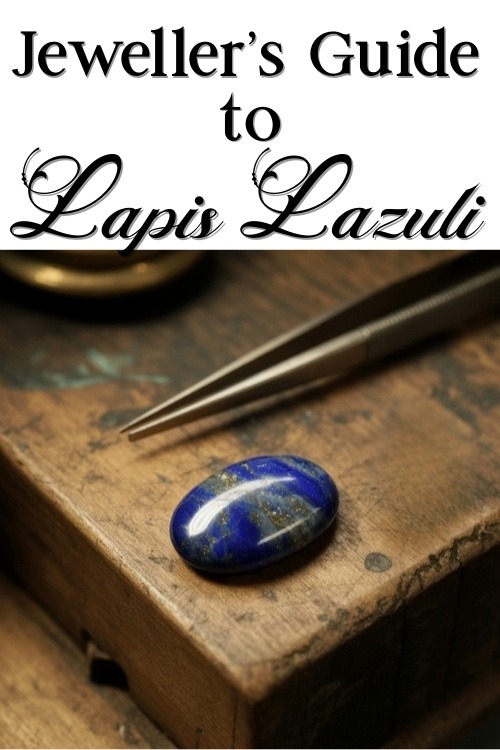
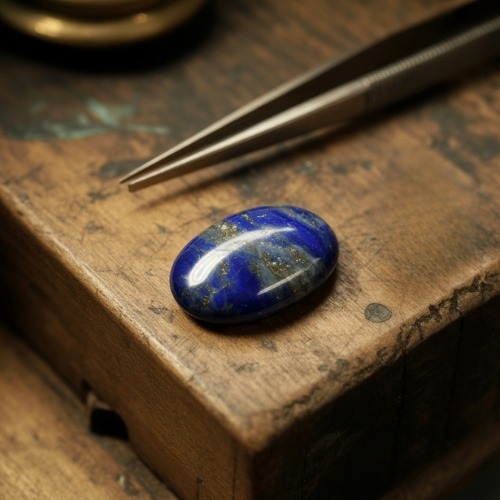
Lapis lazuli is one of the oldest and most recognisable gemstones in the world. Its deep royal blue colour, often flecked with golden pyrite, has been prized for thousands of years in jewellery, carvings, and decorative objects. Unlike many modern faceted stones, lapis offers a rich, velvety colour that feels both historic and luxurious, making it a favourite for statement pieces and artisan jewellery.
Jump to:
Basic Identification Information
Name & Synonyms
Lapis lazuli (Often shortened to just lapis)
Species
Rock composed mainly of the mineral lazurite
Colour Range
Deep royal blue to violet blue, often with white calcite and gold coloured pyrite inclusions
Refractive Index
1.500 to 1.670 (varies due to rock composition)
Birefringence
None
Optical Sign
Aggregate (not singly refractive or doubly refractive in the usual sense, but behaves as singly refractive with a single RI reading)
Pleochroism
None
Specific Gravity
2.50 to 3.00
Fluorescence
Inert to moderate strength.
Orange or Pink under longwave UV. Green, greenish Yellow or Yellowish Green under shortwave UV.
Lustre
Vitreous to waxy
Clarity
Opaque
Gems Often Mistaken For
Sodalite, dyed howlite, dyed jasper
Mohs Hardness
5 to 6
Wearability
Moderate – best suited to earrings, pendants, and occasional wear rings
Birthstone
Not a traditional birthstone, but often associated with December in alternative lists
Spotting Synthetic (Lab-Grown) Lapis Lazuli
Synthetic lapis lazuli has been produced since the mid twentieth century. It was developed to imitate the colour and general appearance of fine natural lapis, and while it is not as commonly encountered as dyed or reconstructed material, it does still appear in the trade.
Under magnification, synthetic lapis often shows a very even, saturated blue colour and a more uniform internal structure than natural material. Natural lapis typically displays some variation in tone, along with visible calcite patches and irregular pyrite inclusions.
In synthetic material, you often see synthetic pyrite inclusions. These inclusions tend to look unusually consistent in size, shape, or distribution. The overall texture can also look slightly glassy or overly uniform compared with the granular, uneven structure seen in natural lapis.
As with many synthetic gems, the key is to look for signs of natural structure (colour variation, and irregular inclusions), more so then looking for the signs of lab creation.
Common Treatments
Lapis lazuli is frequently treated to improve its colour and surface appearance. The most common treatment is dyeing, which is used to deepen or even out the blue tone, particularly in material that contains noticeable white calcite.
Waxing or oiling is also widely used. This helps enhance the stone’s lustre and can make surface features or pale areas less visible. These treatments are considered standard in the trade, especially for lower to mid quality material.
As with any treated gemstone, full disclosure is important, as untreated stones with strong natural colour are generally more desirable.
Durability & Setting Considerations
Lapis lazuli has a hardness of around 5 to 6 and is made up of several different minerals, which makes it softer and more porous than many common jewellery stones. It can scratch or chip more easily than quartz or corundum, so a little extra care in design and wear is recommended.
Lapis is best suited to earrings, pendants, brooches, and occasional wear rings rather than pieces that see constant impact. For rings or bracelets, protective settings such as bezels or halo designs help shield the stone’s edges and reduce the risk of damage.
🛍️ Explore our selection of pre-owned Lapis Lazuli Gemstones for your next jewellery creation.
Care Instructions
Cleaning
Clean lapis with warm water, mild soap, and a soft cloth or brush.
Avoid ultrasonic or steam cleaners, as these can damage the stone and any treatments it’s received.
Storage
Store separately from harder gemstones to prevent scratches.
Soft pouches or lined jewellery boxes work well.
Daily Wear
Avoid exposure to chemicals, cosmetics, and perfumes.
Remove lapis jewellery during physical activity or household chores.
Market & Ethical Notes
The finest lapis lazuli traditionally comes from the Badakhshan region of Afghanistan, which has supplied the stone for over 6,000 years. Other sources include Chile, Russia, and Pakistan.
High quality lapis shows:
- Deep, even blue colour
- Minimal white calcite
- Fine, evenly distributed pyrite
Because lapis is a rock rather than a single mineral, quality can vary widely.
Ethical sourcing considerations often focus on responsible mining practices and transparent supply chains, particularly for material from historic regions.
Symbolic & Spiritual Meanings
Lapis lazuli has long been associated with wisdom, truth, and spiritual insight. In modern crystal healing, it is linked to communication, inner vision, and mental clarity. It is often connected with the throat and third eye chakras, and is believed to support honest expression and intuitive understanding.
🔗 Dive deeper into lapis lazuli’s symbolic and spiritual meanings (coming soon)
Etymology
The name lapis lazuli comes from Latin and Persian roots. Lapis means stone in Latin, while lazuli comes from the Persian word lazhward, referring to the deep blue colour. The term eventually gave rise to the words azure and lazuli, both connected to shades of blue.
🔗 Curious about how lapis lazuli was viewed in ancient cultures? Explore its fascinating myths and legends (coming soon)
📌 Save this jeweller’s guide to lapis lazuli for quick reference next time you are working with this historic, richly coloured gem.