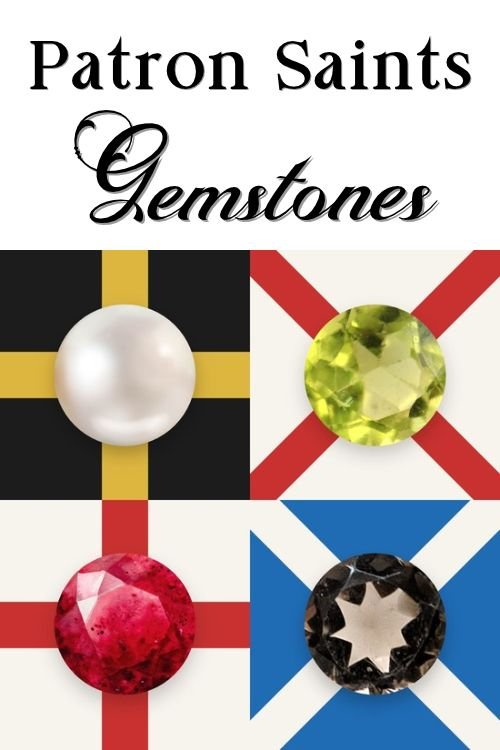
Four nations, four saints, one dragon slain, and a lot of very specific colour schemes. If you’re looking for inspiration for your jewellery makes, patron saints’ days are a lovely excuse to create pieces with a story behind them.
Here are three gems for each, with a bit of heritage or symbolism explaining why they’re a great choice for that saint.
Wales: St David’s Day, 1st March
St David (Dewi Sant) was a 6th century Welsh bishop, born in Pembrokeshire. He founded a monastery where the city of St Davids now stands and spent his life spreading Christianity across Wales, becoming the leading figure of the early Welsh church.
Fun fact: he’s the only patron saint of Britain and Ireland who was actually born in the country he looks after. He’s said to have died on 1st March, and in his final sermon he told his followers to “do the little things”.
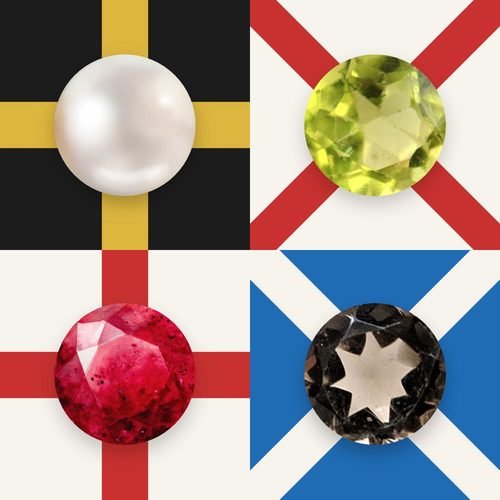
Freshwater pearls
A nod to Conwy, which had a pearl fishery from Roman times onwards. By the early 19th century it was one of the most important in Britain, sending kilos of pearls to London jewellers every week. It’s even said that there is a Conwy pearl in the Crown Jewels. You won’t find Welsh pearls today, though. The freshwater pearl mussel is now critically endangered and fully protected. That said, cultured freshwater pearls will still give you the same soft glow and a little Welsh history, with no mussels harmed.
Citrine
Citrine mirrors the sunny yellow of the daffodil, Wales’s national flower. St David lived long before the daffodil became a Welsh emblem, but I think he’d approve, since people wear daffodil buttonholes to celebrate him. Citrine has also long been linked with optimism and warmth, which gives it double appeal for the 1st March given it’s also the start of spring.
Garnet
A deep red gemstone for Y Ddraig Goch, the red dragon on the Welsh flag. Garnet has long been associated with courage and protection, so it’s a fitting stone for the dragon, and a great pick if you want a piece that celebrates Wales more broadly rather than St David himself.
Ireland: St Patrick’s Day, 17th March
St Patrick was a 5th century missionary, born in Roman Britain rather than Ireland. At 16 he was captured by raiders and enslaved in Ireland for six years before escaping. He later returned to Ireland as a bishop and is credited with bringing Christianity to the country, which is why he became its patron saint.
Legend says he used the three-leaved shamrock to explain the Holy Trinity, and 17th March is traditionally considered the date of his death.
Connemara Marble
Often called Ireland’s national gemstone, this green banded marble comes from Connemara in County Galway. Every piece has its own swirling pattern, which makes it ideal for one-of-a-kind cabochon work.
Peridot
Bright, zesty and shamrock green, peridot is an affordable way to bring in that colour. It’s long been associated with good fortune and positivity, which suits a day all about luck, fun, and, of course, the colour green.
Emerald
You can’t consider gemstones for the Emerald Isle without including emeralds. Linked with renewal and harmony, they’re a classic choice. On the bench, remember that most emeralds have inclusions and are often oiled, so give them protective settings and keep them well away from ultrasonic cleaners.
England: St George’s Day, 23rd April
St George was a Roman soldier of Greek descent, said to have been born in Cappadocia in what is now Turkey. He was executed around 303 AD for refusing to give up his Christian faith. He never visited England, but crusaders brought his story home, and his reputation as the ideal brave knight caught on. Edward III adopted him as England’s patron saint when he founded the Order of the Garter in the 1300s.
As for the dragon-slaying legend we all know and love? It wasn’t added until centuries after his death, but everyone enjoys a good legend, so it stuck.
Whitby Jet
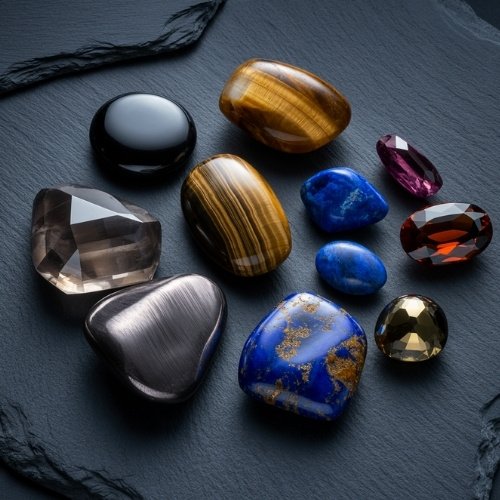
Jet is found around the world, but Whitby jet, formed from fossilised wood on the Yorkshire coast, is England’s own and widely regarded as the best. It was a favourite in Roman Britain, where it was carved into jewellery and amulets and thought to protect its wearer. That makes it a fitting choice for a saint who started out as a brave Roman soldier. Queen Victoria later made it the height of fashion, and its deep, glossy black looks striking beside silver.
Ruby or Red Spinel
The rich red of ruby and spinel mirrors the red cross of St George’s flag, but thanks to a famous case of mistaken identity, both stones have an even better claim to a place on this list. The famous Black Prince’s Ruby, which sits in the Imperial State Crown, isn’t a ruby at all. It’s a spinel, named after Edward III’s son, one of the very first Knights of the Garter. Legend says Henry V wore it into battle at Agincourt, the same battle where Shakespeare has him rally his troops with “God for Harry, England, and St George!”
Blue John
A rare banded fluorite with purple, blue and yellow stripes, found only near Castleton in Derbyshire. It has no link to St George himself, but as a gem found nowhere else in the world, it more than earns its place on England’s Patron Saints day list. It’s soft and fragile, so it’s best for inlay or protected settings rather than everyday rings.
Scotland: St Andrew’s Day, 30th November
St Andrew was a fisherman, one of Jesus’s twelve apostles, and the brother of St Peter. He’s said to have been crucified on an X-shaped cross in Greece, and that cross became the saltire, the white diagonal cross on the Scottish flag.
So how did a fisherman from Galilee end up as Scotland’s patron saint? Legend says some of his relics were brought to Fife, and the town of St Andrews grew up around them. His popularity got a boost from another story, about a Pictish king who saw a white saltire against a blue sky before a battle, won, and adopted Andrew as patron in thanks. Centuries later, the Declaration of Arbroath made it official in 1320.
Sapphire
The blue behind St Andrew’s white saltire is pure sapphire territory, echoing that famous sky from the Pictish legend. But sapphire’s link to St Andrew runs deeper than colour. In the Middle Ages it was a favourite for bishops’ rings, which feels fitting for a saint whose town became the religious heart of Scotland. Its traditional links with loyalty and wisdom complete the picture, making it a perfect match for the apostle who stayed faithful to the end.
Amethyst
Amethyst’s purple brings in the thistle, Scotland’s national flower. Folklore says the thistle earned its place when a barefoot Norse invader trod on one and yelped, waking the sleeping Scots he was about to attack and saving the day. Scotland’s highest order of chivalry, the Order of the Thistle, is dedicated to St Andrew, tying the nation’s flower and its saint together. Amethyst makes for a great sparkly nod to that prickly hero, and to the saint who shares its honours.
Cairngorm Quartz
Mined in Scotland and named after the Cairngorm mountains, this quartz ranges from deep smoky brown to warm honey-yellow, so it covers a mix of smoky quartz, citrine, and what I call smoky citrine (yellow-brown or brown-yellow quartz). It was a staple of traditional Highland dress, from kilt pins to the stone on a sgian-dubh. It was so popular that supply couldn’t keep up with demand, so plenty of “Cairngorms” in antique jewellery were imported, heat-treated quartz.
A story in every stone
Of our four patron saints, only St David was born in the country he looks after. The rest arrived as a captive, a crusaders’ hero and a handful of relics, yet each nation took them in and made them its own. Gemstones work in much the same way. A stone mined on the other side of the world can feel as if it was always meant for a Welsh pendant or a Scottish brooch, once it has the right story attached.
That’s the real joy of designing for saints’ days. You’re not just matching colours to flags, you’re passing on a little piece of history to whoever wears it.
🛍️ If any of these stones have sparked an idea, have a browse of our reclaimed gemstones. You’ll find garnet, sapphire, amethyst, smoky quartz and more, all pre-loved and ready for a new story.
📌 Don’t forget to bookmark this Patron Saints Gemstones artical so you can find it again when designing your next jewellery collection.