Estimated reading time: 7 minutes
Moonstone and labradorite are two gems that make jewellers and collectors pause every time a new parcel arrives. Both belong to the feldspar family, and both flash light in ways that feel almost otherworldly.
Despite their similar shimmery colours, the two stones are visually very different. Moonstone tends to have a lighter base, while labradorite is usually darker. This striking difference might make you wonder why I’m comparing them at all. The answer: rainbow moonstone, a universally used, yet misleading trade name. Rainbow moonstone tends to be pale or white labradorite, not moonstone. So, while all labradorite is labradorite, not all moonstone is moonstone. This blurring of the lines inspired me to write a comparison of these two types of feldspar.
For both jewellers and gem collectors, knowing more about the differences between these two gems, and where they overlap, can help you make informed purchasing choices. IT can also help to explain the price differences and let you decide exactly what gemstone your looking for.
Jump to:
How to Tell Them Apart: Visual & Gemmological Clues
Visual Clues
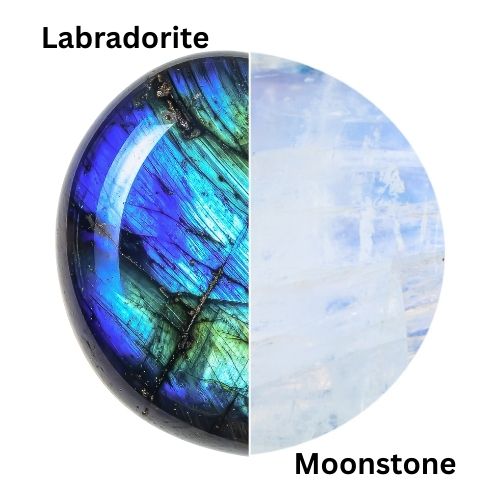
When you compare a classic moonstone with a piece of labradorite side by side, you’ll notice immediate differences. True moonstone tends toward a gentle, glowing shimmer that looks like moonlight rolling beneath the surface. The effect, called adularescence, is delicate and usually observed as a soft blue or silvery shimmer floating inside the stone.
Labradorite, on the other hand, often carries a deeper body colour, gray, green, or brown, and displays vivid flashes of multiple colours (blue, green, gold and sometimes orange or red) that seem to dance across the surface when tilted. This is labradorescence and it’s what makes labradorite so striking.
In the trade, many pieces labelled “rainbow moonstone” are actually labradorite with a light base colour, giving a multicoloured effect that people love. Genuine moonstone rarely shows those broad labradorite‑style colours.
Gemmological Tests
| Property | Labradorite | Moonstone |
|---|---|---|
| Refractive Index (RI) | 1.554 – 1.573 | 1.518 – 1.524 |
| Birefringence | 0.008 – 0.010 | 0.005 – 0.008 |
| Pleochroism | None | None |
| Optical Character | Biaxial + | Biaxial + or – |
🔗Want to take a deeper dive into identifying and working with these gems? Check out their individual guides:
A Jeweller’s Guide to Labradorite
A Jeweller’s Guide to Moonstone
Colour
Colour differences between moonstone and labradorite are some of the most helpful visual clues you’ll use in practice.
Classic moonstone tends to be translucent to semi‑transparent, with a milky white base and a soft blue sheen. Another style features an opaque base colour of grey, peach, yellow, or brown with a silvery shimmer that seems to float across the surface as you move the gemstone.
Labradorite, in contrast, usually starts with a darker body tone, such as gray, blue‑gray, or greenish, and then surprises you with flashes of colour that seem electric. These flashes, known as labradorescence, can include blues, greens, golds, and occasionally oranges or reds. The effect catches light dramatically and often becomes the star of a design, making even a simple piece of jewellery feel extraordinary.
Clarity & Inclusions
Labradorite
- Commonly has twinning, albite platelets, or small mineral inclusions like magnetite or ilmenite.
- The play of colour can mask or highlight inclusions, depending on cut and orientation.
- Translucent to opaque clarity is typical; transparent labradorite is very uncommon.
Moonstone
- Often shows parallel twinning planes or silk‑like inclusions.
- Can be translucent to opaque; very clear pieces with strong adularescence are rare and prized.
- May contain small miners’ inclusions that add character without detracting from the shimmer.
How They Form
Both gems come from the feldspar family, but their formation conditions differ.
Labradorite forms in igneous rocks like basalt, where calcium and sodium‑rich feldspar crystals are layered in a way that produces the dramatic labradorescence it’s famous for.
Moonstone, on the other hand, forms in pegmatitic environments where the slow cooling of magma allows the feldspar crystals to stack together in the way needed for adularescence to appear.
Durability & Wearability
Moonstone and labradorite share a similar hardness and both have perfect cleavage, which means they can chip or fracture if struck. As such, working with them is quite similar. Both make excellent earrings and pendants, but rings and bracelets need a bit of extra protection to prevent scratching or cracking.
For everyday wear, delicate moonstone pendants or earrings are both beautiful and practical. Labradorite’s slightly denser structure and vibrant colour flashes make it especially well-suited for statement pieces.
Enhancements & Treatments
Neither of these gemstones tend to be treated, but both can be when they’re very low grade material.
Labradorite is very occasionally dyed, usually to a darker base colour, to make the colour flashes more visible. Moonstone, on the other hand, can sometimes be coated/impregnated with resin to improve it’s durability and appearance.
Price Comparison
Moonstone can be surprisingly affordable at the lower end, with common white or rainbow moonstone pieces often retailing for around £1–£15 per carat mark. These are generally smaller, commercial-quality stones with modest adularescence. Fine-quality moonstone showing a strong blue shimmer and clean clarity can command a premium, typically ranging from £40 to £95+ per carat depending on size and the intensity of adularescence.
Labradorite, in its typical commercial quality, is generally more accessible, with retail prices starting at £1–£10 per carat for pieces with attractive but modest labradorescence. Exceptional labradorite, such as high-quality spectrolite or stones with vivid multi-colour flashes, can approach the lower end of fine moonstone pricing, generally around £30 to £50+ per carat.
Size & Availability
Labradorite is widely available in a range of sizes, and it’s often cut into larger cabochons or slabs to show off its colour play. For jewellery making, labradorite pieces from about 1 ct up to around 20 carats are common, and well‑cut stones larger than that do appear, especially in cabochon form. Very large faceted labradorite stones (above about 20 carats) are known but are quiet unusual, because rough material can fracture during cutting.
Moonstone that shows classic adularescence is easiest to find in small to medium sized. Stones around the 1 to 5 carat mark are the most common for jewellery making and easy to source, but larger clean stones with a strong blue sheen become rarer and more valuable as they get bigger. High‑quality moonstones above about 15 carats are relatively uncommon in the market.
Cut & Shape
Moonstone is most often cut as cabochons to highlight adularescence, with smooth domes that let light roll across the surface. Faceting is rare because it can disrupt the shimmer, and both moonstone and labradorite are prone to breaking during the faceting process.
Labradorite also shines in cabochons but can be cut into a wider variety of shapes and sizes. Orienting the cut to maximise labradorescence is key to creating pieces that truly dazzle.
Rarity & Sourcing
Moonstone deposits are found in places like Sri Lanka, India, and Madagascar, but top material with strong adularescence is a small fraction of total production.
Labradorite has broad geographic sources, including Canada, Finland, and Madagascar, making it more commonly encountered. The “spectrolite” variety from Finland is especially prized for its rich multi‑colour flashes.
Symbolic & Spiritual Associations
Labradorite is tied to transformation, protection, and inner vision, with the dramatic flashes of colour reflecting a sense of discovery and unexpected beauty.
Moonstone has long been associated with calm, intuition, and moon energy, drawing connections to nocturnal light and emotional harmony. The lunar connection also leans into beliefs around moonstone enhancing female energies or connecting one to the feminine divine.
🔗 Discover the deeper meanings of these gems:
Symbolic & Spiritual Meanings of Labradorite
Symbolic & Spiritual Meanings of Moonstone
Comparison Summary
| Property | Labradorite | Moonstone |
|---|---|---|
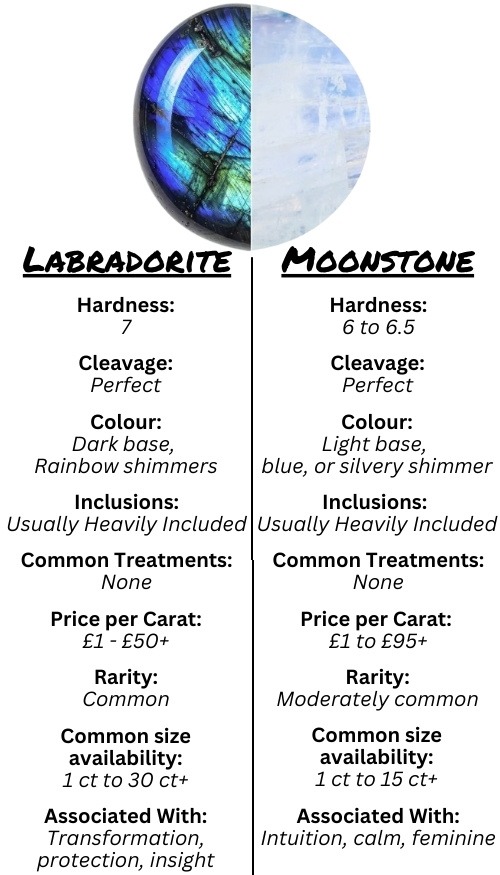
| Hardness | 7 | 6–6.5 |
| Cleavage | Perfect | Perfect |
| Colour | Usually a dark base with multi‑colour flashes | Usually a pale base with a blue or silvery shimmer |
| Commonly Included? | Yes | Yes |
| Common Treatments | Rarely treated | Rarely treated |
| Price per Carat | £1 to £50+ depending on quality | £1 to £95+ depending on quality |
| Rarity | Common | Moderately common, rare in fine quality |
| Large Sizes? (5 ct+) | Readily available | Readily available, but in fine quality is much rarer |
| Associated With | Transformation, protection, insight | Intuition, calm, feminine |
Moonstone and labradorite are both gems with personality, but they speak in very different visual languages. True moonstone’s soft, moonlit shimmer feels more subtle and serene. Labradorite’s bold multi‑colour flashes make it a show‑stopper in any design.
For jewellers, understanding these differences helps you set correct expectations with clients and choose the right gem for a piece’s mood and purpose. And for collectors or enthusiasts, knowing what you’re holding or selling builds confidence and appreciation for these beautiful feldspars.
🛍️ Looking for the perfect sustainable gemstone for your next jewellery making project? Explore our pre-owned Labradorites and Moonstones
📌 Save this Labradorite vs Moonstone comparison to come back to whenever you need a quick refresher.