Estimated reading time: 4 minutes
If you’ve spent any time reading about or handling gemstones, you’ve probably heard of the Mohs hardness scale. But what is it really, and why should jewellers care about it? Let’s break it down.
Jump to
What is the Mohs hardness scale?
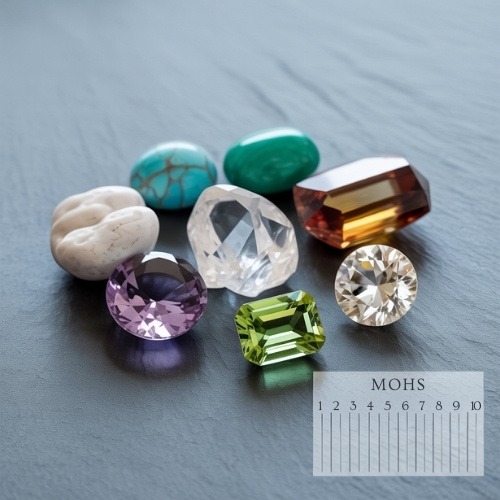
In short, the Mohs hardness scale is not a durability rating. It simply measures how resistant a mineral is to being scratched.
It was developed in 1812 by German mineralogist Friedrich Mohs, who wanted a simple method to help him identify minerals in the field. The scale ranks minerals from 1 (talc, the softest) to 10 (diamond, the hardest). Each mineral can scratch those below it on the scale and can be scratched by anything above it. By carrying a small set of known minerals, you can try scratching a rough gem to help narrow down what it could be.
This test is considered destructive, as it will leave scratches if you test with a mineral that is harder than the one you have. Because of this, it should never be done on cut gemstones.
Why it matters when making jewellery
Hardness affects how you handle, set, and finish gemstone jewellery. Softer gems need extra care during setting, whereas harder stones are generally more forgiving if a tool slips. This doesn’t mean you can do anything to a diamond and it will be fine, only that the occasional slip is far less likely to be devastating than it would be when setting something like turquoise.
Polishing compounds and abrasives also come in different hardnesses, so the methods used to finish a piece may vary depending on the gemstone involved.
- Emery or sandpaper usually falls between 7 and 9.
- Rubber wheels and burs can contain diamond with a hardness of 10 (or act like they’re around a 9 when they don’t have diamond in them).
- Rouge polishing compound is around 6, and tripoli is roughly 8.
Even if a gemstone is harder than some of these materials, facet junctions and delicate edges can still be dulled through contact. Because of this, it is safest to keep finishing tools away from the gemstone wherever possible, but understanding relative hardness does help you judge which stones are likely to be more forgiving.
How hardness can influence the design process
Hardness is not just something to consider at the workbench. It should also guide your design choices.
Gemstones that rank higher on the Mohs scale are generally better suited to pieces that see frequent contact, such as rings and bracelets, as they resist scratches from a wider range of materials. Softer gemstones like opal, turquoise, or kyanite tend to work better in jewellery that is not exposed to constant friction, such as pendants, earrings, and brooches.
It is also worth thinking about how often you expect the piece to be worn. Is it something designed for everyday wear, or a piece intended for special occasions? Jewellery worn daily benefits from gemstones with a hardness of 7 or above, even when the piece is not on the hands or wrists. This is because household dust commonly contains quartz, which sits at 7 on the Mohs scale. The more frequently jewellery is worn, the more opportunities there are for contact with dust.
Ultimately, understanding hardness helps you balance beauty with durability. It supports both the creative and practical sides of jewellery making, and helps ensure your customers can enjoy their pieces for many years to come.
Gem hardness and after care
Gemstone hardness also affects the aftercare advice you give to customers.
Alongside explaining whether a piece is suitable for everyday or occasional wear, hardness helps you show why different types of gemstone jewellery should be stored separately. For example, if a customer owns a sapphire piece and a quartz piece, the sapphire is significantly harder than quartz and can easily scratch it if the pieces come into contact in a jewellery box.
Even when making jewellery that isn’t set with gemstones, knowing about hardness is useful. Silver and gold both have a hardness of around 2.5, so they can be stored together safely. Whereas copper, which has a hardness of 2.5 to 3, should be stored separately from silver and gold jewellery.
Understanding relative hardness makes it easier to give clear, practical care advice that helps prevent avoidable damage over time.
Bottom line
The Mohs hardness scale isn’t just useful as a quick field test, it’s a practical tool for jewellers. It guides how you handle, set, and care for gemstones, and influences design and gem selection. Knowing which gems are harder than your tools, polishing compounds, or everyday dust makes a real difference in durability and the long-term beauty of your creations.
📌 Don’t forget to save this guide to the mohs hardness scale so you can find it again!