Estimated reading time: 8 minutes
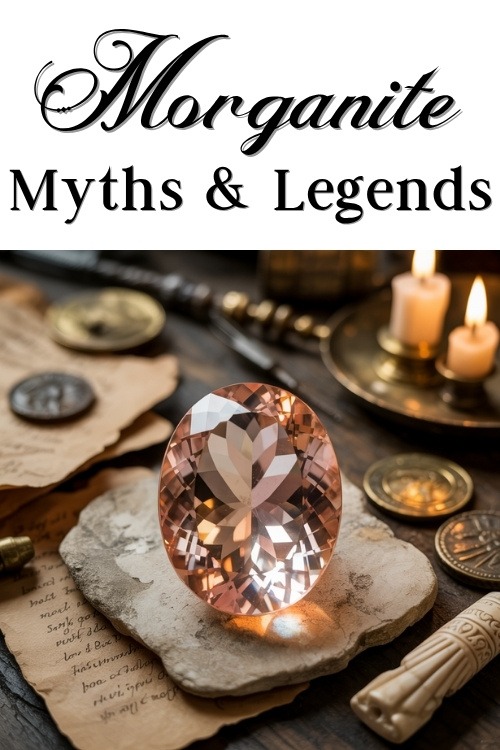
Morganite has a softness that feels as though it should come with centuries of romantic stories attached. Its blush pink colour seems made for myth, and yet it’s one of the youngest named gemstones in the world. It has no ancient legends, no place in medieval lapidaries, no role in the rituals of antiquity. Its story begins not in the distant past, but in 1910.
Since no ancient myths speak directly of morganite, I’ve explored the history of its discovery, the lands it comes from, and the long cultural threads around pink stones and coloured gems that morganite, had it been known earlier, would surely have been a part of.
Jump to:
Origins: A Stone Hidden in Plain Sight
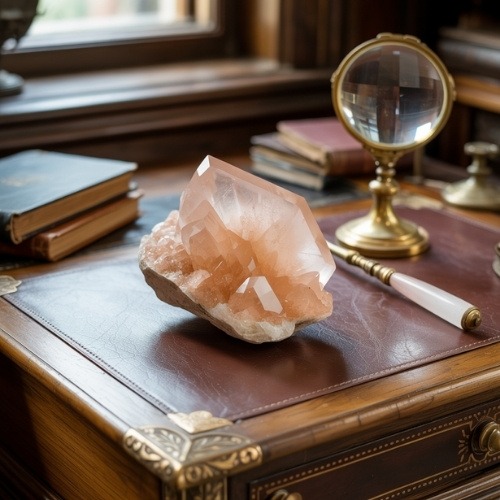
Morganite belongs to the beryl family, the same mineral group that gives us emerald and aquamarine. It owes its distinctive colour to trace amounts of manganese within the crystal structure. The more manganese present, the deeper the pink. Its tones range from the palest peachy blush to a richer, more saturated rose, and the finest stones have a clarity and warmth that is genuinely difficult to find in other pink gems.
For most of history, if morganite was encountered at all, it was probably mistaken for something else entirely. It was only with the development of modern gemmology that it was recognised as its own distinct variety.
The Gilded Age: A Gem Named for a Collector
The formal identification of morganite belongs to one of the more colourful chapters in the history of gemmology. A time when George Frederick Kunz, the chief gemmologist at Tiffany & Co, was working towards becoming one of the most influential figures in American gem science. And when J.P. Morgan, one of the most powerful financiers of the Gilded Age, had an appetite for gem collecting that was as formidable as his appetite for business. Together, they assembled some of the finest gem collections of the era.
When some fine specimens of pink beryl arrived from Madagascar and came to Kunz’s attention, he saw an opportunity to honour his long-standing patron. On the 5th of December 1910, at a meeting of the New York Academy of Sciences, he proposed the name morganite, and it was accepted with great enthusiasm.
It’s worth noting that morganite is unusual among gemstones in being named for a living person rather than a place, colour, or classical reference, but it’s not entirely alone in this. Kunzite, another pink gemstone, was named after Kunz. Meaning this powerful gemstone duo from the early 1900’s both have pink gems names in their honour.
Madagascar: Where Morganite First Came to Light
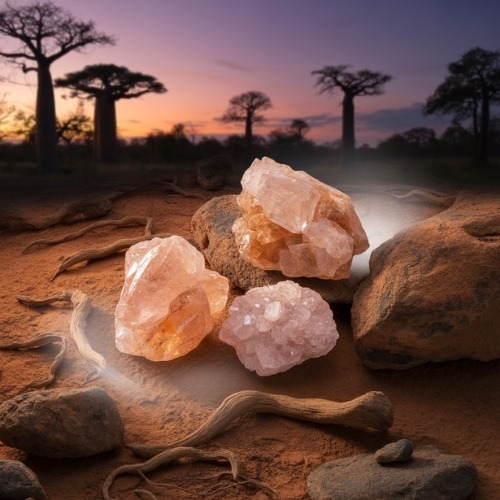
The stone that would become morganite was first formally identified from specimens found in Madagascar, an island off the southeastern coast of Africa that has long held an extraordinary place in the natural world. Due to its geological isolation, Madagascar is home to landscapes, species, and mineral formations found nowhere else on Earth, and it has been a recognised source of gemstones since at least the sixteenth century.
The Malagasy people believe the natural world and the spiritual world are intimately connected, and gemstones are not separate from this belief. Across Madagascar, stones and minerals have traditionally been associated with protection, kept close during significant life events, and viewed as part of the living body of the land rather than merely objects to be found within it.
Morganite wouldn’t have been known or named in this tradition, but had it been discovered by the native peoples earlier, it would have been treated the same as any other gemstone. A protector to be respected and cherished.
Afghanistan and the Ancient World of Coloured Stones
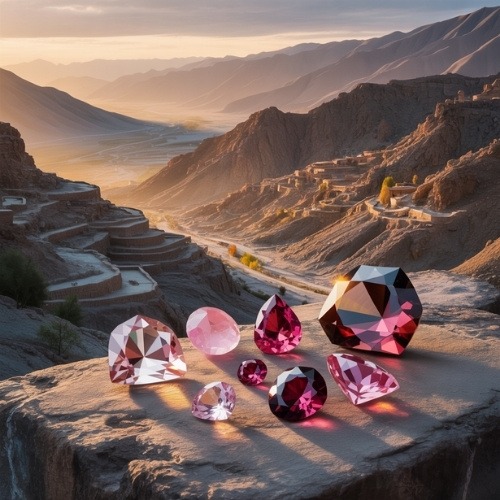
Morganite is also found today in the gem-bearing mountains of Afghanistan and Pakistan, regions with some of the oldest and richest mining histories anywhere in the world. Gem mining in Afghanistan stretches back approximately 2,300 years, and by the tenth century the mines of the region were famed across the ancient world. This is the landscape that gave lapis lazuli to the Egyptians and Mesopotamians, that supplied the trade routes of antiquity, and that sat at the crossroads of empires.
The civilisations that flourished around these mining regions held deeply developed beliefs about coloured stones. In Mughal culture, which extended across the territories that now include Pakistan and Afghanistan, gemstones carried spiritual significance as a matter of course. Spinels from the mines of Badakhshan that ranged in tone from deep red through to soft rose, were considered among the most precious gems of the empire. These stones were often engraved with the names of emperors and carried as protective talismans.
Had morganite been discovered sooner, it would likely have sat alongside these soft rose spinels. Honoured for its beauty in a culture that already read warmth and feeling into pink-toned stones.
Colour Symbolism: The Language of Pink
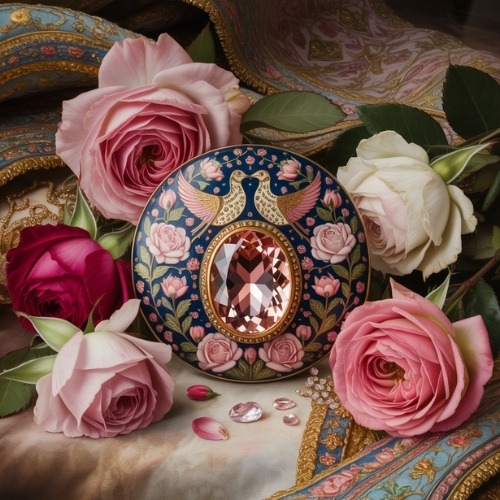
Pink has its own history, even if morganite does not.
In the Persian tradition that ran through so much of the ancient world surrounding morganite’s source regions, the rose was among the most powerful of all symbols. Persian poetry and art returned again and again to the flower as a metaphor for earthly beauty, divine love, and the fragile perfection of the world.
Colour mattered within this symbolism
- Red roses spoke of passionate love and sacrifice
- White roses carried associations with purity and spiritual love
- Pink roses symbols of abundance, paradise, and a joy understood as both earthly and heavenly at the same time
Jewellery of the Qajar and Safavid periods used birds and flowers as recurring motifs representing an idealised paradise, and the rose was central to that imagery. Morganite’s soft blush, in that symbolic vocabulary, would have spoken the language of the pink rose.
More broadly, pink has long carried associations with tenderness, warmth, and the emotional heart across many cultures. It sits between red, the colour of passion and life force, and white, associated with purity and the spirit. In that middle space, it has often been understood as the colour of love in its gentler forms. Affectionate rather than fierce passion, open rather than consuming. Morganite’s colour places it squarely in this territory. It doesn’t demand attention, it just gently exists waiting to be appreciated.
Modern Lore: The Stone of Divine Love
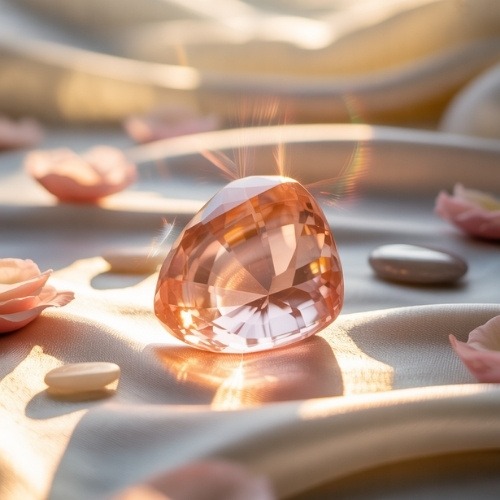
In contemporary crystal and metaphysical traditions, morganite has accumulated associations that feel entirely in keeping with its colour and character. It’s most commonly described as a stone of divine love. Not a romantic love specifically, but a broader, unconditional warmth that encompasses compassion, self-acceptance, and emotional openness.
It is often associated with the heart space, with healing old emotional wounds, and with the kind of quiet courage it takes to remain open after being hurt. Some traditions describe it as a stone for new beginnings in love, or for releasing grief and resentment. Others connect it to the gentler, more sustained kind of love that deepens over time rather than arriving in a rush.
As a member of the beryl family, it’s also inherited beryl’s long-standing associations with clarity, calm, and clear-headedness. Qualities that give its emotional warmth a grounded, steady quality.
🔗 Want to explore the symbolic and spiritual meanings around morganite? Discover the full range of Morganite Meanings here
A Young Gem With a Rich Inheritance
Morganite shows that a gemstone does not need ancient myths to feel full of meaning. What it has instead is a story of a remarkable island, a friendship between a gemmologist and a collector, and a colour that has spoken the language of love across cultures for centuries. It arrived late. But it arrived into a world that seems to have been preparing for it for a very long time.
These morganite stories make beautiful marketing content, so feel free to weave them into your story when showcasing your jewellery.
🔗 Want help using gemstone knowledge to market your pieces? Read Using Gemstone Knowledge to Boost Your Jewellery Sales.
🔗 Working with morganite in your jewellery making? Take a look at my Jeweller’s Guide to Morganite
🛍️ Curious to find a pre-owned and recycled gemstones for your next design? See what’s available
📌 Save these morganite myths and legends so you can find them again.