Estimated reading time: 8 minutes
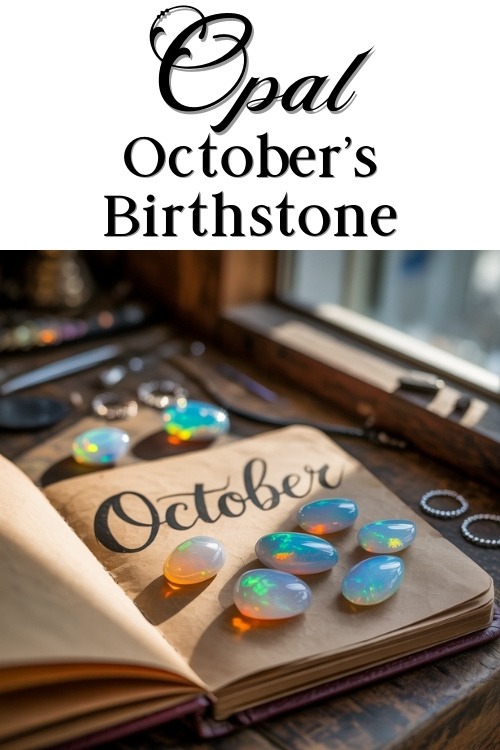
October arrives with a showstopper of natural beauty. The season tips fully into autumn, leaves catch fire in amber and rust tones, and the light takes on that particular golden quality that makes everything feel a little magical. It’s a month of transformation, of colour, of things being more than they first appear. And rather wonderfully, that description of October also perfectly describes opal. October’s first birthstone is one of the most remarkable gemstones in the world, not for the colour it has, but for the play of colours it shows.
Jump to:
Why Opal is October’s Birthstone
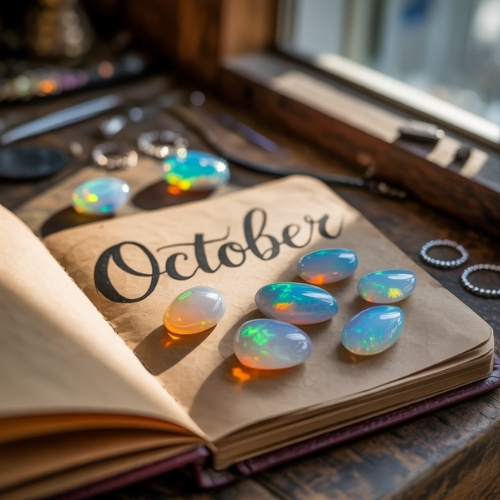
Like most birthstone traditions, opal’s link to October is a blend of ancient symbolism and more recent standardisation. Early birthstone associations were fluid. Different cultures favoured different stones for each month, and the gems shifted depending on tradition, availability, and local meaning.
Opal had long been prized across many civilisations before it was formalised as October’s stone. The Romans, in particular, held it in extraordinarily high regard, believing it to contain the best qualities of every other gemstone. Its shifting spectrum of colour felt cosmically significant. A stone that held the whole rainbow couldn’t help but feel powerful.
Opal was officially confirmed as October’s primary birthstone in 1912, when the American National Association of Jewelers established their standardised list. A fitting stone to represent this slightly magical, colour changing, autumnal month.
Tourmaline was later added as an alternative for October in 1952, acknowledging the wide range of colour available in that stone too, but opal has always been the gem most strongly associated with this month.
🔗 Explore the History of Birthstones to learn more about this timeless tradition
History and Lore of Opal
Opal has one of the most dramatic reputations in gem history. It has been beloved by some cultures, feared by others, yet consistently impossible to ignore.
The Romans were among its greatest admirers. Pliny the Elder described opal as surpassing all other gems because it contained the fire of ruby, the purple of amethyst, the green of emerald, and the yellow of topaz, all in a single stone. Roman senator Nonius famously chose exile over selling his opal to Mark Antony, a story that says everything about how deeply these stones were valued.
In medieval Europe, opal was associated with good fortune. It was thought to preserve the colour of fair hair, sharpen eyesight, and even grant invisibility. A belief which partly explains why it became associated with thieves and tricksters in some folklore.
That positive reputation took a sharp turn in the nineteenth century after Sir Walter Scott’s novel Anne of Geierstein portrayed an enchanted opal with ominous powers, and superstition around the stone grew considerably.
Fortunately, Queen Victoria was having none of it. She adored Australian opals, wore them regularly, and gave them as gifts to her daughters. Her actions did a great deal to restore the stone’s reputation as a gem of beauty and good fortune.
🔗 Dive deeper into Opal Myths and Legends
Opal’s Meaning, Symbolism, and Energy
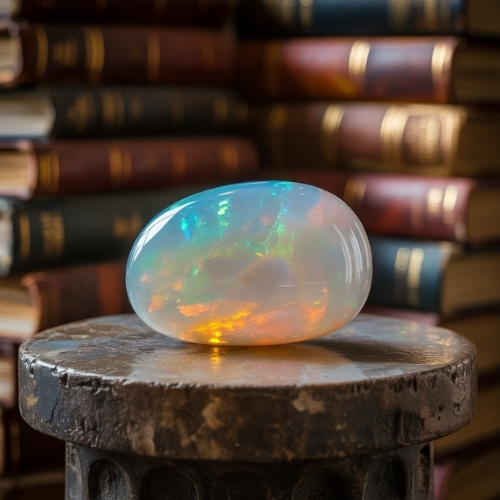
Opal is most strongly associated with creativity, inspiration, and emotional expression. Its play of colour has long made it a symbol of possibility and inner depth.
In crystal traditions, opal is thought to amplify emotions and encourage spontaneity. It is often seen as a stone that supports self-expression and helps bring buried feelings to the surface in a gentle way. Some traditions associate it with loyalty and faithfulness, which is perhaps why it has historically been considered a meaningful gift.
Because October sits at a seasonal turning point, opal feels like the right stone for the month. It celebrates transformation, asks you to look at things from a different angle, and reminds you that beauty can be found in change.
🔗 Discover the Symbolic and Spiritual Meanings of Opal
Shades, Varieties, and Buying Tips
Not all opal is considered precious, but those that display a stunning optical phenomenon known as play-of-colour are. It’s those flashes of spectral light that makes opal unlike anything else in the gem world.
The most prized variety of opal is black opal, which come primarily from Lightning Ridge in New South Wales, Australia. The dark body colour provides a dramatic background that makes the play-of-colour appear especially vivid. White or light opals have a pale or milky body and are far more common. The paler body colour tends to make the play-of-colour appear softer or more delicate. Another type that tends to sit at the paler end of the spectrum is crystal or jelly opal. These gems have transparent or semi-transparent bodies, which can create a beautiful depth to the colour play.
Then there is boulder opal (a personal favourite, and the only type of opal I currently have in my gem collection), which are an Australian specialty. They form in thin seams within ironstone host rock, and are often cut with the matrix still attached, giving them a wonderful earthy quality.
When buying opal, the play-of-colour is the main event. Look for stones that display a broad range of colours, with good brightness across the face of the stone. Keep in mind it’s common to see strong flashes of blues and greens within opals, but reds are a rare treat. Coverage matters too. A stone that only flashes in one corner is less desirable than one that lights up edge to edge. Ideally that play-of-colour should be visible from multiple viewing angles too, not just one awkward sweet spot.
Opal is a relatively soft stone, sitting at around 5.5 to 6.5 on the Mohs scale, which makes it more vulnerable to scratching and impact than sapphire or ruby. This is worth bearing in mind for setting design. Bezels and protective settings are often a wise choice. Opal also contains water, usually between three and twenty percent, which means it can be sensitive to very dry environments or sudden temperature changes.
Doublets and triplets are common in the opal market. These are composite stones: a thin slice of opal bonded to a darker backing (doublet) or further covered with a protective dome of crystal or glass (triplet). These composite gems sometimes use non-precious opal (sometimes call potch) as the backing, so although they’re not a solid opal, they do still have a gemstone back as well as the thin layer of precious opal. They can look beautiful and are sold at a fraction of the price of solid opal, but they should always be disclosed.
🔗 Working with opal gemstones or want to know more about the varieties and trade names? Have a read of my Jewellers Guide to Opal
Fun Facts About Opal
- Australia produces around 95% of the world’s precious opal. Lightning Ridge, Coober Pedy, and Andamooka are among the most significant mining regions in this country.
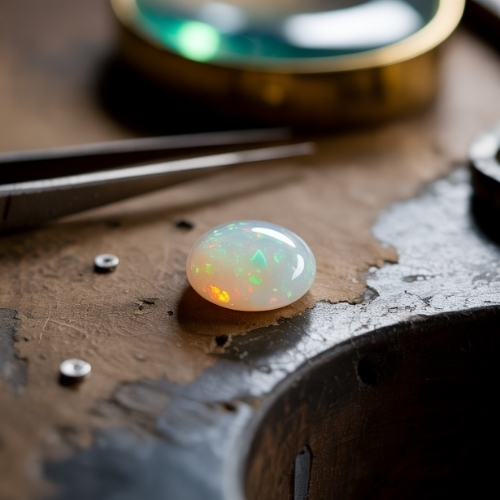
- The play-of-colour in opal is caused by tiny silica spheres arranged in a regular grid. When light passes through, it diffracts into spectral colours. The size of the spheres combined with the spaces between them determines which colours appear.
- Opal is not a crystal in the traditional sense, it’s an amorphous mineraloid, which means its internal structure is irregular rather than geometrically ordered.
Modern Alternatives for October’s Birthstone
Tourmaline is the main modern alternative for October, added to the official birthstone list in 1952. It is one of the most colour-varied gemstones in existence, found in virtually every hue imaginable, including the much-loved pink and green combination known as watermelon tourmaline. It has excellent hardness and wears very well in jewellery, making it a practical and beautiful option for those who find opal a little too delicate for everyday wear.
Aquamarine and rose zircon are sometimes mentioned in older or regional birthstone lists as alternatives for October, though neither has the widespread recognition of tourmaline.
Opal’s Enduring Place in October Birthstone Lore
Opal is a stone that refuses to be ordinary. Its shifting colours, rich history, and the sheer variety of forms it takes make it one of the most captivating gemstones you can work with. Whether you’re drawn to the electric flash of a black opal, the soft glow of a white stone, or the earthy beauty of boulder opal, there’s a depth and individuality to every stone. For a month that celebrates transformation, opal feels like the perfect fit.
🛍️ Interested in using pre-owned opal in your next design? View our current Opal selection
📌 Save this post so you can revisit Opal, October’s Birthstone, whenever you need inspiration.