Estimated reading time: 6 minutes
Whether carved into sacred amulets or imagined as a celestial gemstone, the Eye of Horus remains one of the most powerful and enduring symbols from ancient Egypt. It carries stories of resilience, healing, and the eternal cycle of renewal. So, where did this legendary symbol come from? Let’s explore its myth.
Jump to:
The War Between Gods
In the land of Kemet, where the Nile brought life to the desert, a terrible struggle shook the divine order. Osiris, the wise and just king, was murdered by his jealous brother Set, the god of chaos. With Osiris gone, Set seized the throne, plunging the land into turmoil.
But Osiris’s son, Horus, refused to simply stand by and watch. The falcon-headed god of the sky rose to challenge his uncle. He was determined to avenge his father and to take his rightful place.
Their battles were fierce and unrelenting, shaking both the earth and sky. The other gods looked on as order and chaos collided.
The Loss of an Eye
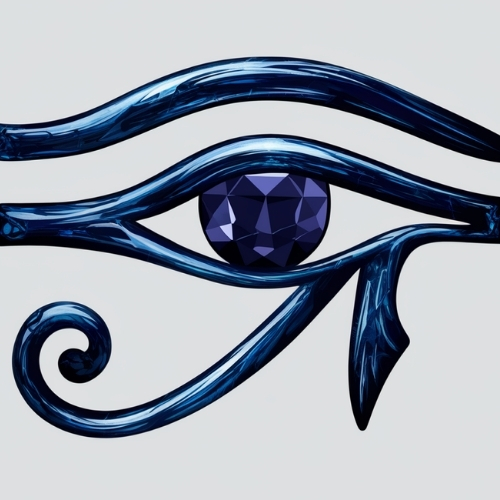
In one of their most brutal clashes, Set struck Horus with devastating force. He tore out Horus’s left eye, the eye that represented the moon, the guide through darkness. As the world dimmed, Set became convinced of his victory. He shattered Horus eye and scattering it’s pieces across Egypt, the same as he’s done with Osiris body.
Yet Horus did not give up. Though wounded and weakened, he fought on, holding fast to his purpose, to bring balance back to the land and honour his father’s legacy.
The Restoration of Sight
Hope returned when Thoth, the god of wisdom and magic, stepped in. With careful skill, and with the help of Hathor, goddess of healing, he gathered the broken pieces and restored the eye. But it wasn’t quite the same. It had become something far greater.
Reforged with divine power, the eye transformed into the Wedjat, the Eye of Horus. From that moment on, it stood as a symbol of healing, protection, and strength. With his vision restored and his power renewed, Horus finally overcame Set and claimed the throne of Egypt. Peace returned, and the Eye of Horus lived on as a reminder of victory over chaos and the promise of renewal.
From Myth to Material: The Amulet That Outlived the Gods
For the people of ancient Egypt, the Eye of Horus was much more than myth. It was one of the most widely used protective charms in the ancient world. It appears to have been in active use from the time of the Old Kingdom (around 2686 BCE) all the way through to the Roman period, over two thousand years later.
Wedjat amulets were crafted from a wide range of materials including Egyptian faience, glass, gold, and semiprecious stones such as lapis lazuli. They were worn by the living for protection and placed with the dead to aid with safe passage through the after life. During the Middle Kingdom, pairs of these eyes were even painted onto the sides of coffins, positioned so the deceased could look outward, seeing the world beyond and warding off harm.
Perhaps on of the most striking examples of of a Wedjat amulet is the one from Pharaoh Psusennes I tomb. French archaeologist Pierre Montet discovered the intact tomb of the Pharaoh in 1940. Within the silver sarcophagus he found a magnificent gold and lapis lazuli Eye of Horus amulet resting on the king’s mummy, placed directly over the chest as a spiritual shield for eternity. It is a beautiful, tangible reminder that this symbol was not merely decorative. It was deeply and seriously believed in.
A Gemstone of Divine Vision?
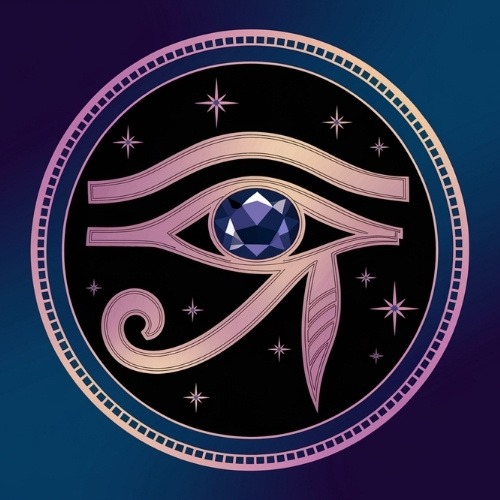
Some legends suggest that when Horus’s eye was restored, it wasn’t simply made whole but transformed or infused into a gemstones, giving it an otherworldly glow. History doesn’t give us a definitive answer, or name the gem the eye could have been turned into, but several stones carry a strong connection to the eye’s mystical qualities.
- Lapis Lazuli – The rich royal blue stone beloved throughout ancient Egypt, connected to wisdom, divine vision, and the afterlife. The Egyptians carved it into Eye of Horus amulets specifically, believing pieces made from lapis offered powerful defence against negative energies. One of the most historically grounded stones on this list.
- Amethyst – Deep violet, protective, and tied to clarity of mind, echoing Horus’s restored sight. Particularly prized during the Middle Kingdom, when the Egyptians associated its purple hue with royalty and divine power.
- Blue Spinel – Rare and striking, a stone of strength and renewal. A fitting choice for a god who had to fight his way back to wholeness.
- Blue Zircon – Known since antiquity for protection and insight, a natural guardian for a symbol built around divine vision.
- Iolite – Though not name in ancient Egypt, this blue gem would have been around in those times, just without a name. It’s long been associated with clarity, navigation, and vision beyond the physical realm. Its quiet connection to finding your way through the dark feels very much in keeping with the Eye’s enduring meaning.
One detail that jewellers often find useful: there are technically two eyes in this mythology. The left eye of Horus, the one lost in battle and restored by Thoth and Hathor, is the lunar eye and represents healing, protection, and restoration. The right eye is the solar eye, associated with Ra and the fierce, protective power of the sun. It is the left eye, the Wedjat, that appears in the vast majority of jewellery and amulets both ancient and modern. So when you or your customers are working with the Eye of Horus as a motif, it’s worth remembering you want to be creating a left eye.
A Legacy in Stone
Today, the Eye of Horus is still worn as jewellery, etched into charms, and cherished as a protective emblem across cultures. For some, it’s a connection to history or simply a fashion statement, but for others, it carries the same promise it once held: guidance, strength, and protection in times of uncertainty.
Just a quick side note: this gemstone-themed ancient Egyptian myth makes great marketing content, so feel free to retell it to your audience!
🔗 Want some guidance on using gemstone knowledge to market your jewellery business? Read Using Gemstone Knowledge to Boost Your Jewellery Sales
🔗 Interested in more ancient Egyptian gemstone stories? You might enjoy The Emerald Tears of Isis
📌 Save this legend of the Eye of Horus so you can easily find it again.