Estimated reading time: 7 minutes
The Vikings were fearless sailors, crossing the rough waters of the North Atlantic long before compasses or GPS existed. But here’s the puzzle: how did they manage to stay on course when the sun disappeared behind thick clouds or rolling fog?
That’s where the legend of the Viking sunstone comes in. This mysterious crystal may have been their secret navigational weapon, helping them locate the sun even when it was completely invisible. So, what was the sunstone? How did it supposedly work? And why has it fascinated historians and gem lovers alike? Let’s explore.
Jump to:
What Was the Viking Sunstone?
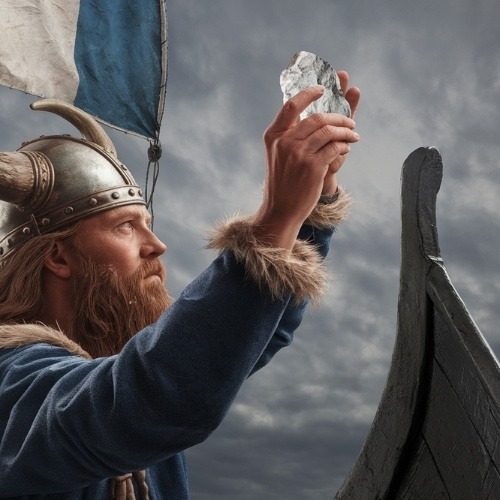
The sunstone is first mentioned in medieval Icelandic sagas, where it’s described as a crystal that sailors could use to detect the sun’s position on overcast days. The most cited source is a 13th-century tale called Rauðúlfs þáttr, in which King Olaf uses a sunstone to verify the sun’s position on a snowy, completely overcast day.
Imagine yourself on a boat in ancient times, before the compass had been invented, holding a crystal that could point you in the right direction when the horizon vanished into grey mist. That’s the power the sunstone was said to have.
Archaeologists have been unable to confirm what crystal that was used as a sunstone when examining a Viking vessel, but the science behind the idea is sound. Experiments with certain minerals show that the concept itself is far more than legend.
Interestingly, sunstones also appear in the inventories of several Icelandic churches and monasteries from the 14th and 15th centuries, suggesting they held a significance that stretched beyond navigation. Maybe they straddled that interesting line between practical tool and something more spiritual or symbolic.
Why Did the Vikings Need a Sunstone?
Sailing the North Atlantic was no small feat. The skies were frequently overcast, fog could roll in without warning, and during summer the sun barely dipped below the horizon at those far-north latitudes, making shadows unreliable and the stars invisible.
Yet the Vikings travelled astonishing distances, reaching Iceland, Greenland, and even North America. They weren’t navigating blind, either. Surviving records suggest Viking sailors used an array of methods and observations to keep themselves from getting lost including:
- The sun’s position on clear days
- Coastlines
- The flight patterns of birds
- Whale migration paths
- Distant clouds gathering over islands
A crystal that could reveal the sun’s hidden location on top of all of that would have given them real confidence to push forward when others might have turned back to avoid being lost at sea.
How Did the Sunstone Work?
Medieval texts only give us hints, but modern science has offered some fascinating answers. The leading theory is that the sunstone worked by detecting polarised light.
Here’s the simple version of what that means: when sunlight scatters through the atmosphere, it becomes polarised in a pattern centred on the sun’s position. Certain crystals can interact with that polarised light in a way that makes the sun’s direction detectable, even through thick cloud cover. A Viking sailor could hold the crystal up to the sky, rotate it slowly, and watch for changes in brightness or colour to pinpoint where the sun was hiding.
A 2013 study published in the Proceedings of the Royal Society A tested both iolite and Iceland spar under simulated overcast conditions and found iolite accurate to approximately 2.5 degrees, and Iceland spar accurate to 1%. Making both gems perfectly usable for open-sea navigation. The study concluded that both minerals were viable candidates, and that the saga reference likely referred to one or both.
More recently, in 2018, research took things further. Computer simulations of 3,600 voyages found that when navigators took sunstone readings at intervals of three hours or less, ships successfully made landfall between 92% and 100% of the time. The results held across all three of the crystal types tested.
Which Gemstone Was the Viking Sunstone?
Historians and gemologists have narrowed it down to three strong candidates.
Iolite (Cordierite)
Iolite was the original gemstone thought to be the Viking’s sunstone, earning it the nickname “Viking’s compass”. It was readily available in Norway and Greenland, well within Viking territory, making it a very plausible they would have been able to source it for use as an everyday tool.
It helps locate the sun due to one of its optical properties, its pleochroic. This means it shifts colour depending on the angle of light. By turning the crystal and watching the hue change from a blue-violet to a near-yellow, sailors could determine the direction of the sun.
Iceland Spar (Clear Calcite)
Iceland spar is a transparent variety of calcite with a striking optical property called birefringence. Look through it, and you’ll see a double image. By rotating the crystal and finding the angle at which those two images become equal in brightness, it’s possible to pinpoint the sun’s position on a cloudy day to within one degree.
While many gems show birefringence, Iceland spar is unusually clear and strong in its effect, making it far more practical than most. It was also abundant in Iceland and parts of Scandinavia, and has a long history in the advancement of optics. It was studied by researchers such as Christiaan Huygens and Sir Isaac Newton, and has been used in technologies ranging from polariscopes to a gunsight used during World War II.
The most tantalising physical evidence of Iceland spar being the sunstone came from an unlikely place. A piece was recovered from the wreck of an Elizabethan warship, the Alderney, which sank near the Channel Islands in 1592. The stone was found less than a metre from a pair of navigation dividers, suggesting it may have been stored alongside the ship’s other navigational tools. If polarised light navigation was in use in the 1590s, it’s not a stretch to think it had been used much further back in history.
Tourmaline
Tourmaline is the lesser-known third candidate, and it rarely gets a mention in relation to the sunstone, which is a shame, because it holds up surprisingly well under scrutiny. It was known and available in the ancient world, and while no direct evidence places it on ships, it’s a perfectly credible candidate that deserves more of the spotlight.
Like Iceland spar, tourmaline is a polarising crystal, capable of filtering and interacting with polarised light in a way that reveals the sun’s position. The same 2018 computer simulation study that modelled thousands of Norse voyages tested tourmaline alongside calcite and iolite, and found it performed equally well when readings were taken at regular intervals.
A Gemstone with a Legendary Purpose
The exact identity of the Viking sunstone remains an open mystery. Whether sailors relied on Iceland spar, iolite, tourmaline, or some combination of all three, the crystals they called sunstones were precision instruments, quietly doing the work that GPS does for us today.
The sunstone is a wonderful reminder that, long before modern technology, humans were already finding ingenious ways to read the natural world. Sometimes a piece of crystal was all you needed, which is quite an extraordinary thought.
Just a quick side note – The tale of the Viking sunstone makes wonderful storytelling content for jewellers and makers. If you create with iolite, tourmaline, or calcite, this is exactly the kind of history your customers will love hearing about, so feel free to share it!
🔗 Want some guidance on using gemstone knowledge to market your jewellery business? Read Using Gemstone Knowledge to Boost Your Jewellery Sales
📌 Save this Viking Sunstone post so you can easily find them again.