Emerald and peridot share a colour family, but aside from that overlap, they couldn’t be more different in personality, origin, or price tag. Despite their differences peridot has often been presented as emerald. Historically this mis-identification has led to some famous, and large, collections of emerald being nothing of the sort.
The Shrine of the Three Kings in Cologne Cathedral, Germany, is a great example of this. It was long believed to be decorated with emeralds, but when the stones were finally tested, they turned out to be peridots. Another historic confusion between the two was Cleopatra’s Emerald collection. Although it’s no longer available to be tested, some historians now believe a fair amount of it was actually peridot.
It’s an easy mistake to make, especially when emerald dips toward the yellow end of its green spectrum, but once you know what to look for, you’ll never mix them up again. Whether you’re a jeweller weighing up which green gem suits a commission, or a collector trying to understand what you’re holding, this guide walks you through everything you need to know.
How to Tell Them Apart: Visual and Gemmological Clues
Visual Clues
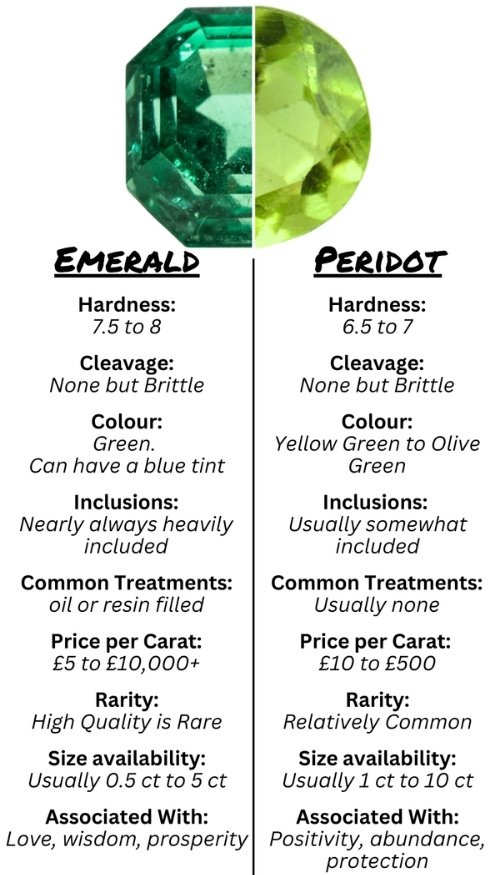
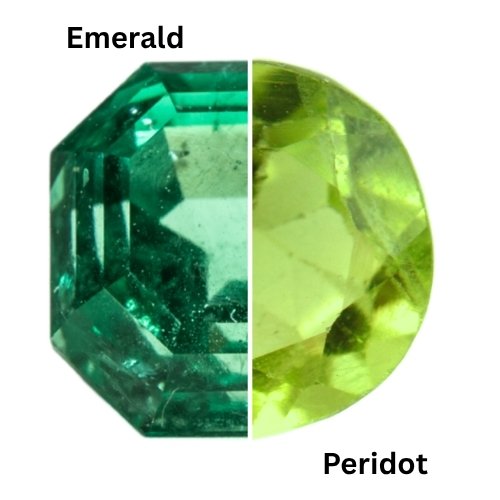
Side by side, emerald and peridot tell very different stories. Emerald tends toward a deep, rich colour, often with a bluish undertone, and will almost always carry inclusions. Only the truly exceptional (and eye-wateringly expensive) stones are eye clean. That’s not a flaw. It’s simply the nature of the gem, and those inclusions are so accepted they even have their own name, jardin.
Peridot, on the other hand, is a sunnier green ranging from yellow-green to olive tones, often with a golden undertone that gives it a distinctly cheerful character. It never shows the bluish-green hue that emerald can carry, and it tends to be cleaner to the eye. If the green stone in front of you is relatively included-free, and feels quite fresh in tone, peridot is a strong contender.
Gemmological Tests
| Property | Emerald | Peridot |
|---|---|---|
| Refractive Index (RI) | Between 1.565 and 1.602 | Between 1.634 and 1.710 |
| Birefringence | 0.005 to 0.009 | 0.035 to 0.038 |
| Pleochroism | Moderate to strong (yellowish-green and bluish-green) | None or weak (green and yellow-green) |
| UV Fluorescence | Usually none, but sometimes a weak red glow | None |
| Optical Character | Doubly refractive, uniaxial negative | Doubly refractive, biaxial positive or negative |
Peridot’s notably high birefringence is a useful identification tool, even without the correct tools to test it. If you look through the table of a well-cut peridot at the pavilion facets below, you may notice a “seeing double” effect, where the back facets appear duplicated. It’s a distinctive quirk you won’t see in emerald.
🔗 Want a deeper dive into working with these gems? Head to their individual guides:
A Jeweller’s Guide to Emerald
A Jeweller’s Guide to Peridot
Colour
Colour is one of the quickest ways to begin separating these two gems in practice.
Emerald gets its saturated green from trace amounts of chromium and vanadium, and that colour can lean anywhere from a lighter, brighter green right through to a rich, velvety forest green. Many emeralds show colour zoning, and that bluish tint, when present, is one of the hallmarks of a fine stone.
Peridot’s green is entirely down to iron, and it always sits in the fresher part of the spectrum. It’s tones are yellow-green to olive, sometimes with a distinctly golden quality in good light. No matter how pale or deep the peridot, you will never see a bluish tint. That’s a hard rule, and a very useful one when trying to decide which gem you’ve got.
Clarity and Inclusions
Emerald is a Type 3 gemstone, which means inclusions are expected, even in fine material. The characteristic inclusions are so distinctive they’re called jardin, meaning garden in French. It’s a beautifully apt description for the liquid-filled fractures, gas bubbles, and mineral crystals that give each emerald a unique internal landscape. An eye-clean emerald at any meaningful size is genuinely very rare and priced accordingly.
Peridot is a Type 2 gemstone, meaning it sits in the middle ground where it’s common to see gems with some inclusions, but also common to see eye clean examples. Its also got a signature inclusion known as a “lily pad”. A disc-like fracture surrounding a small crystal that’s unique to peridot and a reliable identification marker when you spot one.
How They Form
These two gems come from very different corners of the geological world, which goes some way to explaining how different they are in character.
Emerald is a variety of beryl, formed in hydrothermal veins and metamorphic rocks where the right combination of heat, pressure, and chemistry produces those chromium- and vanadium-rich crystals. The finest material comes from Colombia, Zambia, and Brazil.
Peridot takes a more dramatic route to the surface. It’s a variety of the mineral olivine which forms deep in the Earth’s mantle and is carried upward by volcanic activity. It’s also found in pallasite meteorites, and more recently has been identified as a mineral in the soil of Mars, making peridot one of the very few gems with an extraterrestrial source. Major deposits are found in Myanmar, Arizona, and China. Hawaii also deserves a mention here, as Papakōlea Beach has green sand thanks to such high levels of olivine crystals.
Durability and Wearability
Emerald sits at 7.5 to 8 on the Mohs scale, giving it a reasonable level of scratch resistance for daily wear.
Peridot comes in at 6.5 to 7, which puts it just below the hardness of household dust, meaning it can gradually dull over time if worn every day without care.
Neither gem has true cleavage, but both can be brittle under impact. Emerald’s natural fractures make it particularly vulnerable to knocks, despite its relative hardness. Peridot has fair to good toughness but can also break quiet readily if struck.
For settings, emerald is best suited to protective designs. Pendants and earrings are ideal, or rings with bezels or other protective styles. Peridot is durable enough for rings but benefits from the same protective settings, especially for pieces that will likely be worn daily.
Enhancements and Treatments
Emerald is almost universally treated with oil or resin to improve clarity and reduce the visibility of surface-reaching fractures. It’s so standard in the trade that untreated emeralds of any quality command a meaningful premium. It’s worth asking about when buying as oiling in particular is not a permanent treatment, so it’ll need to be re-applied every now and then to keep the emerald looking at it’s best.
Peridot, by contrast, is rarely treated at all. Its naturally good clarity, and resistance to dying or colour change from heat, means it usually needs no intervention.
Both gems can be synthesised, and as such lab-grown versions exist in the market for both. Although it’s worth noting that while lab-grown emerald is quiet common, lab-grown peridot is very rarely seen as it’s usually made for industrial use not jewellery making.
Price Comparison
The price range for emerald is one of the widest of any gemstone. At the lower end, opaque or heavily included gems can start at around £5 per carat (or even less if it’s dyed material). At the upper end, large, high-quality stones with strong colour and minimal treatment can reach £10,000 per carat or beyond. Where a stone sits in that enormous range depends on colour saturation, clarity, size, origin, and treatment level.
Peridot is considerably more accessible, ranging from around £10 to £500 per carat. Fine-quality peridot with strong, vivid colour, good clarity and large carat weight sits at the upper end of that range, but the gem is generally very fairly priced for what it offers visually.
Size and Availability
Most faceted emeralds on the market fall between 0.50 and 5 carats. Natural inclusions and fractures make larger rough harder to cut without loss, so stones above that range become progressively rarer and more costly.
Peridot is more accommodating in size. Faceted stones from 1 to 10 carats are commonly available, with stones under 1 ct also easy to source. Larger peridots are generally much more attainable than comparable emeralds.
Cut and Shape
Emerald is most commonly cut into the shape that actually bears its name. The emerald cut is a step faceted rectangle that’s had it’s corners cut off to help protect against the stone chipping. Despite it being a very popular choice, it’s not the only shape you’ll see emeralds in, ovals and cushions are also popular choices. These shapes are chosen to enhance colour depth and to minimise stress on the stone’s natural fractures during cutting.
Peridot lends itself to ovals, rounds, and cushions, with faceting styles chosen to maximise its natural brilliance and sparkle. Orienting the cut carefully is also important given peridot’s high birefringence.
Rarity and Sourcing
Fine emerald is genuinely rare. The most sought-after material comes from Colombia, valued for its depth of colour, with Zambia and Brazil also producing significant quantities. Top-quality stones at larger sizes are among the rarest coloured gems on the market.
Peridot is more widely available geographically, with notable deposits in Myanmar, the USA (particularly Arizona), and Pakistan. The gem is not considered rare at commercial quality, though fine large stones with vivid colour are less common than the market might suggest.
Symbolic and Spiritual Associations
Emerald has long been linked to love, wisdom, and prosperity. Historically it was regarded as a stone of protection and foresight, and its royal associations run deep across many cultures.
Peridot carries a warmer, more optimistic energy. It’s associated with positivity, abundance, and good fortune, and believed by some to protect it’s wearer by warding off negativity. Its sunny green feels fitting for those associations.
🔗 Discover the deeper meanings behind these gems:
Symbolic & Spiritual Meanings of Emerald
Symbolic & Spiritual Meanings of Peridot
Comparison Summary
| Property | Emerald | Peridot |
|---|---|---|
| Hardness | 7.5 to 8 | 6.5 to 7 |
| Cleavage | None, but brittle | None, but brittle |
| Colour | Shades of green, often with blue tones | Yellow-green to olive green |
| Commonly Included? | Type 3, nearly always heavily included | Type 2, commonly somewhat included |
| Common Treatments | Oiling, resin filling | Rarely treated |
| Typical Retail Price per Carat | £5 to £10,000+ | £10 to £500 |
| Rarity | High quality is rare | Relatively common |
| Large Sizes (5 ct+) | Available but costly | Readily available |
| Associated With | Love, Wisdom, Prosperity | Positivity, Abundance, Protection |
Emerald and peridot may share a colour family, but they are gems with very different personalities. Emerald brings history, depth, and a certain drama. Inclusions and all. Peridot offers warmth, clarity, and an extraterrestrial backstory that tends to delight people when they hear it.
For jewellers, understanding these differences helps you guide clients toward the right gem for their brief, their budget, and their expectations of wear. And knowing your peridot from your emerald means you won’t be fooled the way Cologne Cathedral was.
🛍️ Looking for a sustainable green gemstone for your next project? Explore our pre-owned green gems
📌 Save this comparison for your bench reference.