Estimated reading time: 5 minutes
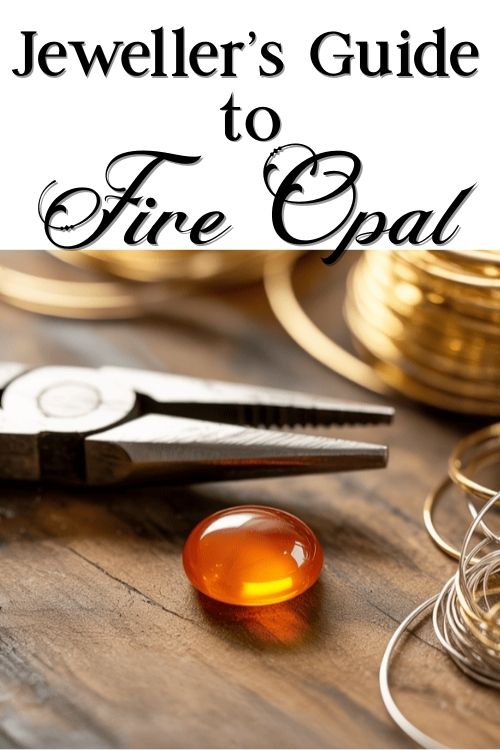
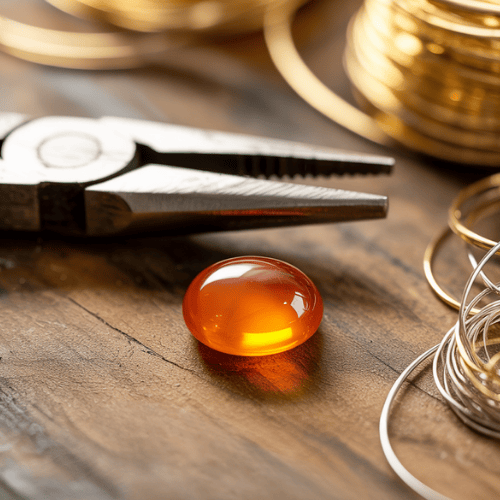
Fire opals vivid oranges, reds, and golden hues seem to hold a flicker of flame at the center, giving the stone a radiant presence unlike any other opal. Jewelers and collectors value it for its striking body colour, luminous transparency, and the way it captures light in a gentle, fluid way.
🔗 Interested in working with a variety of opal types? Read A Jeweller’s Guide to Opal
Jump to:
Basic Identification Information
Name and Synonyms
Fire Opal, Mexican Fire Opal, Sun Opal, Orange Opal, Precious Orange Opal (when there is play-of-colour)
Species
Opal
Colour Range
Orange, Red, Yellow, Brownish.
Refractive Index
1.370 – 1.470
Mohs Hardness
5 to 6.5
Birefringence
None as singly refractive
Optical Sign
None as singly refractive
Pleochroism
None
Specific Gravity
Between 1.25 and 2.07
Fluorescence
From none to a moderate response to UV light
When present fire opals can fluoresce white, or greenish brown.
Lustre
Vitreous (glass like) to resinous
Clarity
Fire opal doesn’t have an official clarity level, but it’s usually transparent to semitransparent.
Opaque orange opal isn’t usually referred to as fire opal.
Optical Phenomenons
Play-of-colour (commonly seen)
Gems Often Mistaken For
Carnelian, Chalcedony, Citrine
Wearability
Fair. Requires protective settings and mindful wear.
Birthstone
October
Spotting Synthetic (Lab Grown) Fire Opal
When it comes to synthetic fire opals, the primary clue is how perfect they look. There will be no colour zoning within the orange body colour, and the play-of-colour is usually strong and visible across the whole gem from every viewing angle.
Under a microscope, the play-of-colour in many lab creations shows either a column like pattern or a snakeskin pattern. You can sometimes spot the snakeskin effect (often called chicken wire) from the top of the gem, but you usually need a side on view to see the columns of colour clearly.
Natural fire opal usually has subtle internal texture, soft hazy zones, and the occasional inclusion. If play-of-colour is present, it tends to be patchy or more visible from certain viewing angles rather than all of them.
Common Treatments
Fire opal, like any opal, is sometimes treated to improve its appearance. Common treatments include impregnation, smoke, sugar-acid, and dyeing.
Impregnation uses a colourless substance to make the stone more durable and to help hide surface reaching fractures. This treatment is more commonly done to lower quality material or to porous gems that would benefit from a tougher outer coating. It can also help reduce the gem’s sensitivity to moisture changes, though it does not make a porous opal fully moisture proof.
Smoking, sugar-acid, and dyeing are all treatments used to improve or alter the body colour of the gem. These methods are often used to make the play-of-colour more visible, but in the case of dyeing, the goal is usually to change the base colour entirely.
Durability and Setting Considerations
Fire opal contains natural internal water and is sensitive to sudden temperature changes, strong impacts, and prolonged dryness. This means all soldering should be completed before the stone is set. Ideally most of the polishing should be done beforehand too, as some polishing methods heat the metal and, by extension, the stone. Sudden temperature shifts or the gem drying out can cause crazing (a web of tiny fractures) or cracking.
While fire opal is not the best choice for rings that will be worn every day, it can be comfortably set into occasional wear rings with a protective setting like a halo or a bezel. Pendants, earrings, and brooches are generally safer options for fire opal jewellery because they carry a much lower risk of knocks and abrasion.
🛍️ Explore our selection of pre-owned Fire Opal Gemstones for your next jewellery creation.
Care Instructions
Cleaning
If possible, clean fire opals with a damp cloth and a small amount of mild soap. Not all fire opals respond well to being submerged in water, and you often don’t know which ones need to be kept drier until it’s too late.
Never use ultrasonic or steam cleaning.
Storage
Store separately from harder gemstones to prevent scratches. Wrap in a soft pouch or lined box. For long term storage, keep fire opal in a slightly humid environment to reduce the risk of dehydration.
Daily Wear
Remove fire opal jewellery during sports, vigorous activity, gardening, or household cleaning. Keep away from sharp temperature shifts such as hot water, saunas, or direct intense heat.
Market and Ethical Notes
The most prized fire opal comes from Mexico, especially the state of Querétaro. Other sources include Ethiopia, Brazil, and Honduras.
Value is influenced by clarity, transparency, vividness of body colour, and the presence or absence of play-of-colour. Transparent fiery red stones with a good play-of-colour are the rarest and command the highest prices.
Mexican sources are often small scale mines that support local communities, though working conditions vary. As with all opal, responsible sourcing is best confirmed through reputable suppliers who provide clear information about origin and handling.
🔗 Learn more about the ethical and environmental story behind Reclaimed and Recycled Gemstones.
Symbolic and Spiritual Meanings
Fire opal is traditionally linked with creativity, passion, vitality, and emotional renewal. Many associate it with igniting inner courage and strengthening personal power. Modern chakra practices often connect fire opal with the sacral chakra and solar plexus chakra, encouraging confidence and expressive energy.
🔗 Dive deeper into Fire Opal symbolic and spiritual meanings
Etymology
The name “opal” comes from the Latin opalus, which likely stems from the ancient Sanskrit upala, meaning “precious stone.” Fire opal gained its descriptive name from its intense flame like base colouring.
🔗 Curious about how fire opal was viewed in ancient cultures? Explore its fascinating myths and legends
📌 Save this jeweller’s guide to fire opal for quick reference next time you’re working with this stunning gem.