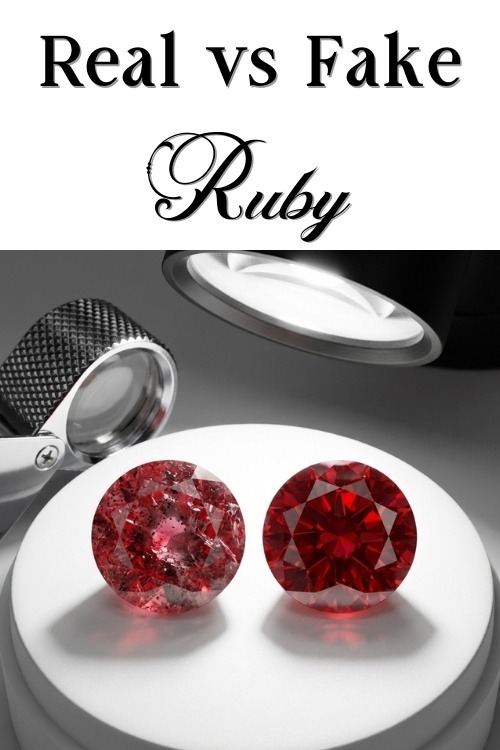
Estimated reading time: 10 minutes
Rubies are one of the most sought-after gemstones, prized for their rich red colour and long history in jewellery. But their popularity and high price tag mean they’re frequently imitated or mis-sold due to misidentification. So if you’ve ever wondered how to tell if a ruby is real or fake, you’re not alone. While professional laboratory testing is sometimes needed for a definitive answer, there are several clues you can learn to recognise yourself.
Whether you’re a jeweller, collector, or gemstone enthusiast, learning how to spot fake rubies and identify real ones can save you from costly mistakes. As a gemologist who regularly examines coloured gemstones, I’ve handled many natural, synthetic, and imitation rubies over the years. So I’ve put together this guide to help you understand the most common ruby imitations, how to check if a ruby is real, and what to watch out for when buying rubies online.
Jump to:
What does “Fake Ruby” even mean?
You’ll often see the phrase “fake ruby” used online to describe anything that isn’t a natural, mined ruby. It’s a convenient shorthand, but it can be a little misleading.
In gemology, different materials fall into different categories:
- Natural ruby – formed naturally within the earth
- Synthetic ruby – grown in a lab but chemically and structurally identical to natural ruby
- Simulants – materials that imitate the appearance of ruby, such as glass, cubic zirconia, or other gemstones being sold as ruby look-alikes.
Because synthetic rubies are still chemically ruby, gemologists don’t usually consider them “fake” unless they’re being sold as natural ruby without disclosure. Likewise, a red cubic zirconia sold honestly as “ruby-coloured CZ” isn’t really fake either. It’s simply a ruby simulant.
In practice, the issue usually comes down to how a stone is described. A gemstone only becomes misleading when it’s represented as something it isn’t.
For the purposes of this guide, I’ll use the term fake ruby in the way most people online mean it, but what we’re really looking at are imitations, simulants, synthetic, and heavily treated rubies.
Common fake rubies and ruby imitations
Not all rubies are what they seem. Here are some of the most common stones that are mistaken for or sold as ruby.
1. Glass-Filled Rubies
Many lower-quality rubies on the market are treated with lead glass to fill fractures and improve their clarity. While these stones do contain natural ruby, they are significantly weaker than untreated stones and can be damaged by everyday wear or even common cleaning solutions.
Another important point is that there is no minimum ruby content required for these stones. Some may contain a substantial amount of natural ruby, while others are made up largely of glass with only small areas of ruby present.
As these stones became more commonplace in the early 2000s, many gem laboratories began treating them as a separate category rather than simply describing them as treated rubies. Then, in 2010, the World Jewellery Confederation introduced the term “composite ruby” in its Blue Book standards to describe rubies that have been combined with glass or other materials. This helped reinforce the idea that these stones should be considered distinct from natural rubies and that glass filling must always be disclosed.
How to Spot:
Under magnification, you might see blue or orange flashes within the stone where the glass and ruby meet. You may also notice gas bubbles trapped in the glass, as well as what appear to be surface-reaching fractures even though the surface itself feels smooth.
2. Synthetic Rubies
Synthetic rubies are still rubies. They have the same chemical composition and crystal structure as natural ruby, but they are created in laboratories rather than forming within the earth. They are most commonly produced using the flame fusion process, although they can also be grown using flux or hydrothermal methods.
These are the stones I personally dislike seeing described as fake. They are not fake rubies, they are simply lab-grown ones. The only time I feel that term is justified is when a synthetic stone is being mis-sold as a natural ruby.
How to Spot:
Natural rubies usually contain inclusions, so synthetic rubies can sometimes appear unusually flawless.
Rubies can also show growth lines that are visible under magnification. In natural rubies these lines are typically straight and may form angular patterns, sometimes intersecting at sharp angles. In flame fusion synthetic rubies, however, the growth lines are usually curved and do not intersect.
Another, somewhat less reliable comparison is a ruby’s glow under ultraviolet light. Synthetic rubies often fluoresce a very bright red, while natural rubies tend to show a slightly weaker fluorescence.
3. Red Spinel
Natural spinel is a beautiful gemstone in its own right, but it has been mistaken for ruby throughout history. In fact, the famous “Black Prince’s Ruby” in the British Crown Jewels is actually a red spinel.
This kind of misidentification is far less common today, as modern gem testing can easily tell the two stones apart. However, spinel can still sometimes be mis-sold as a ruby.
How to Spot:
One of the key differences between ruby and spinel is how they interact with light. Spinel is singly refractive, while ruby is doubly refractive. There are a couple of ways to test this. A polariscope is usually the quickest and easiest method, although a refractometer will also reveal the difference.
Ultraviolet light can sometimes help as well. Spinel typically shows weaker fluorescence, while many natural rubies display a stronger red glow.
4. Garnet
Red garnet is another gemstone that is sometimes confused with, or mis-sold as, ruby. At first glance some varieties can look quite similar. However, garnet is generally softer, less durable, and far more abundant than ruby, which is why its value tends to be lower.
How to Spot:
Garnet often shows slightly brownish or orange undertones that can usually be seen when the stone is backlit with a strong white light.
Like spinel, garnet is singly refractive, while ruby is doubly refractive. This means you can easily tell these gems apart with a polariscope or refractometer.
5. Glass
Coloured glass is cheap and easy to produce and can easily be cut to resemble a ruby. It is much softer and lacks the brilliance and hardness of real ruby, but it is probably one of the most common fake rubies on the market.
How to Spot:
Glass usually lacks the natural inclusions found in gemstones and instead may contain round gas bubbles.
It can also have an overly smooth appearance, slightly rounded facet edges, or even concave facets if the stone was moulded rather than cut.
Like spinel and garnet, glass is also singly refractive.
6. Cubic Zirconia (CZ)
Cubic zirconia is best known as a diamond simulant but can, and often is, produced in ruby-like red colours.
How to Spot:
CZ is typically too perfect. It often has flawless clarity, very strong sparkle, and a different light refraction pattern compared to natural ruby.
Like many ruby imitations, CZ is also singly refractive.
How to tell if a ruby is real
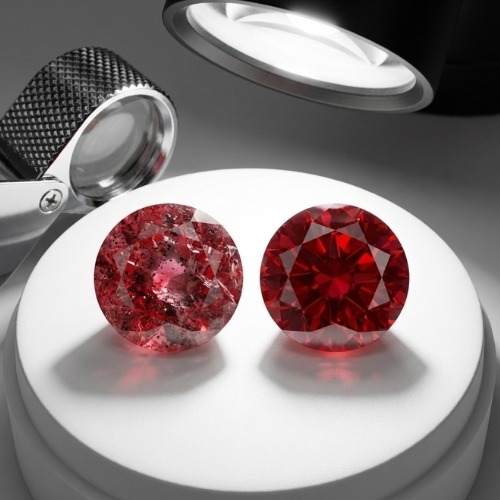
If you’re trying to figure out whether the ruby sitting in front of you is real or fake, one of the first things to examine is its inclusions, or lack thereof. Using a jeweller’s loupe (10x magnification), look for inclusions, growth lines, or signs of treatments such as glass filling.
What do natural ruby inclusions look like?
One of the most reliable ways to identify a ruby as natural is by examining its inclusions. Common inclusions found in natural rubies include:
- Silk. Silk is a common feature in natural corundum (the mineral species ruby belongs to). It is the term used to describe extremely fine needles of rutile within the stone. Under magnification these needles can appear like delicate threads or a woven fabric, and they can sometimes give rubies a soft, glowing appearance.
- Crystal inclusions. These occur when tiny mineral crystals become trapped inside the ruby as it forms. In natural rubies, these inclusions often stand out clearly against the stone’s red colour and may appear as small well-formed crystals or irregular mineral grains. Some laboratory-grown rubies can also contain crystal inclusions, but they are typically fewer in number and may appear alongside other growth features that indicate a synthetic origin.
- Fingerprint inclusions. These resemble tiny networks of fine fractures that create patterns similar to a fingerprint. They form when small fractures within the ruby partially heal during its natural growth, trapping tiny fluid inclusions along the fracture lines.
What do synthetic ruby inclusions look like?
Synthetic rubies often display different internal structures. As most lab-grown rubies are produced using flame fusion, they commonly show curved growth lines and gas bubbles.
Flux-grown rubies can display different features, including flux veils, crystal inclusions formed from the flux, and nail-head spicules. These appear as needle-like inclusions with a small crystal at one end that resembles the head of a nail or pin.
Learning to recognise these natural and synthetic growth patterns under magnification is one of the most useful skills you can develop when identifying rubies. However, while these clues can help you spot many ruby imitations, definitive identification often requires professional gemmological testing.
🔗 If you’d like to explore the characteristics of ruby in more detail, you can also read my Jeweller’s Guide to Ruby.
When to get it tested
If you’re unsure whether a ruby is natural, synthetic, treated, or truly fake, professional testing is the safest option, especially if you’re planning to sell it.
Most gem laboratories offer two types of reports: verbal and written. A verbal report simply confirms the identity of the gemstone, while a written report provides an official document detailing the lab’s findings.
A written report usually costs more, but if you use a reputable gemological laboratory it provides the documentation needed to sell your ruby with greater confidence, and often at a higher price.
A certified gemological laboratory can confirm:
- whether a gemstone is ruby
- whether a ruby is natural or synthetic
- whether it has been treated
In some cases, laboratories may also be able to determine a ruby’s geographic origin. However, this is not always possible, as origin can only be established when a stone contains identifiable geological characteristics.
🔗 Want an insight into how gemstones are tested outside of a professional lab? Read Gemstone Identification: How I Test Gemstones (coming soon)
Buying Rubies Online: What to Watch Out For
Buying gemstones online can be convenient, but it also comes with risks. Here are a few red flags to watch for when shopping for rubies online.
Vague descriptions
If a listing simply says “ruby” without specifying whether it is natural or synthetic, it may be glass-filled, lab-grown, or an imitation.
Prices that seem too low
Natural rubies are valuable gemstones. If a ruby is unusually cheap, it’s likely glass-filled, synthetic, or a simulant.
Stock images instead of actual stones
If a seller uses identical images across multiple listings (or you see multiple sellers using the same photos), you may be looking at a genuine ruby, but it might not be the stone the seller intends to send you.
No mention of treatments
Ruby is commonly heat treated. Reputable sellers will clearly disclose treatments. If a listing avoids mentioning them altogether, that can be a warning sign.
🔗 Want to learn more about spotting misleading listings? Read How to Spot a Misleading Gemstone Listing (coming soon).
Final Thoughts
Learning how to identify real rubies and spot fake ones takes practice, knowledge, and careful observation. For jewellers and designers, understanding the differences between natural ruby, synthetic ruby, and ruby simulants can help protect both your reputation and your investment, so it’s well worth spending some time practising these skills.
🛍️ If you’re looking for responsibly sourced gems, browse our selection of pre-owned natural rubies, and lab grown rubies.
📌 Don’t forget to save this guide to distinguishing natural rubies from synthetic and imitation gems so you can find it again