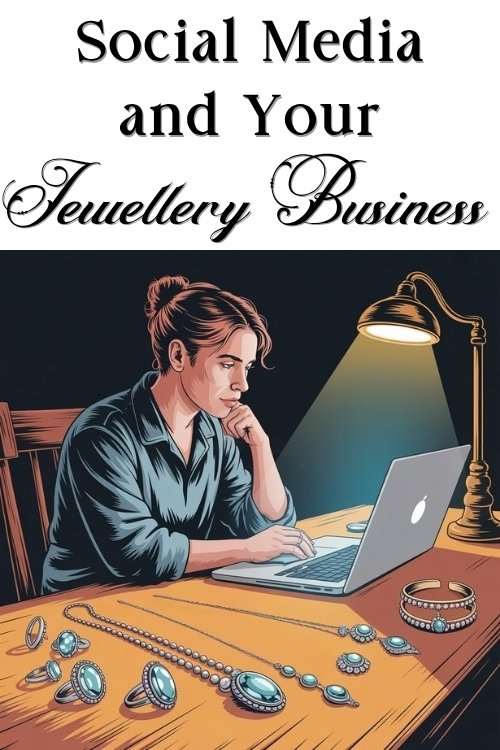
Social media is often seen as a must-have for jewellery businesses, but it can feel overwhelming. So many platforms, so many strategies, so many “post now or lose your audience” rules. The truth is, social media isn’t a magic wand, and it’s certainly not mandatory. But understanding how it works, and which platforms might suit your business, can help you make smarter decisions about where, if, and how to show up.
Done thoughtfully, it can be a genuinely useful tool for building brand awareness and a following of loyal customers. Done reluctantly and spread too thin, it’s mostly just exhausting busy work that’ll produce very little if any benefit.

Know Your Audience to Choose the Right Platform
Not all social media platforms are created equal, and your customers aren’t evenly spread across them all. So, before picking your platform(s) you need to know your audience. Figure out who your jewellery is for and then use that knowledge to decide where to spend your marketing time.
Here’s a quick overview of the more popular social media sites, who uses them, and how they’d usually be used for marketing.
(Demographic info is based on data from early 2026. These figures shift over time, so please treat the demographics as a guide rather than hard facts.)
Instagram:
Popular with younger-to-middle aged adults, with the biggest slice of users in the 25 to 34 bracket, followed closely by 18 to 24 year olds. It skews slightly female, roughly 55% women to 45% men, and tends to attract higher-income users. Great for visually appealing images and short videos. Jewellery brands can shine here through lifestyle shots, reels, and behind-the-scenes content.
Facebook:
Skews noticeably older, with the most active age group being 30 to 49, and it remains the dominant platform for Baby Boomers. Good for community-building, in-person event promotion, and connecting with interest based groups. While strong visuals still matter on Facebook, the captions and conversations they spark tend to do more of the heavy lifting than on Instagram. Due to this it’s worth putting as much thought into what you write as you do the images when you’re posting to Facebook.
TikTok:
Still primarily a younger platform with around 63% of 18 to 29 year olds use it, though its 30 to 49 year olds demographic has grown significantly in recent years. Women make up a larger share of users than men. It’s highly visual, trend-driven, and focused on short, entertaining video content. The catch for most small jewellery businesses is the time investment. Short video content that performs well here tends to require more effort to create and can feel quite alien if you’re not already a natural on camera.
Pinterest:
Often lumped in with social media, but it’s actually a visual search engine with strong bookmarking features. Around 70% of its users are women, the biggest age group is 25 to 34, and it skews toward higher-income users who are actively planning purchases and gathering inspiration. The “social” aspect is limited, but it’s perfect for driving traffic through SEO discovery and inspiration.
It has a reputation of being a bit of a slow burn marketing option, which is true, but growth speed should be balanced against content longevity. A pin might take a few months to really start driving traffic your way, but this one pin can then keep being found for years, where as other social media posts tend to have a shelf life of a couple of days. It’s also a platform designed to send people to your site, unlike most social media platforms that are designed to keep the user on their app/website.
X (formerly Twitter):
Not traditionally a strong platform for jewellery brands because it’s more text-focused and moves very quickly. Close to two-thirds of its users are men, which also makes it a generally poor fit for the jewellery audience. It can work if your brand has a clear voice or you want to join conversations around small business, creativity, or handmade culture, but it’s usually not the best place to prioritise for small product-based businesses.
By understanding where your ideal customers hang out, you can focus your time and energy on the platforms that are most likely to deliver you results.
Social Media is About Stories, Not Sales
Just as a quick reminder before we dive into which platform(s) would be best for you, and how I personally use social media. Many small business owners, jewellery makers included, lose sight of the ‘social’ element of social media. They feel pressure to constantly post products and promotions, chasing sales with ‘buy my stuff’ content. The most effective social media, however, is rarely a direct sales pitch. Instead, it’s about entertaining your audience by sharing your stories:
- What inspired your brand
- Why are you passionate about making jewellery
- What inspired a design or collection
- Your creative process or behind the scenes moments (including the occasional silly mistakes that make you human)
- The history or meaning behind the gemstones you work with and how it inspired your decision to use that stone
Story-driven content encourages engagement, builds trust, and can spark interest in your brand in ways that traditional ads don’t. Remember, jewellery is a luxury purchase rather than an essential one, which means your customer is buying to fulfil an emotional desire. Stories are far better at speaking to emotions than a straightforward sales pitch ever will be.
🔗 Want some tips on using metaphysical beliefs and/or gemstone myths, legends and history as non-sales content for your social media? Read Using Gemstone Knowledge to Boost Your Jewellery Sales
Questions to Ask Yourself Before Choosing Your Platform(s)
Before committing your precious time and energy to a platform, it’s worth sitting down with these questions:
- Who is my ideal customer? Think about their age, interests, and how they shop. Are they a younger buyer discovering jewellery brands on Instagram who’s likely to be making spontaneous purchasing decisions, or a more thoughtful customer who uses Pinterest to plan their purchases and gift ideas in advance?
- Where does my ideal customer actually spend their time? Use the demographic guide above as a starting point, but also think about your own experience. Where do you see similar jewellery styles to your designs when you’re browsing? Chances are if other brands are marketing on that platform, it’s because your audience is already there and waiting for you.
- What kind of content can I realistically create? Are you comfortable on camera? Do you enjoy making and editing videos even if it’s just your hands in shot? Or do you prefer writing and static photography? Be honest with yourself here as the best platform for you is one you can sustain, and hopefully, enjoy showing up on.
- Do I have the time and energy for this platform long-term? A profile you update once and abandon is worse than no profile at all. Better to do one thing well than three things poorly.
- Does this platform play to my strengths? If you’re great at SEO and love writing, Pinterest’s description fields and blog-driven traffic might suit you better than TikTok’s trend-chasing, video-first format.
- Am I choosing this platform because it genuinely suits my business, or because I feel like I should? Feeling pressured into a platform rarely leads to content you’re proud of, or any real account longevity.
How Often Should You Post?
So, you have a sense of where to post and what kinds of content resonate. The next question is inevitably: how often should I be posting to my chosen platform(s)?
While the recommended frequency varies slightly across the different platforms, the honest answer is that consistency matters far more than volume. Posting twice a week every week will almost always outperform posting twelve times in a week and then going quiet for a month once your energy or enthusiasm has waned. Algorithms across most platforms reward regular activity, and your audience builds trust with you when you show up reliably rather than sporadically.
That said, “consistent” doesn’t have to mean “every day.” If weekly works for you, weekly is fine. If three times a week is sustainable, great. The goal is to find a rhythm you can actually maintain without burning out, and that will look different for everyone.
Pinterest is a slight exception here. Because it functions as a search engine, it benefits from more regular pinning than most platforms. That regular pinning doesn’t need to be the overwhelming ten to twenty pins a day schedule you might have seen recommended though, two to three pins a day is plenty for slow and steadily growth.
There’s also a strong argument for quality over quantity across all platforms. One genuinely useful, well-thought-out post will do more for your brand than five rushed ones that don’t really say anything and just exist because you thought you needed to pump out content to be successful. Think of it like the jewellery you make: a single well-crafted piece beats a handful of rushed ones every time.
My Approach
I’ll be honest here. I’m not a huge fan of social media. I don’t enjoy it and I’m not very good at faking it, which leaves any post I do feeling a bit flat. This has also led to me never really being successful on these more traditional platforms like Instagram.
You may have heard the advice that a business should be active on at least three social media platforms consistently, I know I have in several of the beusiness courses I’ve done. But personally, I find that a stretch too far, and I suspect I’m not alone in that.
My preference is to have one main platform that I put real effort into for brand discoverability, that’s Pinterest in my case, where SEO matters more than being entertaining and I can reach people who are actively searching for gemstones. Then a second, lighter-touch channel for having a presence in case someone looks me up, which for me is Instagram. It’s not where I expect to find most of my customers, but a minimal effort yet professional-looking profile there does no harm.
Beyond two platforms, unless your content is very quick to repurpose, I feel the time investment starts to outweigh the returns. Spreading yourself across three or more channels often means doing all of them at a mediocre level rather than one or two really well.
If you’re just starting out, I’d also suggest focusing on one platform first. Give yourself the time you need to go through the learning curve with it. Get comfortable with making the content. Figure out what resonates with your audience, and then double down on that style of content. Get that platform running properly before you even think about adding in a second. Social media marketing, like business in general, should be considered a marathon, not a sprint.
Finding Your Balance
Social media isn’t mandatory, but it can be a powerful tool when used intentionally. By understanding your audience, telling stories, and focusing on platforms that match your style, you can reap the benefits without becoming trapped on a content treadmill. Whether that means using Instagram, Facebook, TikTok, or Pinterest, the key is knowing your audience and aligning your efforts with your own strengths.
At the end of the day, social media is just one tool in your jewellery business toolkit. It’s worth understanding, but it doesn’t have to define how you work or whether you’re successful.
📌 Save this social media guide for jewellery businesses so you can find it again.