Tanzanite and Iolite are two stunning blue-violet gemstones that can sometimes be mistaken for one another, especially in their deeper shades. Both show striking purplish-blue tones and strong pleochroism, but beyond that, they’re quite different in composition, formation, and value.
Tanzanite is a relatively “new kid on the block,” discovered in the 1960s, yet it quickly became famous for its captivating colour and rare Tanzanian origin. Iolite, on the other hand, has been around for centuries and even earned the nickname “Viking’s Compass” because of its unique optical properties.
Let’s take a closer look at what makes these two gems unique, from their gemmological traits to their symbolic meanings. By the end, you’ll be able to tell the difference and choose which one suits your next design best.
Visual & Gemmological Clues
Visual Clues
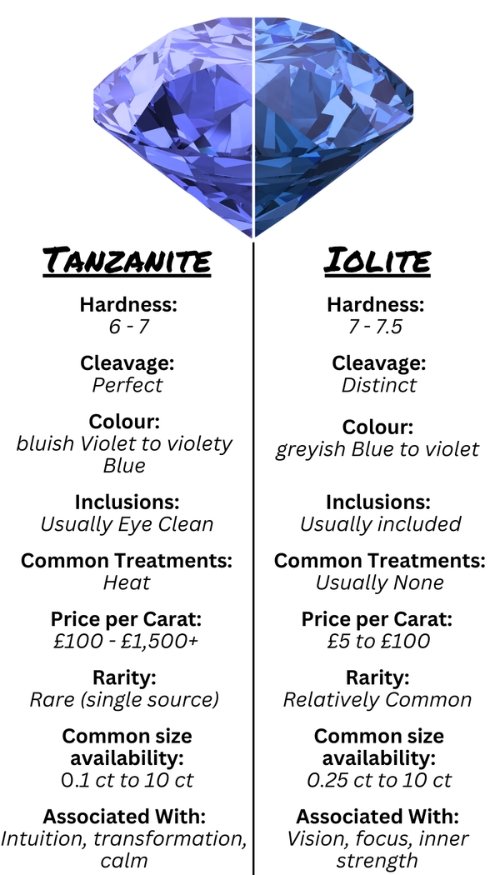
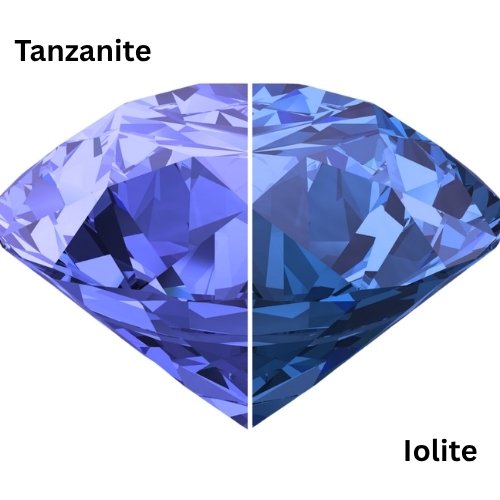
Tanzanite tends to display rich violet-blue to purplish-blue hues that shift depending on the lighting and viewing angle. It’s often transparent and has excellent clarity, especially in well-cut faceted stones.
Iolite, in comparison, leans toward deeper blue with greyish or slightly inky undertones. Its pleochroism is strong too, though the colours usually appear a little more subdued than Tanzanite’s. Inclusions are fairly common, but high-quality faceted stones can still appear eye-clean, sometimes showing subtle colour zoning.
Gemmological Tests
| Test | Tanzanite | Iolite |
|---|---|---|
| Refractive Index (RI) | 1.686 – 1.705 | 1.522 – 1.596 |
| Birefringence | 0.008 – 0.013 | 0.005 – 0.018 |
| Pleochroism | Weak to Strong and 3 colours | Moderate to Strong and 3 colours |
| Optical Character | Doubly refractive, biaxial positive | Doubly refractive, biaxial positive or negative |
🔗Want to take a deeper dive into identifying and working with these gems? Check out their individual guides:
A Jeweller’s Guide to Tanzanite
A Jeweller’s Guide to Iolite
Colour
Tanzanite ranges from violet-blue to deep purple-blue, with most stones being heat-treated to enhance their signature tone. In its natural form, Tanzanite tends to have a brownish tint that disappears with gentle heating.
Iolite, on the other hand, shows a greyish-blue to violet hue that often carries a steely or smoky look. Thanks to its pleochroism, you might catch flashes of yellow-grey or blue depending on the viewing angle.
Clarity & Inclusions
- Tanzanite: Typically eye-clean (Type 1). When inclusions do occur, they’re usually fine needle-like crystals or small liquid inclusions.
- Iolite: Often, but not always, has visible inclusions (Type 2), such as plate-like crystals or internal zoning. Despite it often being included, it’s still relatively easy to find beautiful eye-clean examples.
How They Form
Tanzanite is a variety of the mineral zoisite, forming deep within metamorphic rocks under high pressure and heat. It’s famously found only in one place, the Merelani Hills of northern Tanzania.
Iolite is a variety of cordierite, found in both metamorphic and igneous rocks. It’s mined in several locations, including India, Sri Lanka, Brazil, and parts of Africa, making it more widely available.
Durability & Wearability
On the Mohs hardness scale, Tanzanite sits around 6 to 7, meaning it’s slightly softer than household dust (which comes in at about 7, thanks to its quartz content) and can pick up scratches from everyday wear. Iolite, on the other hand, measures 7 to 7.5, making it a little more resilient for daily use.
Tanzanite has perfect cleavage in one direction and only fair toughness, so it can chip or break if accidentally struck. Iolite also has cleavage in one direction but slightly better toughness overall, making it a touch more durable.
For jewellery use, Tanzanite is best suited to earrings, pendants, or rings that aren’t worn daily. Iolite can handle everyday wear more comfortably, especially when rings have it set in protective mountings.
Enhancements & Treatments
- Tanzanite: Almost always heat-treated to achieve its vivid blue-violet colour. The treatment is stable and widely accepted as untreated stones tend to appear brownish.
- Iolite: Generally left untreated, as its natural colour and clarity are already attractive without enhancement.
Neither gem is commonly lab-grown, but both can be imitated. Tanzanite in particular is often seen in fake or simulant forms on the market.
Price Comparison
- Tanzanite: Prices usually range from around £100 per carat for small or lower-grade gems up to £1,500+ per carat for large, intensely coloured, high-clarity stones.
- Iolite: A far more affordable option, generally priced between £5 and £100 per carat depending on size and quality.
Size & Availability
Tanzanite is typically found in sizes ranging from 0.1 to 10 carats, though larger stones (up to 20+ carats) do exist, they’re rare and significantly more expensive.
Iolite, by contrast, is readily available in a wide variety of sizes. Faceted stones between 0.25 and 10 carats are common, with larger gems still somewhat easy to find and affordable.
Rarity & Sourcing
Tanzanite’s rarity is part of its allure. It comes from a single location in Tanzania, and supplies are expected to diminish in the coming decades.
Iolite, meanwhile, is much more abundant and mined in several regions worldwide. It isn’t considered rare, but its natural beauty and colour make it a gem of great visual appeal.
Cut & Shape
Tanzanite is most often cut into ovals, cushions, pears, or emerald shapes. These are designs that maximise brilliance and highlight its pleochroic flashes of colour.
Iolite is usually cut into ovals, rounds, or cushions, with the cutter carefully orienting the rough to show the best blue-violet colour face-up while still balancing its pleochroism and trying to prevent the cut stone from looking too dark.
Symbolic & Spiritual Associations
Tanzanite is said to support spiritual growth, transformation, and intuition, carrying a calm and insightful energy.
Iolite is often linked to vision, clarity, and self-discovery. It was historically thought to help navigators find their way, and today, it’s still associated with focus and inner strength.
🔗 Discover the deeper meanings of these gems:
Symbolic & Spiritual Meanings of Tanzanite
Symbolic & Spiritual Meanings of Iolite
Comparison Summary
| Feature | Tanzanite | Iolite |
|---|---|---|
| Hardness | 6 to 7 | 7 to 7.5 |
| Cleavage | Perfect in one direction | Distinct, but more durable |
| Colour | Blue-violet to violet-blue | Greyish-blue to violet |
| Commonly Included? | Usually eye clean | Usually included |
| Common Treatments | Heat treated | Rarely treated |
| Price per Carat | £100–£1,500+ | £5–£100 |
| Rarity | Extremely rare (single-source) | Relatively common |
| Large Sizes? (5 ct+) | Available but pricey | Readily available |
| Associated With | Intuition, transformation, calm | Vision, focus, inner strength |
Tanzanite and Iolite share a beautiful violet-blue charm, but their differences in rarity, durability, and value make them distinct in their own right.
If you’re drawn to a rare, luxurious stone with dramatic pleochroism and vivid colour, Tanzanite is an unforgettable choice. But if you’d prefer a more affordable, durable gem with subtle colour shifts and historic charm, Iolite is the gem for you.
Either way, both of these beauties bring a touch of magic to any jewellery design.
🛍️ Looking for the perfect sustainable gemstone for your next jewellery making project? Explore our pre-owned Tanzanite and Iolite
📌 Save this Tanzanite vs. Iolite comparison to come back to whenever you need a quick refresher.