What if a ring could carry a secret message? That’s the whole idea behind acrostic jewellery. Long before text messages and heart emojis, people were writing love notes with gemstones.
This hidden language was the height of fashion in the 19th century. It was worn by empresses, gifted by Napoleon, and treasured by Victorian sweethearts who liked their feelings hidden in plain sight. It’s also a tradition that’s surprisingly easy to bring into your own work today.
So let’s explore where acrostic jewellery came from, how to read an antique piece, and how you can use this clever little code in modern jewellery design.
- What Is Acrostic Jewellery?
- Where It All Began: Mellerio’s Paris
- Napoleon and the Acrostic Bracelets
- The Victorian Era: Regard Rings and a Language of Gems
- Not Just Love Notes
- Popular Acrostic Words and Their Gemstones
- How to Decode an Antique Acrostic Piece
- Decline and Revival
- Using Acrostic Jewellery in Modern Design
- Hidden in Plain Sight
What Is Acrostic Jewellery?
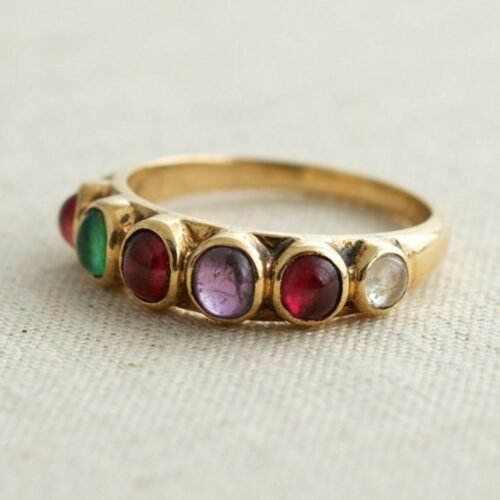
An acrostic is a word hidden in the first letters of other words. In jewellery, those other words are gemstone names. Set the stones in the right order, read the first letter of each, and you get a message.
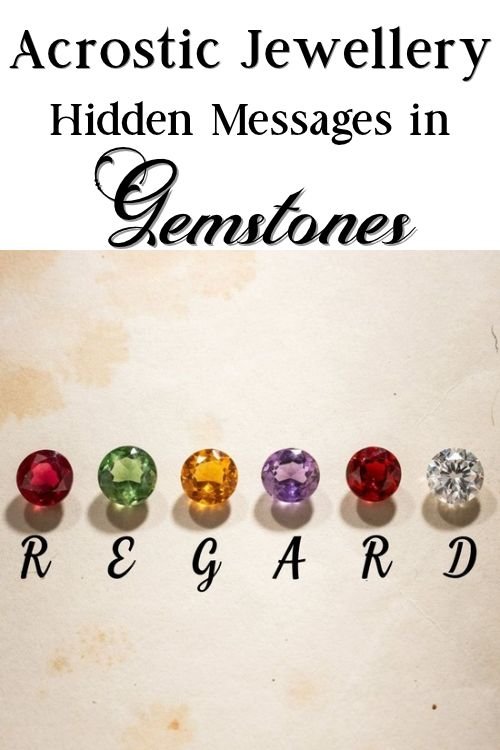
REGARD is the classic example. Ruby, Emerald, Garnet, Amethyst, Ruby, Diamond. To most people it’s just a pretty, colourful ring. To the person who gave it, and the person who received it, it says something much more personal.
That’s the charm. The message is right there for anyone to see, but only those who know the code can read it. These pieces were given as love tokens, friendship gifts and keepsakes, mostly in the late 18th and 19th centuries.
Where It All Began: Mellerio’s Paris
Acrostic jewellery is usually credited to Jean-Baptiste Mellerio (1765 to 1850), of the Paris jewellery house Mellerio dits Meller. Mellerio was a court jeweller and a favourite of Marie Antoinette.
Exactly when he came up with the idea is a little fuzzy. Some sources say the late 1700s, others say the very early 1800s. The story goes that one of his first designs spelled “J’adore”, French for “I adore you”. Jade, Amethyst, Diamond, Opal, Ruby, Emerald. And some say, this ring that would start a fashion trend that lasted for about 100 years, was made for Marie Antoinette.
By 1819, the London fashion magazine La Belle Assemblée was reporting that “the acrostic rage prevails in jewellery”.
There was a rival claim too. One biographer of Napoleon’s stepdaughter, Hortense, credited the “alphabet of gems” to Prince Metternich in Austria. Historians have found nothing to back that up though, so Mellerio keeps the title.
Napoleon and the Acrostic Bracelets
If acrostic jewellery needed a greater celebrity endorsement than Marie Antoinette, it got one. Napoleon Bonaparte loved the idea, and he used it to mark big moments for himself and his family.
His favourite trick was spelling out names and dates. In 1806, he commissioned several acrostic bracelets for his first wife, Empress Joséphine. These came from his court jeweller, Marie-Étienne Nitot, whose firm later became the house of Chaumet.
His sister Elisa got one too. When she gave birth to a daughter in Lucca in 1806, Napoleon marked it with a bracelet reading “Napoleon 3 Juin 1806 a Lucques”. Elisa had hoped for a boy, but she named the baby Napoleone anyway.
The most famous set he commissioned belongs to his second wife, Empress Marie-Louise. Chaumet made her three acrostic bracelets. Between them, the stones spell out both their first names, their birthdays, and the dates they met and married in 1810. It’s a love letter, a diary and a piece of jewellery all at once.
With an emperor setting the trend, the rest of Europe followed. The fashion soon crossed the Channel, where English jewellers took it up with enthusiasm.
The Victorian Era: Regard Rings and a Language of Gems
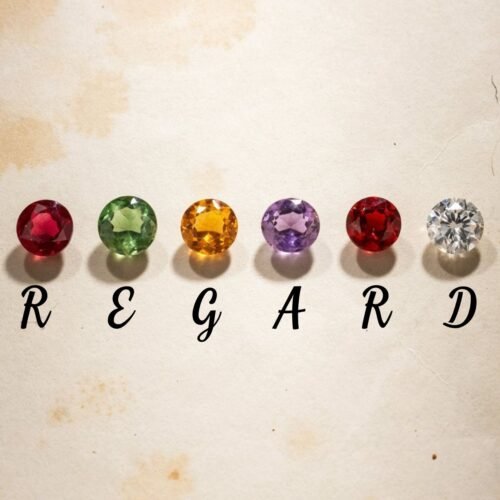
The Victorians took acrostic jewellery and ran with it. They adored sentiment, symbolism and a good secret. Flowers had meanings, colours had meanings, and so too did gemstones.
REGARD became the star. It’s the most common acrostic word by far, and REGARD rings survive in very large numbers compared with other sentimental jewellery from the period. So if you handle antique or reclaimed stock, there’s a real chance one will cross your bench at some point.
Earlier Georgian pieces often went a step further, setting the acrostic into a heart or padlock shape, complete with a key.
The language of gemstones
Acrostics worked on the first letter simply spelling out a message, but Victorians went a step further. They also gave each stone a meaning. Some of the most common ones were:
- Amethyst: devotion, fidelity and piety
- Emerald: hope, rebirth and lasting love
- Garnet: constancy and true friendship
- Pearl: purity and innocence, but also tears
- Ruby: passion and deep love
- Sapphire: truth, sincerity and faithfulness
- Turquoise: friendship and protection from misfortune
Opal had a rockier time during the Victorian period. At the start of this era, it was considered unlucky thanks to a novel published in 1829 by Sir Walter Scott. However, Queen Victoria didn’t agree. She wore opals, collected them, and gave opal jewellery to her daughters, which did a lot to rescue their reputation.
🔗 Curious about opal’s bad luck reputation? Read Opal Myths and Legends
Love, loss and mourning jewellery
Victorian sentiment wasn’t all romance. When Prince Albert died of typhoid in December 1861, Queen Victoria went into a mourning that lasted the rest of her life. She ruled that only jet jewellery could be worn at court for a year after his death.
Where the Queen led, the country followed. Whitby jet, a fossilised wood from the Yorkshire coast, became the mourning material of choice. Mourning pieces also used black enamel, onyx and locks of a loved one’s hair. Small seed pearls were sometimes included as well, to represent tears.
Acrostics turned up in grief too. One source says Victoria wore a bracelet spelling ALBERT in amethyst, lapis, beryl, emerald, ruby and turquoise.
Not Just Love Notes
Romance gets most of the attention, but acrostics carried all sorts of messages.
Friendship and remembrance. In France, two of the most popular words were souvenir (remembrance) and amitié (friendship).
Names and dates. Wealthy clients commissioned pieces spelling out names, birthdays and anniversaries, just as Napoleon did. Longer names were usually saved for brooches and bracelets worn by women, as there simply wasn’t room on a ring.
Men’s pieces. Acrostics weren’t only worn on the outside. They also appeared inside the lid of a man’s watchcase or snuffbox, which is about as secret as a message gets.
Politics. During the anti-slavery campaign and the push to reform the Corn Laws, rings spelling REPEAL were sometimes worn by both men and women. A protest badge made of gemstones.
Popular Acrostic Words and Their Gemstones
REGARD was the bestseller, but there were plenty of other words to choose from. Here are the ones you’re most likely to come across.
| Word | Gemstones, in order |
|---|---|
| REGARD | Ruby, Emerald, Garnet, Amethyst, Ruby, Diamond |
| DEAREST | Diamond, Emerald, Amethyst, Ruby, Emerald, Sapphire, Topaz |
| DEAR | Diamond, Emerald, Amethyst, Ruby |
| ADORE | Amethyst, Diamond, Opal, Ruby, Emerald |
| J’ADORE | Jade, Amethyst, Diamond, Opal, Ruby, Emerald |
| LOVE | Lapis lazuli, Opal, Vermeil*, Emerald |
| LOVE ME | Lapis lazuli, Opal, Vermeil*, Emerald, Moonstone, Emerald |
| FOREVER | Fire opal, Opal, Ruby, Emerald, Vermeil*, Emerald, Ruby |
| SOUVENIR | Sapphire, Opal, Uraninite, Vermeil*, Emerald, Natrolite, Iris quartz, Ruby |
| HOPE | Heliotrope (bloodstone), Opal, Peridot, Emerald |
| AMOUR | Amethyst, Moonstone, Opal, Uvarovite, Ruby |
| RESPECT | Ruby, Emerald, Sapphire, Peridot, Emerald, Carnelian, Topaz |
Notice how often ruby, emerald, diamond and amethyst turn up? That’s no accident. Their letters cover a lot of common English and French words, and they were valuable, well-loved stones in their own right.
*Vermeil in this context doesn’t mean gold-plated silver like it does today. Back at the height of acrostic jewellery, vermeil was an alternative name for garnet.
How to Decode an Antique Acrostic Piece
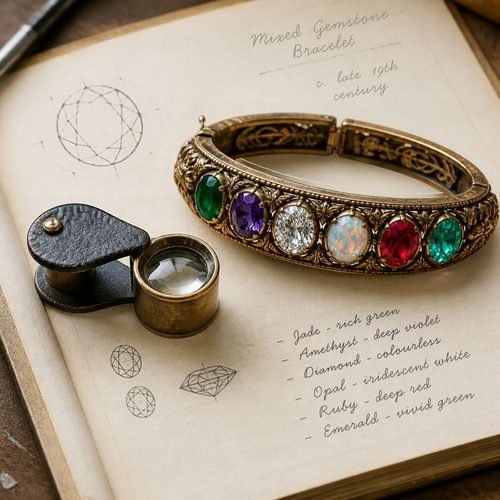
This is where a little gem knowledge really pays off. Reading an acrostic sounds simple, but antique pieces can be surprisingly sneaky.
Old names, not modern ones. Gem names have changed over the centuries, and the code uses the name the jeweller knew. The big one is vermeil. As I said above, today it means gold-plated silver, but it was once a name for garnet.
The language matters. A French piece will use French gem names, and the word itself may be French too. That’s how you end up with souvenir spelled with uraninite and natrolite. If a sequence makes no sense in English, try it in French.
Not every stone is what it seems. Acrostic pieces were made at all price points, and some cheaper ones mixed real gems with coloured paste. So before you read the word, it’s worth testing the stones and considering what gem they were imitating.
Look for the obvious words first. Six stones running red, green, red, purple, red, then a colourless one? That’s almost certainly REGARD. Seven starting with a diamond? Probably DEAREST.
🔗 Not sure how to identify the stones? Read Gemstone Identification: How I Actually Test Gemstones
Decline and Revival
Acrostic jewellery stayed popular right into the early 20th century. Then the First World War largely wiped out the taste for sentimental jewellery, and the fashion dwindled.
It didn’t vanish completely, though. In the 1920s, some jewellers reworked the idea to suit Art Deco tastes, with sleek stacking rings that still carried a hidden word.
Today it’s having a proper revival. Chaumet, the same house that made Marie-Louise’s bracelets, made an AMOUR acrostic bracelet in 2004 and still offers acrostic bracelets today. And more recently, London jeweller Jessica McCormack created a Love Letters collection, and Verdura made a D.E.A.R. bracelet.
Using Acrostic Jewellery in Modern Design
So why should any of this matter to a maker in 2026? Because customers love two things: personalisation and a good story. Acrostic jewellery gives you both.
It’s a lovely way to add a hidden layer of meaning to a piece. A name, a date or a private word that only the wearer knows is there. That’s exactly the sort of thing people buy for engagements, anniversaries, new babies and big birthdays.
Choosing your word
Short words are your friend, especially for rings. Four to six stones sit comfortably on a band. Longer words and full names work better on bracelets, necklaces and brooches, just as they did for the Victorians.
Commissions are where this really shines. Initials, a child’s name, a pet’s name, or a word that means something to a couple. You could also offer the classics, like REGARD or DEAREST, as ready-made designs with the history attached.
Finding a stone for every letter
The good news is you have far more gems to play with than Mellerio did. A few ideas to get you started:
- A: Amethyst, Aquamarine, Ametrine, Amazonite
- B: Beryl, Bloodstone
- C: Citrine, Carnelian, Chrysoprase, Cat’s eye chrysoberyl
- D: Demantoid garnet, Diamond, Diopside
- E: Emerald
- F: Fire opal, Fluorite
- G: Garnet, Goshenite, Goldstone (a man-made gem)
- H: Heliodor, Hematite, Hessonite
- I: Iolite
- J: Jade, Jet
- K: Kunzite, Kyanite
- L: Lapis lazuli, Larimar, Labradorite
- M: Moonstone, Morganite, Malachite
- N: Nephrite
- O: Obsidian, Onyx, Opal
- P: Peridot, Prehnite, Pearl
- Q: Quartz
- R: Rhodolite garnet, Rose quartz, Ruby
- S: Sapphire, Scapolite, Spinel
- T: Topaz, Tourmaline, Tanzanite, Turquoise
- U: Uvite, Uranium glass, Uvarovite
- V: Verdelite, Vermeil (old name for garnet)
- W: Watermelon tourmaline
- X*: Xanthite, Xonotlite (both collector rarities)
- Y: YAG (a man-made gem), Yellow Sapphire
- Z: Zircon, Zoisite
Some of the letters don’t have many options even today, so you could always cheat a little and include the colour to achieve the letter you are after, like I have for W and Y.
Having several options per letter also means you can play with colour. REGARD doesn’t have to be the classic red and green. Swap the rubies for rose quartz and the amethyst for aquamarine, and you’ve got a much softer version with exactly the same message.
*I personally think the only letter you’re really going to struggle to include in a design is X. I did, however, find out there is a colour called Xanthous, which is a golden yellow tone that you often see in citrines, so you could always colour match that shade should a client really want an X in their piece.
Balancing meaning, colour and wear
The message comes first, but the piece still has to look good and last. Lining up stones of a similar size and cut keeps a row tidy, even when the colours are all over the place.
Think about wear too. A ring gets knocked about, so a soft stone like opal or malachite in the middle of a band won’t love daily life. If a softer stone is essential to your word, a pendant or earrings might suit it better.
🔗 Need a refresher on durability? Read What is the Mohs Hardness Scale? And why does it matter?
Telling the story in your listings
A secret message only works if someone knows it’s there. Include a small card with each piece that names the stones and reveals the word. It turns a pretty ring into a gift with a story.
In your product listings and social posts, lean into the history. Something like “Inspired by Georgian and Victorian acrostic jewellery, the stones in this ring spell REGARD, a secret love note that’s been passed between sweethearts for over 200 years” does far more work than “multi-gemstone ring”.
And if you use an old name to make a letter work, like vermeil for garnet, say so. It’s a charming detail, and it keeps things honest.
🔗 Want more ideas for turning gem history into sales? Read Using Gemstone Knowledge to Boost Your Jewellery Sales
Hidden in Plain Sight
Acrostic jewellery has always been about saying something without saying it out loud. A Parisian jeweller’s clever idea became an emperor’s love letter, a Victorian sweetheart’s secret, and even a quiet political statement.
Two centuries later, the code still works. A row of stones, a hidden word, and a story that makes a piece feel truly personal. Whether you’re decoding an antique ring or designing a name for a new commission, you’re keeping a lovely old tradition alive.
🔗 Looking for gems with meaning behind them? Read 10 Gemstones For Love Themed Jewellery
🛍️ Looking for small coloured stones to spell out hidden messages in your next design? Explore our pre-owned gemstones
📌 Don’t forget to save this guide to acrostic jewellery so you can find it again.