Estimated reading time: 7 minutes
Gemstones have captivated humans for centuries, not just for their natural beauty, but for the mystical powers they are believed to hold. Among the most revered in Hindu, Buddhist, and Jain traditions is the Navaratna, or “Nine Gems.” This sacred collection is deeply rooted in Vedic astrology, with each stone linked to a celestial force thought to influence human destiny. It is one of the oldest and most enduring examples of gems meaning something more than just a fashion statement.
Jump to:
Myths, Legends, and the Origins of Navaratna
The story of the Navaratna is as enchanting as the gems themselves, and it begins with the stars. Ancient Vedic seers, known as Rishis, observed that nine celestial bodies exerted an influence over human lives, determined by their position at the exact moment of a person’s birth. These were the five planets visible to the naked eye, Mars, Mercury, Jupiter, Venus and Saturn, together with the Sun and the Moon, and two shadow points known as Rahu and Ketu. This system of study became known as Jyotish, a word that translates roughly to “science of light” or “study of heavenly bodies” and it forms the foundation from which the Navaratna tradition grew.
Just a little side note on the two shadow points as I think there origin story is really interesting:
According to Hindu tradition, both can be traced back to the legend of Samudra Manthan, in which gods and demons churned the divine ocean to obtain Amrut, the elixir of immortality. A demon named Svarbhanu disguised himself among the gods to steal a drop of the elixir, but was exposed and beheaded. Because he had already swallowed the nectar, both the severed head and the body remained immortal, becoming Rahu and Ketu. Eclipses are explained in this tradition by Rahu (Svarbhanu’s head) swallowing the Sun or Moon, though being bodiless he cannot hold them for long, which is why the darkness always passes.
🔗 Interested in another gemstone linked legend from the churning of the divine ocean? Read The Legend of The Kalpavriksha
In Hindu astrology, the placement of these nine celestial forces in a person’s horoscope is believed to shape the course of their life, and wearing the nine gems they correspond to is said to provide astrological balance and benefit to the wearer. Ancient texts including the Agni Purana and other Vedic commentaries describe how these stones were revealed, offering humanity a means of balancing the cosmic energies that govern us.
The concept of Navaratna also extended beyond gemstones into Indian royal culture, where kings and emperors kept nine legendary advisors or scholars at court, also called their Navaratnas. King Vikramaditya’s nine gems included the poet Kalidasa, while Emperor Akbar’s included Birbal and Tansen. The idea of nine perfectly complementary elements, whether celestial, material or human, clearly held a deep resonance across Indian culture and history.
The tradition of the Navaratna extended into other cultures too. In Buddhist tradition the Navaratna reflecting the nine qualities needed to reach enlightenment. In Jainism, they represent virtues such as truth, non-violence, and the pursuit of perfection.
Across cultures and centuries, these gems carry a sense of sacredness that has never truly gone out of fashion.
The Nine Celestial Gems and What They Mean
Each of the nine stones is paired with a celestial body, and each carries its own symbolism and energy. Here is a closer look at them.
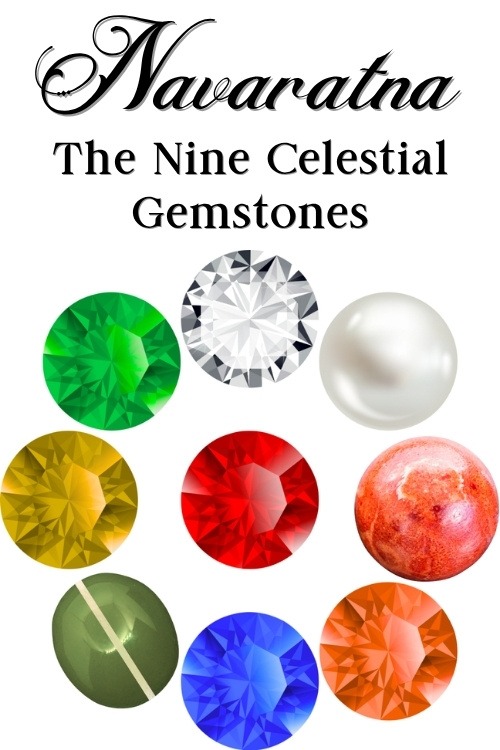
- Ruby, known in Sanskrit as Manikya, is paired with the Sun. Called the king of gemstones, it represents power, vitality, and confidence. It is said to radiate positive energy, protect the wearer, and inspire passion and courage.
- Pearl, or Moti, is linked to the Moon. Cherished for its calming and nurturing qualities, the pearl symbolises purity and emotional balance, reflecting the gentle, soothing influence of the Moon.
- Red Coral, known as Moonga, is paired with Mars. Its vivid colour channels the Martian energy of courage, strength, and determination. It is thought to boost stamina and shield the wearer from negative forces.
- Emerald, or Panna, belongs to Mercury. With their rich green hues, emeralds are seen as stones of wisdom and communication. They’re believed to enhance intellect, spark creativity, and smooth relationships.
- Yellow Sapphire, known as Pukhraj, is connected to Jupiter. It embodies knowledge, prosperity, and spiritual growth, and is often worn to attract abundance, blessings, and wisdom.
- Diamond, or Heera, is paired with Venus. With its unmatched brilliance, the diamond symbolises love, beauty, and luxury. They’re thought to nurture artistic expression and harmonious relationships.
- Blue Sapphire, known as Neelam, belongs to Saturn. Beyond its striking colour, this gem is revered for its spiritual depth. It’s believed to bring discipline, counter negative energy, and offer wisdom through the grounding influence of Saturn.
- Hessonite Garnet, or Gomed, is linked to Rahu, the ascending lunar node (the demon’s head). Sometimes called the widow’s stone, hessonite is thought to ease the challenges associated with Rahu, fostering clarity and guarding against unexpected obstacles.
- Cat’s Eye, known as Lehsunia, is paired with Ketu, the descending lunar node (the demon’s body). Mysterious and immediately recognisable, it is said to protect against psychic disturbances and negative influences, while sharpening intuition.
How to Wear the Navaratna
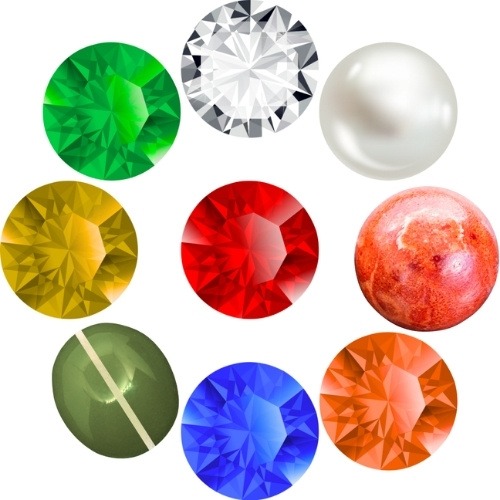
Traditionally, the nine stones are arranged in a specific pattern to maximise their astrological influence. The ruby sits at the centre, representing the Sun, with the remaining eight stones placed around it. Diamond sits at the top, blue sapphire at the bottom. To the left of the ruby (as you look at it), running top to bottom, you will find emerald, yellow sapphire, and cat’s eye. To the right, pearl, red coral, and hessonite.
This arrangement appears most often in rings, pendants, and talismans, and is designed to harmonise the energies of all nine celestial bodies. Navaratna jewellery is traditionally worn on the right hand or around the neck. Astrologers may recommend specific arrangements for personal guidance, but many people wear these stones in there standard arrangement for their symbolic power, their spiritual resonance, or simply for their beauty, which is an equally valid reason.
A Few Fascinating Tidbits
Regional variations do exist. While the traditional Navaratna list is fairly consistent, some communities swap or reclassify gems based on local beliefs or the availability of certain stones, so you may encounter slightly different versions depending on where you look.
The influence of the Navaratna on jewellery design is still very much alive today. Enthusiasts wear them as talismans for balance, success, and protection, as well as for the visual impact of nine vivid stones working together in a single piece.
It is also worth noting that while many people attest to the beneficial effects of crystal healing, scientific evidence in this area remains limited. That said, the centuries-old cultural significance of the Navaratna stands firmly on its own merits, as a tradition that has inspired art, belief, and extraordinary craftsmanship across generations.
The Celestial Charm of the Nine Gems
The Navaratna beautifully bridges the celestial and the earthly. Whether you are a jeweller, a gem enthusiast, or simply someone drawn to the intersection of history, myth, and gemmology, these nine stones offer a glimpse into a world where beauty, spirituality, and tradition have been inseparable for thousands of years.
Hopefully this has sparked a little curiosity and maybe even sent you down a Vedic astrology rabbit hole. After all, there are worse ways to spend an afternoon.
Quick side note – Gemstone history, myth and legend makes great marketing content, so feel free to retell this story to your audience!
🔗 Want some guidance on using gemstone knowledge to market your jewellery business? Read Using Gemstone Knowledge to Boost Your Jewellery Sales
📌 Save this guide to the Navaratna so you can easily find it again.