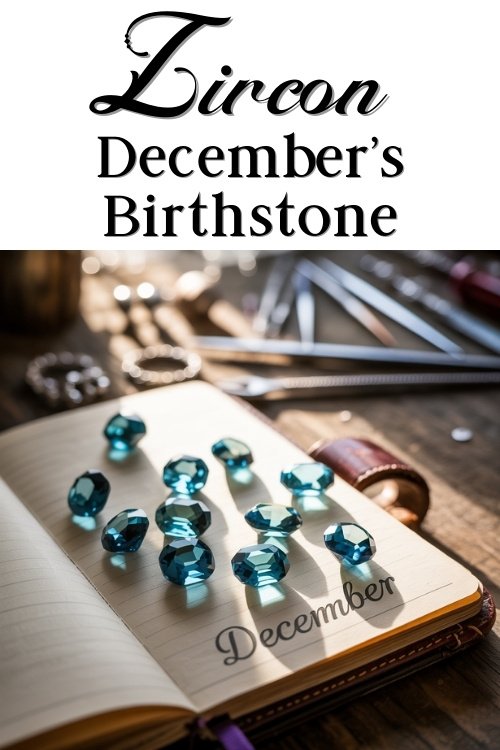
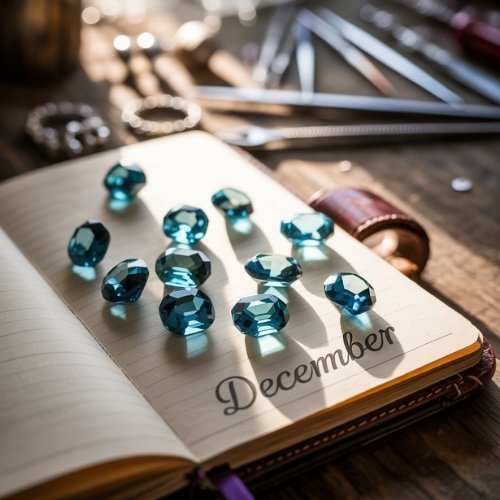
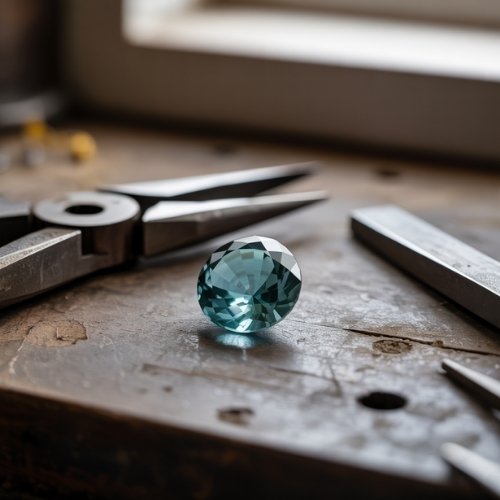
December is the month of fairy lights, tinsel and anything that sparkles. So it’s only fair that one of its birthstones is a gem famous for its fire. Blue zircon brings a cool, icy blue and a flash that can give diamond a run for its money.
It’s also one of the most misunderstood gems on the birthstone list. Zircon gets mixed up with cubic zirconia (CZ) all the time, thanks to the similar name. But zircon is completely natural, and some of its crystals are older than almost anything else on the planet.
So let’s explore why zircon is the birthstone for December, the stories it has gathered over the centuries, and what to look for when you’re buying one.
Jump to:
Why Zircon is the Birthstone for December
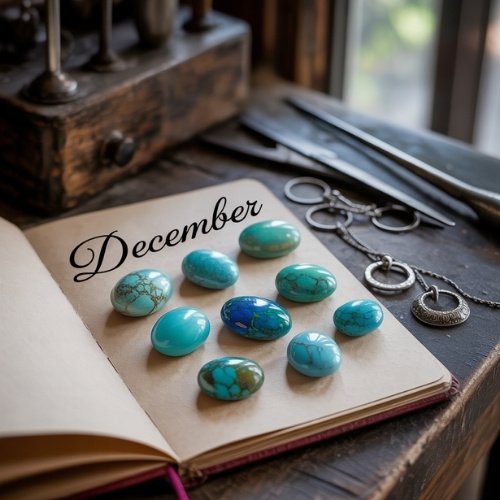
December is one of only a few months with three official birthstones. Turquoise came first, followed by zircon 40 years later, and much more recently tanzanite.
When the American National Association of Jewelers published the first standard birthstone list in 1912, December got turquoise, with lapis lazuli as its alternative. In 1952 the Jewelry Industry Council of America revised the list, and decided zircon should replace lapis lazuli. Tanzanite then joined them both in 2002.
When people talk about zircon as December’s birthstone, they usually mean blue zircon. It’s easy to see why it was chosen. Its colour sits happily alongside turquoise and those pale winter skies, and it adds something turquoise can’t, real sparkle. For a month spent under twinkling lights, a bright, fiery gem next to the opaque turquoise makes a lot of sense.
Interestingly, December is the month the UK and US seem to disagree the most on. For the UK December’s main stone is tanzanite, with blue topaz as the only alternative.
🔗 Explore the History of Birthstones to learn more about this timeless tradition
History and Lore of Zircon
The name zircon most likely comes from the Persian word zargun, meaning gold coloured. Today we know zircon comes in a whole rainbow of colours, but whoever named it probably had no idea. That’s true of a lot of gemstones. Before modern testing equipment, people identified gems by their colour and appearance alone.
As well as its main name, zircon picked up a fair few trade names along the way too. Red, orange and brown stones were called hyacinth or jacinth. Yellow and colourless stones were called jargoon. And have you heard of Matara diamond? It was actually colourless zircon from Sri Lanka.
As for this stone’s lore, in Hindu tradition, zircon is sometimes said to form the trunk of the Kalpa Tree. This is the glittering, wish-fulfilling tree that rose from the churning of the cosmic ocean. In Sri Lanka, travellers carried zircon as a talisman for safe journeys. In medieval Europe, the reddish orange hyacinth variety was worn as an amulet. It was believed to guard against evil, bring honour and wisdom, and encourage restful sleep.
More recently, the Victorians loved zircon. Colourless stones were popular as a diamond alternative, and fine blue zircons turn up in English jewellery from the 1880s. Across the Atlantic, Tiffany’s famous gem buyer George Kunz was a big fan too. He even suggested giving blue zircon its own name, starlite, to show off its fiery sparkle. Sadly, the name never caught on.
🔗 Dive deeper into more zircon stories in Zircon Myths and Legends
The Zircon Birthstone’s Meaning, Symbolism, and Energy
Those medieval beliefs still echo in how zircon is described today. It’s widely associated with clarity, wisdom and grounding. A sparkly stone that’s said to keep your feet firmly on the ground.
In crystal traditions, blue zircon is linked to the throat chakra and is believed to support calm, honest communication and inner peace. Warmer golden and brown zircon is connected with the solar plexus and root chakras. It’s said to encourage confidence, motivation and stability.
For December, that mix fits rather nicely. It’s a month for looking back over the year and heading into January with a clearer head.
🔗 Discover the Symbolic and Spiritual Meanings of Zircon
Shades, Varieties, and Buying Tips
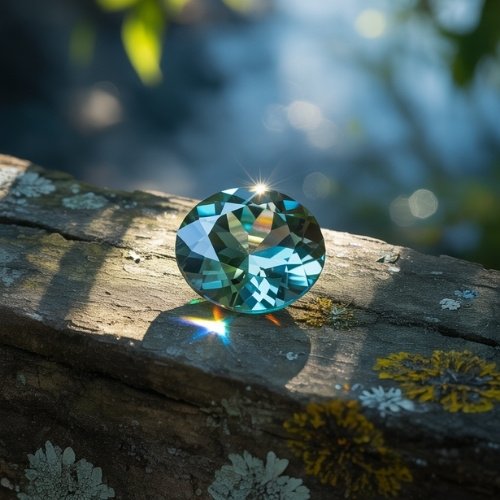
Blue is December’s colour, but zircon comes in a surprisingly wide range. You’ll find it in blue, colourless, golden yellow, orange, red, brown and green, and occasionally pink or purple. Basically, it can be any colour.
Blue Zircon: December’s Signature Shade
Here’s the part that surprises a lot of buyers. Almost all blue zircon started life brown. Heating it in a controlled, low-oxygen environment turns it a bright, slightly electric blue.
The treatment is standard in the trade and considered stable, but heated stones can be a little more brittle. It’s worth assuming any blue zircon you buy has been heated, and letting your customers know.
Other Zircon Colours
Golden and colourless zircon are often heated too, but this time with plenty of oxygen. Strongly saturated red zircon is rare and can fetch premium prices. Many green zircons are what gemmologists call “low” zircon (natural radiation has slowly broken down the crystal structure, softening the sparkle).
Tips for Jewellers
Look for the doubling. Zircon is strongly doubly refractive (light splits into two rays as it passes through the stone). Look through the table, the large flat facet on top, at a slight angle and you’ll often see the back facet edges doubled.
Mind the edges. Zircon sits between 6 and 7.5 on the Mohs scale, but it’s brittle and its facet edges chip easily. Loose stones rubbing together in a parcel can wear each other’s edges down, which the trade calls “paper wear”. Keep them wrapped separately.
It’s heavy. Zircon is one of the heavier stones you’re likely to work with. Its specific gravity (how heavy it is compared to the same volume of water) can reach 4.73, meaning it can come up a bit smaller than its carat weight suggests. For instance a 1 ct round zircon would be about 5.81mm across, whereas a 1 ct round sapphire would be wider at around 6.15mm.
Choose a protective setting. Bezels and halos are kind to zircon, especially in rings. Earrings and pendants are safer choices for everyday wear. Go gently when tightening claws, as heat-treated stones can be more brittle.
Clean it gently. Warm soapy water and a soft brush are all it needs. No ultrasonic or steam cleaners, and avoid sudden changes in temperature.
Know your zircon from your CZ. Zircon is a natural zirconium silicate. Cubic zirconia is a man-made zirconium dioxide. The names are similar, but they’re completely different materials.
🔗 Working with zircon at the bench? Have a read of my Jeweller’s Guide to Zircon
Fun Facts About Zircon
- Zircon is the oldest known mineral on Earth. Tiny crystals from the Jack Hills in Western Australia are around 4.4 billion years old, and have been used by geologists to help determine how old the planet is.
- Its fire (or sparkle) comes surprisingly close to diamond’s. Zircon’s dispersion (how strongly it splits white light into rainbow flashes) is 0.038, while diamond’s is 0.044.
- One of the rocks brought back by the Apollo 14 astronauts in 1971 contains zircon that may have formed on Earth. The theory is that an asteroid impact blasted it off the Earth, and it landed on the Moon.
Alternatives for December’s Birthstone
Turquoise is the US’s original December birthstone. It’s an opaque, sky blue stone with thousands of years of history behind it.
Tanzanite is the newest of the three, bringing a rich violet blue. It was only discovered in Tanzania in the 1960s.
Blue topaz isn’t on the US list, but it’s the official alternative in the UK. It gives a similar icy blue to zircon, at a friendly price.
Zircon’s Enduring Place in December Birthstone Lore
Zircon might be the most underrated stone on the birthstone list. It’s older than the ground beneath your feet, it’s gone by more aliases than a spy in a novel, and it has more fire than nearly any other birthstone.
For jewellers, it’s a gem that rewards a little care. Set it thoughtfully, store it safely and clear up the CZ mix-up, and you’ve got a stone with real sparkle and a proper story behind it. For a month full of frost, fairy lights and celebration, blue zircon feels like exactly the right fit.
🛍️ Interested in using pre-owned zircon in your next design? View our current Zircon selection
📌 Don’t forget to save this guide to December’s birthstone, zircon, so you can find it again.