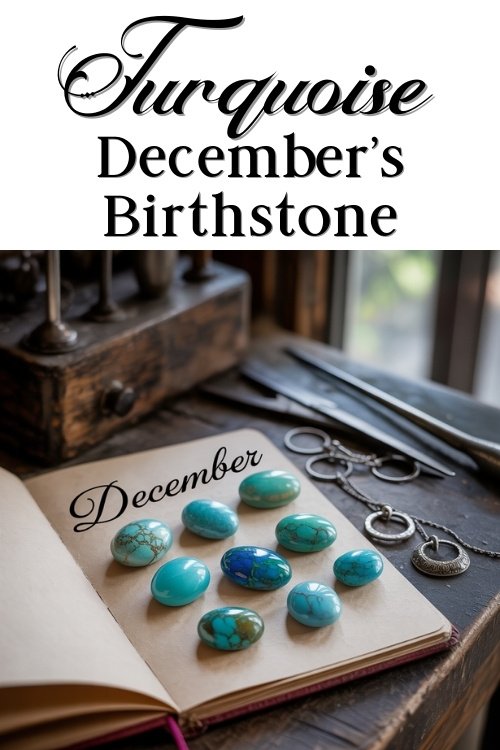
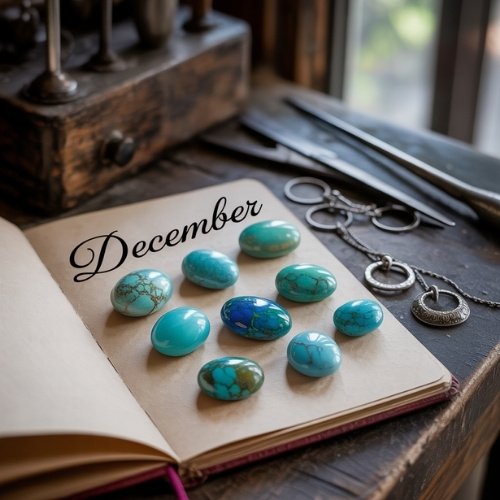
December brings short days, frosty mornings, and skies that shift from pale grey to deep winter blue. Its birthstone reflects that sky perfectly. Turquoise has been treasured for thousands of years, and its calm, sky-like colour makes it one of the most instantly recognisable gemstones in the world. While zircon and tanzanite also sit on the modern December birthstone list, turquoise remains the month’s original and most enduring stone.
Why Turquoise is December’s Birthstone
Turquoise is one of the oldest gemstones used in jewellery anywhere in the world. It has been worn and mined for thousands of years, long before anyone thought to assign gemstones to birth months. Given its ancient roots it’s no surprise turquoise appeared on the birthstone list right from the start.
The modern birthstone system was standardised in 1912, when the American National Association of Jewelers published a unified list. Turquoise was named as December’s birthstone from the very first published list, alongside lapis lazuli as a secondary option.
That list has changed a little since it was first written. In 1952, zircon replaced lapis lazuli as December’s alternative stone. Then in 2002, the American Gem Trade Association added tanzanite, giving December three official birthstones in total. Turquoise, though, has never lost its place as the primary stone for the month.
🔗 Explore the History of Birthstones to learn more about this timeless tradition
History and Lore of Turquoise
Turquoise is one of the oldest gemstones used by humans. The earliest known beads, found in Iraq, date back around 7,000 years, and Egyptian tombs have revealed turquoise jewellery dating back roughly 5,000 years. It was even set into Tutankhamun’s burial mask. The ancient Egyptians called turquoise mefkat, meaning joy and delight, and mined it in the Sinai Peninsula from the earliest dynastic periods onwards.
In Persia, turquoise was considered a national treasure. It was known as firouzeh and was set into daggers, horse bridles, and turban ornaments, prized as a symbol of victory and protection. The most sought after shade, a pure sky blue with no green undertone, is still called Persian blue today, named after this ancient source.
The name turquoise itself comes from the French word for Turkish, a nod to the trade routes through Turkey that first carried the stone into Europe, even though it was never actually mined there.
Turquoise also holds deep significance across the Americas. The Aztecs and Maya used it in ceremonial mosaics and masks. In the American Southwest, turquoise has been mined and worked for centuries, and remains central to Navajo, Zuni, and Hopi jewellery today, where it is valued for its protective and spiritual meaning.
🔗 Dive deeper into Turquoise Myths and Legends
Meaning, Symbolism, and Energy
Turquoise is widely associated with good fortune and communication. Its calming blue tones have long been linked to peace of mind and honest expression. In many cultures, turquoise was worn or carried as a protective talisman. Warriors were said to carry it into battle for safekeeping, and travellers wore it to guard against accidents on long journeys.
In crystal healing traditions, turquoise is connected to the throat chakra, believed to support clear communication and self expression.
There is also an old piece of folklore worth knowing. Turquoise was once believed to change colour as a warning, paling if its wearer fell ill and returning to full colour once they recovered, or if the stone passed to a new owner. In reality, turquoise can genuinely shift in tone over time. It is a porous stone, and prolonged contact with skin oils, perfumes, and sweat can gradually alter its colour. This colour changing belief likely grew from this very real property of the stone.
🔗 Discover the Symbolic and Spiritual Meanings of Turquoise
Varieties, Colours, and Buying Tips
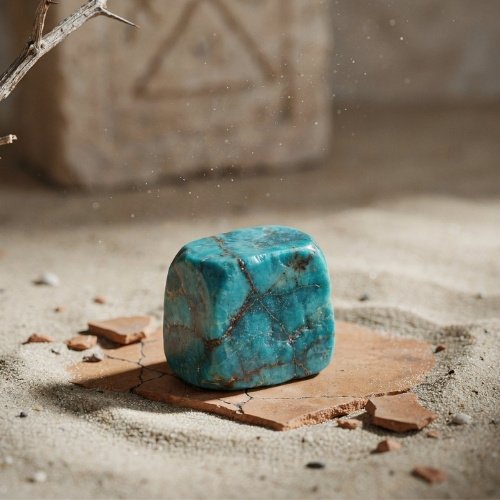
Turquoise ranges from soft sky blue through to deeper greenish blue tones. Its colour comes from trace elements within the stone. Copper produces the classic blue, while iron shifts the colour towards green and zinc can add a more yellow undertone. The most prized colour remains Persian blue, a clean, saturated sky blue without green overtones. Robin’s egg blue is another highly desirable shade.
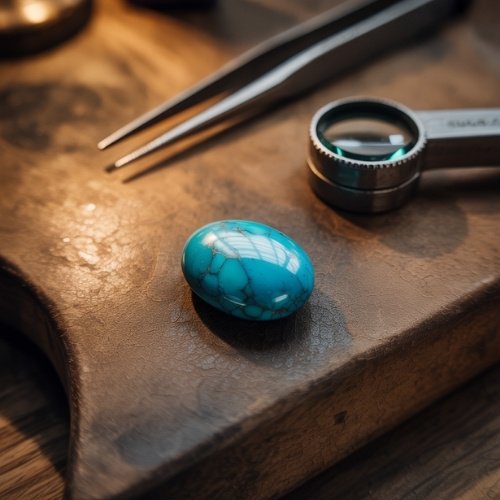
Many turquoise stones also display a natural webbing pattern known as matrix, thin veins of the surrounding host rock left within the gem. Some buyers love a strong matrix for its character (myself included), while others prefer clean, unmarked stones. Neither preference is better or correct, both are simply a matter of personal taste.
Turquoise is quite soft for a gemstone, sitting at around 5 to 6 on the Mohs scale, and it is naturally porous. Because of this, treatment is extremely common in the trade. Stabilisation, where the stone is treated with resin to strengthen it and reduce porosity, is by far the most widespread treatment and is generally considered acceptable practice, provided it is disclosed. Waxing and dyeing are also used, to enhance the colour and improve the stones appearance after the final polish.
Because turquoise is porous, it also needs a little extra care. Avoid perfumes, lotions, and household chemicals, and remove turquoise jewellery before swimming or washing up. Clean it gently with a soft, dry cloth rather than soaking it in water.
🔗 Working with turquoise gemstones? Have a read of my Jewellers Guide to Turquoise
Fun Facts About Turquoise
- Turquoise has been mined at Nishapur in Iran for well over a thousand years, and the site is still producing stone today.
- Turquoise is one of relatively few gemstones to lend its name to a colour. The mineral name came first, brought into English via French during the 1300s, with the colour name following in the late 1500s.
- Turquoise found its way into Victorian serpent jewellery, where it symbolised fidelity and was sometimes said to fade if a wearer’s love faltered, a piece of folklore made popular by Queen Victoria’s fondness for the stone.
Modern Alternatives for December
Zircon offers a striking alternative, with a diamond-like sparkle and a colour range that includes vivid blues alongside golden and colourless varieties.
Tanzanite, the newest of December’s birthstones, brings a rich violet blue that is entirely modern by comparison, having only been discovered in Tanzania in the 1960s.
Both are beautiful stones in their own right, but turquoise, with its thousands of years of history and unmistakable colour, remains the true heart of December’s birthstone story.
Turquoise’s Enduring Place in December Birthstone Lore
Turquoise carries more history than almost any other gemstone in regular use today. From ancient Egypt to Persia, and from Native American craftsmanship to Victorian sentiment jewellery, it has meant something different to nearly every culture that has worked with it, yet its core reputation for protection and calm has never really changed. For a month defined by short days and long nights, turquoise offers its wearers a little piece of clear winter sky to hold onto.
🛍️ Interested in using pre-owned gemstones in your next design? Browse our current selection
📌 Save this post so you can revisit Turquoise, December’s Birthstone, whenever you need inspiration.