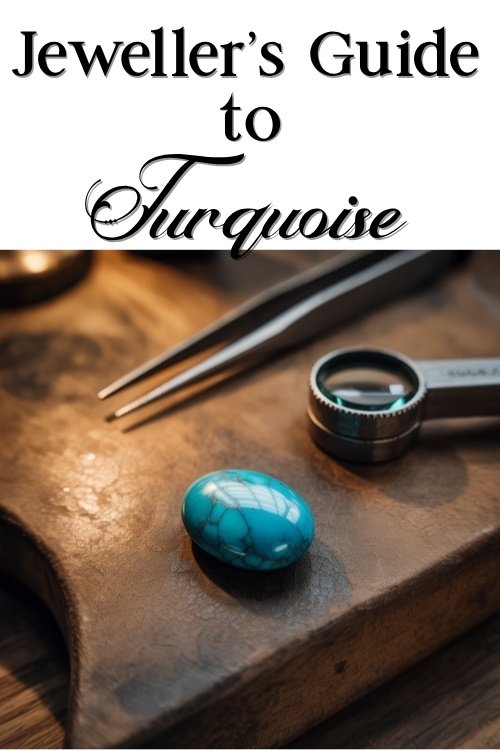
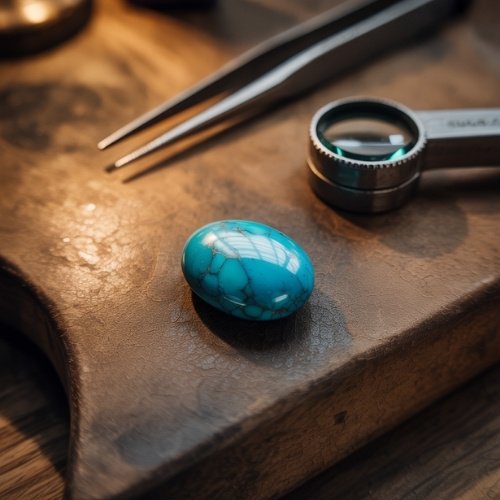
Turquoise has been interesting humans for thousands of years, and it is easy to see why. That distinctive blue that ranges in tone from a vivid sky blue to softer, greener tones flecked with earthy matrix, carries a warmth and depth that no other gem quite replicates. It’s one of the most recognisable gemstones in the world.
Basic Identification Information
Name and Synonyms
Turquoise
Sometimes referred to historically as callais (the term used by Pliny the Elder)
Species
Turquoise
Colour Range
light to medium Blue, greenish Blue, Green, bluish Green, blue-green, green-blue
(Often with black or brown matrix or spider web veining)
Refractive Index
1.610 – 1.650
Birefringence
None
Optical Sign
Aggregate (AGG)
Pleochroism
None
Specific Gravity
2.40 to 2.90
Fluorescence
SWUV: Inert.
LWUV: Inert to weak greenish yellow or blue.
Lustre
Waxy to vitreous
Clarity / Transparency
Typically opaque, but may be semitranslucent in thin sections.
Gems Often Mistaken For
Variscite, chrysocolla, amazonite, apatite, and dyed howlite or magnesite (see Simulants section below)
Mohs Hardness
5 – 6
🔗 Want to know how the information above is used to identify a gemstones? Read Gemstone Identification: How I Actually Test Gemstones
Spotting Simulants and Imitations
Turquoise is one of the most widely imitated gemstones on the market. There are natural gems that are dyed to look like it, glass and plastic imitations and lab-grown synthetic stone. Below I’ll go through each one to help you know what to look for.
The most widespread natural simulants are dyed howlite and dyed magnesite. Both are absorbent white minerals that takes dye readily, making them a convincing lookalikes for turquoise. Although the dye tends to produce too uniform a colour. Both gems also have natural webbing that closely resembles the matrix veining seen in genuine turquoise, making these stones particularly deceptive.
For identification, a refractometer is your first port of call, as howlite and magnesite have different refractive indices to turquoise and can be quickly separated with this test. If you need to go further, an acetone test on an inconspicuous area can often reveal dye (natural colouring wont turn the cotton swab blue). Or a scratch test can be done as both are significantly softer materials, meaning they scratch more easily than the genuine article.
Glass and plastic imitations also appear on the market. Glass typically has far greater translucency than genuine turquoise, and both materials may lack matrix veining entirely, or if it is present, it will often be drawn on rather than running deep into the stone. Other signs to look for include bubbles or flow lines visible just below the surface, and marks on the base suggesting the piece was poured into a mould rather than cut. A heated needle test can identify plastic specifically, which will melt and produce a distinctive smell, whereas genuine turquoise will not.
Finally, lab-grown synthetic turquoise exists and is worth knowing about. While it will have the same RI readings as natural turquoise, under magnification synthetic turquoise typically shows tiny blue microspheres giving it a granular appearance, sometimes described as resembling cream of wheat. It may also display blue thread-like inclusions and an artificial black matrix that sits flush and even with the polished surface, lacking the organic irregularity of natural matrix veining.
Common Treatments
Historically, less than around 10% of all excavated turquoise had the hardness and density to be considered gem quality. The rest requires some form of treatment to be usable in jewellery. Today, turquoise is nearly always treated in some way with some researchers estimate that up to 98% of the turquoise on the market has undergone some form of treatment or enhancement.
Waxing and Oiling
Historically, waxing and oiling were the first treatments used, providing a wetting effect that enhanced colour and lustre. This is more or less acceptable by tradition, and is still seen today, particularly on higher-grade material. The main drawback is that the finish is temporary and will wear away over time.
Stabilisation
Stabilisation is by far the most common treatment and is widely considered an acceptable and standard practice within the trade, provided it is disclosed. Natural turquoise is porous, and those tiny openings in its structure invite oils, lotions, and even humid air to creep in over time, darkening the colour and causing cracks. During stabilisation, turquoise is placed in a vacuum chamber where clear resin is drawn deep into those pores and cured with gentle heat, so the resin locks inside the gem rather than simply forming a surface coat.
The result is a harder, more durable stone that holds its colour well and takes a much better polish. Stabilisation takes nothing away from the turquoise and does not add any colour. It is a permanent treatment, and much of the high-quality, sought-after turquoise available today, including many American mine varieties, has been stabilised.
Dye Treatment
Sometimes the resin used during stabilisation is tinted with dye to boost or alter the stone’s colour. When this happens the stone should be categorised as dyed rather than simply stabilised. Dyeing is also carried out independently on lower-grade material. It is generally considered a less desirable treatment because it can mislead buyers, and colour may fade over time. It is also the process responsible for creating unnatural coloured stones such as “purple turquoise,” which is not a naturally occurring variety.
Reconstitution
Reconstitution involves taking low-grade or off-cut turquoise material, grinding it down into a powder, and then mixing that powder with a binding agent such as resin or epoxy. The resulting mixture is moulded into blocks and then cut and polished into cabochons or beads. There is usually very little actual stone in the final product, which consists mostly of resin and dyes, and it is often sold under the name block turquoise. It is considerably cheaper than both natural and stabilised turquoise.
Durability and Setting Considerations
Wearability
Fair to good, depending on treatment status and setting choice
Turquoise is almost always cut as a cabochon or bead, partly to showcase its colour and matrix, and partly because its aggregate structure does not produce the kind of brilliance that suits faceting. While it doesn’t have cleavage it can still chip so protective settings such as bezels are still a sensible choice, particularly for rings, as they shield the edges of the stone from knocks.
Whether the stone has undergone treatment also needs to be considered when planning your designs and aftercare advice. Stabilised turquoise is considerably more suitable for everyday jewellery, which is one reason why its use in the trade is so widespread. Untreated turquoise is softer and more porous, meaning it can be susceptible to scratching and to discolouration from absorbed oils and fluids over time, so it should be set into occasion wear pieces and, if used in a ring, removed before washing hands.
Care Instructions
Cleaning
Warm soapy water and a soft brush are the safest option for cleaning turquoise jewellery. High heat can cause discolouration and breakage, so steam and ultrasonic cleaners should be avoided.
Storage
Store turquoise separately from harder gemstones such as sapphire, ruby, or diamond to prevent surface scratches. A soft pouch or lined jewellery box is ideal.
Daily Wear
Turquoise may be discoloured by chemicals, cosmetics, skin oils, and perspiration, so it is a good idea to put jewellery on last and remove it before applying lotions, perfume, or using cleaning products. Natural untreated turquoise is particularly susceptible to colour change over time as it absorbs skin oils, though some people appreciate this as a natural ageing process unique to the stone. Stabilised stones are much more resistant to this kind of change.
Market and Ethical Notes
Turquoise is found in only a few places, in dry and barren regions where acidic, copper-rich groundwater seeps downward and reacts with minerals containing phosphorus and aluminium. Key sources include Iran (historically the most prized, particularly the Nishapur region), the American Southwest including Arizona and Nevada, China, Mexico, and parts of Central Asia.
Richness of colour is the chief determinant of value. The most desirable colour is a strong sky blue to robin’s egg blue, sometimes called “Persian blue” in the trade. Value generally decreases with an increase of green hue, lightening of colour, or heavy mottling. The presence or absence of matrix also affects value, though some buyers actively seek out well-patterned spiderweb matrix, particularly in Native American jewellery traditions.
As with many gemstones, the turquoise market has significant transparency challenges. The sheer volume of treated, imitation, and mislabelled material means that sourcing from reputable, knowledgeable suppliers is particularly important. When buying turquoise, always ask for disclosure of any treatments, and be cautious of stones sold at very low prices.
Symbolic and Spiritual Meanings
Birthstone
December
Anniversary
11th wedding anniversary
Few gemstones carry as rich a symbolic history as turquoise. Its use in Egypt stretches back as far as the First Dynasty and possibly earlier, where it was associated with the goddess Hathor and used in everything from jewellery to inlay work. In fact, the ancient Egyptians valued it so highly that turquoise became arguably the first gemstone ever to be imitated, with faience, a glazed ceramic material, created specifically to replicate its colour.
Across cultures, turquoise has long been regarded as a protective stone. Ancient Persians wore it to guard against unnatural death, dating back to the 13th century it was thought to protect the wearer from falling, and Native American traditions connect it deeply to rain, the sky, and good fortune. The Navajo believed turquoise would bring a rich harvest of rain, while warriors are said to have attached turquoise to their bows to improve their aim.
🔗 Curious about how else turquoise was viewed in ancient cultures? Explore its fascinating myths and legends
Today, turquoise is associated with freshness, tranquillity, intuition, serenity, creativity, emotional balance, and loyalty. It is frequently linked to the throat chakra and to honest, clear communication. For centuries it has been known as a stone of luck and protection, said to promote calmness, clarity, and inner balance, making it a popular choice for those drawn to gemstones with meaning and intention behind them.
🔗 Dive deeper into Turquoise’s Symbolic and Spiritual Meanings
Etymology
The word turquoise dates to at least the 14th century and is derived from the Old French turquois, meaning “Turkish,” because the mineral was first brought to Europe through the Ottoman Empire from the mines of historical Persia. It’s one of the very few minerals whose name has also become a colour name, so characteristic and well-known is its hue.
🛍️ Looking for a sustainable gemstone for your next jewellery creation? Check out our selection of pre-owned gems
📌 Save this jeweller’s guide to turquoise for quick reference next time you are working with this beautiful and ancient stone.