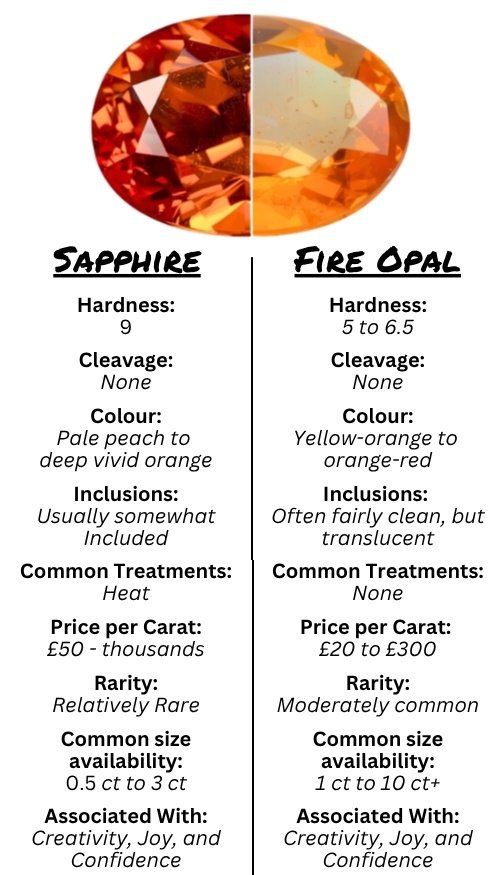
Fire opal and orange sapphire share a warm, fiery palette, but in most cases they’re easy enough to tell apart at a glance. When fire opal displays its characteristic play-of-colour there’s no real room for confusion. But it’s common quiet for fire opal to not have those extra flashes of colour. That’s why in this guide I’m focusing on the trickier scenario, fire opal without play of colour, which sits firmly in the same visual territory as an orange sapphire. That’s where knowing your gemmology matters.
Whether you’re a jeweller sourcing orange stones for a commission or a collector trying to make sense of what you’ve got, here’s everything you need to know about these two orange gemstones.
How to Tell Them Apart: Visual and Gemmological Clues
Visual Clues
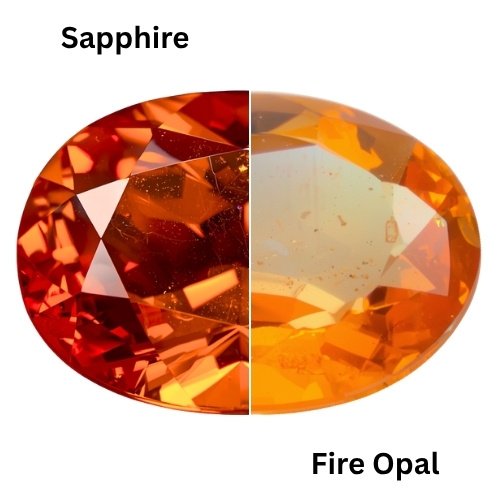
Side by side, these two gems can look remarkably similar when fire opal shows no play of colour. Both can be a vivid, transparent orange. Both can be faceted. Both can look warm and glowing in good light.
That said, there are visual habits that can steer you in the right direction. Fire opal tends toward a slightly warmer, more resinous quality. Its translucency is often described as glassy or jelly-like, and the colour can feel as though it’s lit from within. It typically sits in the orange to orange-red range, but sometimes will lean toward yellow-orange. Fine material from Mexico, which is the most celebrated source, often has an almost luminous quality.
Orange sapphire tends toward a cleaner, crisper brilliance, which comes down to its much higher refractive index. It can span a wider range of tones, from a pale peachy orange right through to a deep, saturated burnt orange. Fine material often has a velvety depth that fire opal doesn’t quite match.
If the stone in front of you has strong sparkle and brilliant facet flash, sapphire is the more likely candidate. If it feels warmer and more glowing with less sharp brilliance, fire opal is worth considering.
Gemmological Tests
| Property | Fire Opal | Orange Sapphire |
|---|---|---|
| Refractive Index (RI) | 1.370 to 1.470 | 1.757 to 1.779 |
| Birefringence | None | 0.008 to 0.010 |
| Pleochroism | None | Strong 2 colours (Orange/Yellow-Brown or Orange/Colourless) |
| UV Fluorescence | None to Strong greenish Brown or White | None to Strong Red, Pink, Yellow, or Orange |
| Optical Character | Singly refractive (can show Anomalous Double Refraction) | Doubly refractive, uniaxial negative |
| Specific Gravity | 1.25 to 2.23 | 3.95 to 4.10 |
Although specific gravity is always tested on faceted gems (it’s more accurate the bigger the stone so tends to be a more routine test for rough material), I included it above due to the large difference between these two gems. Sapphire is noticeably heavy for its size, while fire opal feels much lighter. If you have a loose stone and a calibrated scale, this is a useful check. The refractive index readings and optical character are also completely non-overlapping, so a refractometer will give you a clear answer immediately.
🔗 Want a deeper dive into working with these gems? Head to their individual guides:
A Jeweller’s Guide to Fire Opal
A Jeweller’s Guide to Sapphire
Colour
Orange sapphire gets its colour from a combination of iron and chromium within the corundum crystal structure. It can be found in any shade of orange, but the finest examples, often called padparadscha when they tip toward a pink-orange, are among the most coveted sapphires in the world. The gemstones shade tends to stay consistent across different light sources, so if you have a bold fiery orange sapphire in daylight, it’ll look bold and fiery under artificial lighting too.
Fire opal’s orange comes from iron oxide being present within its silica structure. The colour can shift noticeably between natural and artificial light, often appearing more intense in sunlight. The best material from Querétaro in Mexico produces a vivid, almost electric orange that has made Mexican fire opal famous.
Clarity and Inclusions
Orange sapphire is a Type 2 gemstone, meaning some inclusions are expected but eye-clean examples are not uncommon. Typical inclusions include silk (fine rutile needles) which can give the stone a velvety feel, fingerprints, and needles of various minerals. Inclusions can affect value significantly, but a lightly included stone with strong colour is still very desirable.
As fire opal is usually translucent, it doesn’t have an official clarity type. Good quality material can be quite eye clean, but still often has a softness to its appearance. As opals tend to form in cavities inside host rocks, it can have grains of grit or sand inside it, or even some areas of host rock, although a good quality gem will have had anything like this cut away.
How They Form
Orange sapphire is a variety of corundum, the same mineral family as ruby. It forms in metamorphic and igneous environments where aluminium-rich rocks are subjected to high temperatures and pressures. Major sources of orange sapphire include Sri Lanka, Madagascar, Australia, and Tanzania.
Fire opal forms through a completely different process. It is a non-crystalline hydrated silica that precipitates from silica-rich water moving through volcanic rock. It’s found in Mexica, Ethiopia, and Australia, but Mexico’s deposits, which form in rhyolite volcanic rock, has a distinct character.
Durability and Wearability
This is one of the most important practical differences between these two gems.
Orange sapphire scores 9 on the Mohs scale, making it one of the hardest gemstones available. It has no cleavage and excellent toughness, which makes it well suited to almost any jewellery type, including rings worn daily.
Fire opal scores between 5 and 6.5 on the Mohs scale and is considerably more fragile. Its amorphous structure and water content make it sensitive to heat, low humidity, and sudden temperature changes. It can craze, crack, and lose colour under stress. For jewellery, fire opal is best suited to pendants, earrings, and low-impact rings with protective settings. It should be kept away from ultrasonic cleaners, steam, and prolonged exposure to dry conditions or direct sunlight.
Price Comparison
Orange sapphire occupies a wide price range. Commercial quality stones start at around £50 per carat, while fine, untreated material with vivid colour and good clarity can reach several thousand pounds per carat. Origin plays a role too, with Sri Lankan stones often commanding a premium.
Fire opal is generally more accessible. Good quality transparent material typically ranges from around £20 to £300 per carat, with exceptionally vivid, clean stones at the upper end.
Size and Availability
Orange sapphire is available across a wide range of sizes, though large stones with fine colour become increasingly rare and expensive above 5 carats. Smaller stones of 0.5 to 3 carats in good quality are reasonably accessible.
Fire opal is available in a wide range of sizes. It’s more commonly seen as a cabbed stone, but there’s still plenty of faceted examples available. It’s usually found in sizes from under 1 carat up to 10 carats or beyond. The limiting factor tends to be the mining process, as opal is quiet fragile so the seams of it tend to break apart into chunks as it’s being extracted.
Cut and Shape
Orange sapphire is typically cut to maximise colour saturation and brilliance, with ovals, cushions, and rounds being the most common shapes. The cutter will orient the stone to show the best colour through the table.
Fire opal presents more of a challenge to cut. Its relative softness, sensitivity to heat from polishing friction, and the need to orient the stone to best display its colour all require careful handling. Ovals and cushions are most common. Cabochon cutting is also used, particularly for material that is not fully transparent or that shows a hint of play of colour.
Rarity
Fine orange sapphire is genuinely rare and has become more so as demand for coloured gems has grown. The combination of vivid orange colour, good clarity, and untreated status is particularly hard to find.
Fine fire opal, particularly the vivid, transparent, deeply coloured material from Mexico, is also rarer than its general availability might suggest. Commercial-grade material is widely available, but genuinely fine fire opal is a different proposition.
Symbolic and Spiritual Associations
Orange sapphire carries associations with creativity, joy, and confidence. Corundum as a family has long been linked to wisdom and clarity of thought, and the warmth of the orange variety gives it a particular connection to joy and enthusiasm.
Fire opal is also associated with creativity, joy, and confidence. Its vivid colour and fiery nature have also led to associations with passion and motivation.
🔗 Discover the deeper meanings behind these gems:
Symbolic and Spiritual Meanings of Fire Opal
Symbolic and Spiritual Meanings of Sapphire
Comparison Summary
| Property | Orange Sapphire | Fire Opal |
|---|---|---|
| Hardness | 9 | 5 to 6.5 |
| Cleavage | None, excellent toughness | None, but fragile |
| Colour | Pale peach to deep vivid orange | Yellow-orange to orange-red |
| Commonly Included? | Type 2, commonly somewhat included | Often fairly clean, but translucent |
| Common Treatments | Commonly heat-treated | Rarely treated |
| Typical Retail Price per Carat | £50 to several thousand | £20 to £300 |
| Rarity | Relatively rare | Moderately common |
| Large Sizes (5 ct+) | Available but costly | Fairly accessible |
| Associated With | Creativity, Joy, and Confidence | Creativity, Joy, and Confidence |
Fire opal and orange sapphire make an interesting comparison precisely because their surfaces look so similar while their underlying nature is so different. One is a hard, durable corundum that will handle daily wear without complaint. The other is a hydrated silica gel with an inner glow that needs a little more looking after. Knowing which you’re working with shapes every decision, from setting style to care advice and pricing conversations with clients.
🛍️ Looking for a sustainable orange gemstone for your next project? Explore our pre-owned orange gems
📌 Save this comparison for your bench reference.