Buying gemstones online opens up a whole world of stones you’d never come across locally, and that’s genuinely exciting. But it does come with risks. Not every seller is reliable, and a misleading listing can leave you disappointed and out of pocket. That’s why being able to spot misleading gemstone listings is so important.
Whether you’re sourcing stones to set into your next jewellery piece or building up a collection of beautiful gems, it helps to know what to watch out for. So here are the red flags I’d suggest keeping an eye out for.
- The Photographs
- Too Perfect in Appearance
- Parcel or Lot Listings with a “Hero” Stone in the Photos
- Poorly Written or Inconsistent Descriptions
- Missing or Vague Measurements
- No Information About Treatments
- Misleading Terminology: Simulated vs. Synthetic
- If The Price Seems Too Good To Be True…
- Unrealistic Origin Claims
- Gem Reports and Certificates
- Seller History and Feedback
- No Return Policy or Unclear Seller Information
- A Final Word
The Photographs
We’ve all seen them, those listings that use the exact same photo as half a dozen other sellers, or a glossy image of a towering pile of faceted gems that look more like boiled sweets than actual stones. A genuine listing should show real, unedited photos of the actual gems you’ll be buying. Ideally in natural lighting, or at least a note in the description letting you know what type of artificial light was used. And for a photograph gold star, there should be an image of the gem being held so you can get a feel for the size of the gem, and know how true the photograph’s colouring is.
Similarly, take a close look at the gemstones colour in the photographs. Do the tones match what you’d expect of that gem type? It could be the stone is dyed or colour coated, but it could also mean the seller’s edited the photos. Turning up the saturation to make a pale gem look more intense then it actually is, or really upping the brightness so a darker stone looks more vibrant.
Too Perfect in Appearance
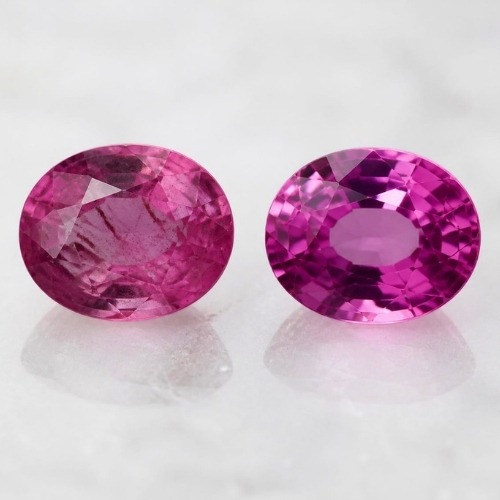
This is where a little bit of gem knowledge can go a long way. While some gem types are commonly eye clean, most natural gemstones will have at least a few inclusions or some colour zoning. Those features that are often seen as imperfection can bring reassurance when shopping (and I think they bring charater to the gemstone too). So if you come across a flawless emerald or sapphire, so take a moment to double check if that’s normal for the gem type and if the price seems about right if flawlessness is rarity.
🔗 Check Gemstone Clarity Explained for the clarity levels of commonly seen gemstones
Parcel or Lot Listings with a “Hero” Stone in the Photos
This one catches a lot of people out. The photos show a gorgeous specimen. Perfectly cut, lovely colour, exactly what you’re looking for. But buried in the listing description is a sentence along the lines of “actual stone is random selection from stock” or “similar to shown.” While many sellers do send out stones that look very similar to the one on the photo, there are sellers out there who photograph a high quality gem then send out ones that are a lower quality.
Poorly Written or Inconsistent Descriptions
The details in a listing matter, and so does the way they’re presented. Things to look out for include:
- Conflicting information. For example, if the weight stated in the title is different from the weight in the description. Honest mistakes and typos happen (even I’ve been guilty of this on occasion!), but if you spot one, it’s always worth asking the seller to clarify to gems details.
- Weight listed in grams rather than carats. This isn’t automatically suspicious, but it can obscure value comparisons, and scales that only measure in grams, when you’re dealing with little gemstones, just aren’t accurate enough. (Side note – it’s 5 carats to a gram in case you’re wondering)
- Over-the-top claims like “BEST QUALITY GEMSTONE IN THE WORLD!!!” or “AAA+++”. While I understand these sellers are usually trying to make their products sound extra special, claims like AAA+++ for a coloured gemstones doesn’t really mean anything. Unlike diamonds, which have a standardised cut, colour, clarity and carat system, there isn’t a universality accepted quality scale for coloured gemstones, so one seller’s AAA+++ and another seller’s AAAA might be the same quality, or widely different qualities.
- Generally sloppy presentation. The odd typo is human, but if the overall listing feels careless or unprofessional, or the way they present the gemstone details changes every time, tread carefully.
Missing or Vague Measurements
Measurements matter. A good listing should include both the stone’s size in millimetres and its weight in carats. Without both, how do you know you’re not about to receive a 1mm “statement gem”? If the size and weight don’t seem right together, a quick check with a gemstone size chart or calculator will either put your mind at rest or confirm your suspicions.
No Information About Treatments
Most gemstones go through some kind of treatment. Heating, irradiating, fracture filling, oiling, the list goes on. It’s done to bring out the best in that stone and in many cases these treatments are widely accepted in the industry. But just because it’s a common practice that most people don’t mind, doesn’t mean it shouldn’t be disclosed.
Honest sellers will tell you if a stone has been treated, or admit if they’re simply not sure. If a listing avoids the topic altogether, that’s a warning sign worth taking seriously.
Misleading Terminology: Simulated vs. Synthetic
The words sellers use matter more than you might think. Simulated (or imitation) gemstones only look like the real thing. They’re usually the most affordable option. Where as synthetic gemstones are lab-grown gems that share the same chemical make-up as their natural counterparts. They’re more valuable than imitations, but generally less expensive than natural gems.
Some sellers blur the lines between these terms, sometimes out of ignorance and sometimes on purpose to bump up the price of an imitation.
I’ve even had my own experience of this – I purchased a bundle of reclaimed gemstones from a seller who’d listed them as a mix of natural and synthetic gems that turned out to be a mix of natural, lab grown, glass and CZ. When I reached out to her it turned out she simply didn’t know the difference between these terms.
If in doubt, don’t be afraid to ask the seller to define what they mean. While them answering doesn’t guarantee they’re selling honestly, you’ll at least have a better idea of what to expect from your purchase. And a means to judge there honesty when the gem arrives.
If The Price Seems Too Good To Be True…
Who doesn’t love a good deal? But when it comes to gemstones, if the price feels too good, it usually is. Occasionally someone underprices a stone because they genuinely don’t know what they have, but more often than not an unbelievable deal ends with you receiving glass or CZ instead of the rare gem you thought you were getting.
Unrealistic Origin Claims
Where a gem comes from can dramatically affect its value. A Kashmir sapphire, a Burmese ruby, or a Colombian emerald, commands a very different price from the same gem without a notable provenance. If a listing boasts a prestigious origin at a suspiciously low price, take it with a hefty pinch of salt. Unless the seller can back it up with documentation from a trusted lab, it may well be marketing fluff, or SEO bait.
Gem Reports and Certificates
A report from a reputable lab, such as GIA, AGS, IGI, or AGL, adds real trust to a listing, especially when dealing with high-priced gemstones. However, it’s worth being cautious about these reports. Always go to the gem lab’s website and type in the report number to make sure it’s not fake.
I’d also suggest doing a bit of a background check on gem labs you’ve not heard of before. While there are many great smaller gem labs out there, there are also companies that create worthless reports for a living. They don’t ever see or test the gem, they just sell a report number to the gem dealer who then fills in the details themselves.
Another point to keep in mind is the language used to name the report. As a rule a reputable gem lab won’t call it a certificate, they’ll use words like report, attributes, or details, instead. So if the gem comes with a ‘certificate’, chances are that’s come from a less than trustworthy source.
Seller History and Feedback
A seller’s track record tells you a lot. Newly created accounts with no feedback selling high-value stones are worth approaching with extra caution. Yes, everyone has to start somewhere, but it’s reasonable to ask questions and take your time. I’d suggest looking to see if they’ve got a cheap gemstone you can purchase as a test run before committing to a high end ston from an unknown seller. And if they don’t have any entry level stones on offer, unfortunatly you might be better off stearing clear of them.
Perhaps more telling is an established account with a pattern of negative feedback specifically mentioning “not as described” or “not what I expected.” One or two unhappy customers can happen to anyone, and it’s usual to see the odd “smaller then I expected” type comments in reviews, but if there is a recurring theme of unhappy customers, that’s a different matter entirely.
No Return Policy or Unclear Seller Information
A good seller should stand behind their stones. They should be easy to contact, and have a returns policy.
If there’s no return policy, or so many hoops to jump though that it’s almost impossible for you to ever get a refund, that’s a definite red flag. Remember in the UK you have a legal right to a 14 day cooling off period for most online purchases, which starts from when the item arrives. You usually have to pay for the retun postage, but you don’t need to give a reason or justify the return, you just need to reach out to the seller (never send it back without talking to the seller first) and say I want to send this back for a refund. They’re legally obliged to say ok.
A Final Word
Trustworthy gemstone listings are open and transparent. They give you clear details, honest photos, and the information you need to buy with confidence. And while no listing or seller will be 100% perfect with the info they present, a a listing with multiple red flags should set off alarm bells. Remember if you’re in doubt it’s usually best to walk away.
And one final reassurance: asking the seller questions or requesting more photos is always an option. The right sellers will be genuinely happy to help you as they’ve got nothing to hide.
🔗 You might also find How to Spot the Difference Between Real and Fake Rubies a helpful read
📌 Don’t forget to save this guide to spotting misleading gemstone listings so you can find it again.