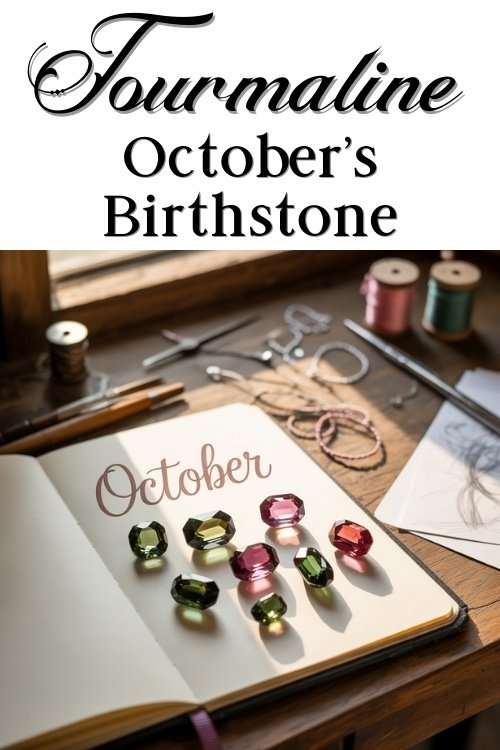
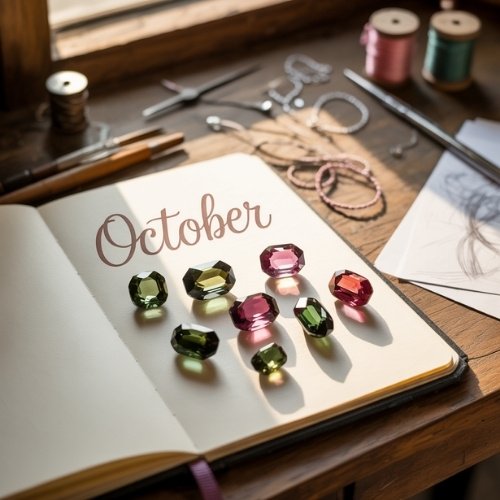
October is a generous month when it comes to birthstones. While opal rightly takes the spotlight as the primary stone, October also claims tourmaline as its second gem, and what a gem it is. If opal is October’s showstopper, tourmaline is its chameleon. A stone of extraordinary colour range, remarkable optical properties, and a history that spans cultures and centuries.
Why Tourmaline is October’s Birthstone
Tourmaline’s place on the birthstone calendar is a relatively recent one. It was added to the official list in 1952 by the American National Association of Jewelers, joining opal as a second option for October. The reasoning was practical as much as symbolic. Opal, for all its beauty, is a delicate stone. Tourmaline offered October babies a more hardwearing alternative without sacrificing any of the colour drama.
Tourmaline comes in virtually every colour imaginable, which means it can echo the rich ambers, deep greens, and vivid pinks of the autumn season just as readily as it can conjure the electric blues of a clear October sky. For a month defined by colour and change, tourmaline fits rather well.
🔗 Explore the History of Birthstones to learn more about this timeless tradition
History and Lore of Tourmaline
Tourmaline has a colourful history in more ways than one. Its extraordinary colour range meant it was frequently mistaken for other stones. Caesar’s Ruby is one of the most well-known examples. This historic rubellite tourmaline pendant, which passed through the French, Swedish, and Russian royal collections over several centuries, was long believed to be a ruby.
But mistaken identity doesn’t mean a lack of story. Tourmaline has a rich mythology all of its own, woven across cultures and continents.
One of the most enchanting comes from ancient Egypt, where tourmaline was believed to have travelled from the heart of the Earth through a rainbow on its way to the surface, which was said to explain its dazzling range of colours.
In India, tourmaline featured in Vedic astrological traditions as a substitute for more precious gems in planetary remedies. Black tourmaline in particular was revered as a protective stone, while pink and green varieties were linked to the heart chakra and emotional healing.
Dutch traders brought tourmaline to Europe in the early 1700s from Sri Lanka, where its curious ability to attract ash and dust when heated earned it the nickname “the ash puller.” This odd trait sparked the belief that tourmaline could draw things out, truth from deception, insight from confusion, and it became a favourite talisman among artists and philosophers.
In imperial China, the gem held a place of real prestige. Empress Dowager Cixi adored pink tourmaline, importing it from California for jewellery and ornaments. Carved tourmalines were used in funerary rituals, believed to guide souls peacefully into the afterlife.
🔗 Dive deeper into Tourmaline Myths and Legends
Tourmaline’s Meaning, Symbolism, and Energy
Tourmaline is most broadly associated with creativity, compassion, and balance. Because it spans such a vast colour range, different varieties carry their own more specific symbolism, but the stone as a whole is seen as one that encourages openness and connection.
In crystal traditions, tourmaline is often thought of as a protective stone, particularly black tourmaline, which is widely associated with grounding and energetic shielding. Pink tourmaline is linked to love and emotional healing. Green tourmaline is associated with vitality and growth. The multicoloured varieties, particularly watermelon tourmaline with its distinctive pink and green zoning, are often seen as stones of harmony, holding opposing energies in balance.
For an October stone, that theme of balance feels apt. The month itself sits at a pivot point, between the warmth of summer and the deep quiet of winter, and tourmaline reflects that capacity to hold more than one thing at once.
🔗 Discover the Symbolic and Spiritual Meanings of Tourmaline
Shades, Varieties, and Buying Tips
Few gemstones offer as much variety as tourmaline. The species encompasses a whole family of chemically related minerals, and the colours they produce range from the deepest black to near-colourless, with just about everything in between.
Each colour of tourmaline has it’s own trade name:
- Rubellite is the trade name for red to pink tourmaline of strong saturation. At its finest, it rivals ruby in intensity and is one of the most valuable tourmaline colours.
- Indicolite refers to blue to blue-green tourmaline, a rarer colour that has become increasingly sought after, particularly as fine blue gems of all types have grown harder to source.
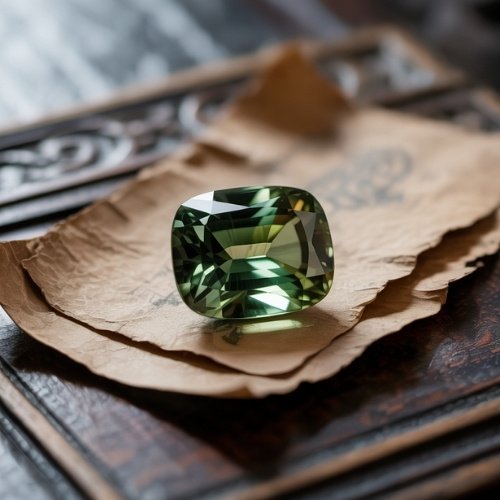
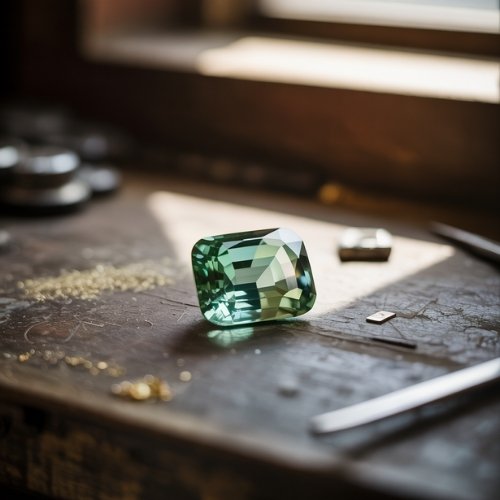
- Verdelite covers the green tourmalines, which range from pale minty tones to rich forest greens.
- Schorl is the common black variety, historically used in mourning jewellery but now enjoying a revival in contemporary design.
- Watermelon tourmaline is perhaps the most visually striking variety for jewellers to work with. These stones show a pink or red centre surrounded by green, with a pale zone in between, which when cut in cross section looks remarkably like a slice of watermelon.
- Then there is Paraiba tourmaline, which sits in a category of its own. First discovered in Brazil in the 1980s, and later found in Nigeria and Mozambique, Paraiba tourmaline contains copper and manganese, which give it a neon colour unlike anything else in the gem world. Prices reflect that uniqueness.
When buying tourmaline, colour saturation and evenness of tone are the main quality factors. Strong, vivid colour commands a premium, while pale or heavily included stones are more affordable but still be beautiful in the right setting.
Tourmaline has good hardness at 7 to 7.5 on the Mohs scale, making it a practical choice for everyday jewellery, including rings, with a sensible setting design. But one thing worth knowing is that tourmaline often shows pleochroism, meaning it can display different colours when viewed from different directions. This is worth factoring in when considering how a stone will be oriented in a setting.
🔗 Working with tourmaline or want to know more about the varieties and trade names? Have a read of my Jewellers Guide to Tourmaline
Fun Facts About Tourmaline
- Tourmaline’s piezoelectric and pyroelectric properties mean it can generate an electric charge under pressure or heat. It was used in pressure-measuring instruments during the Second World War.
- The Chinese market was so critical to the tourmaline trade that when the Chinese government collapsed in 1912, it took the tourmaline trade down with it.
- Tourmaline is a lesser known candidate for the mysterious Viking Sunstone. An unknown type of crystal that helped the vikings navigate on overcast days.
Alternatives for October’s Birthstone
Opal is of course the primary birthstone for October, and for those drawn to something more ethereal and visually dramatic, it remains an extraordinary choice. The two stones complement each other nicely as a pair, with opal’s otherworldly play-of-colour sitting in interesting contrast to tourmaline’s bold, saturated hues.
Aquamarine and rose zircon appear in some older or regional birthstone lists as October alternatives, though neither carries the same widespread recognition as opal or tourmaline.
Tourmaline’s Enduring Place in October Birthstone Lore
Tourmaline is a gem that rewards curiosity. The more you learn about it, the more there is to discover, whether that’s the science behind Paraiba’s electric glow, the history of rubellite masquerading as ruby in royal collections, or the quiet satisfaction of finding a watermelon slice with perfect colour zoning.
For jewellers especially, it’s a stone that gives you extraordinary creative freedom. Virtually any colour palette, any aesthetic, any brief, and tourmaline has something to offer. For October, a month that never does anything by halves, that feels exactly right.
🛍️ Interested in using pre-owned tourmaline in your next design? View our current Tourmaline selection
📌 Save this post so you can revisit Tourmaline, October’s Birthstone, whenever you need inspiration.