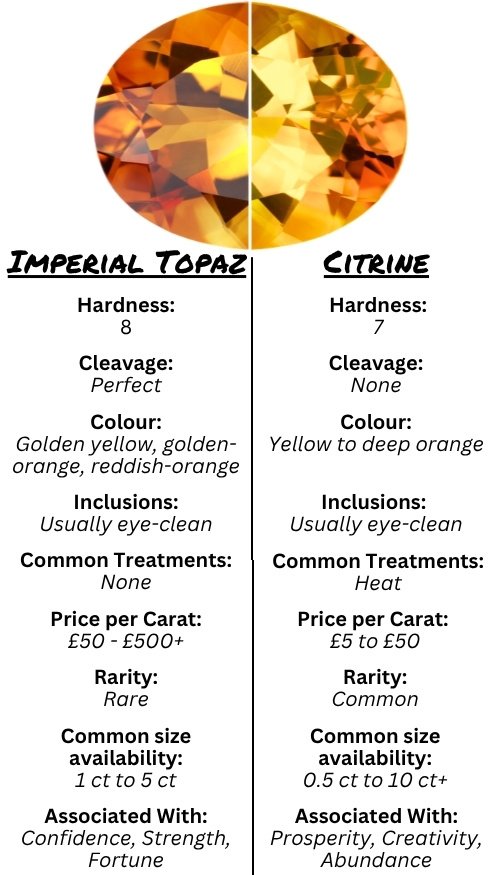
Imperial topaz and citrine share a warm, golden palette that has caused confusion between them for centuries. Both stones glow with amber and honey tones, and when cut and set they can look strikingly similar side by side. The confusion has been compounded by misleading trade names. Citrine has been sold as topaz quartz or Madeira topaz, despite containing no topaz whatsoever.
Once you know what to look for though, telling them apart is straightforward. This guide covers everything you need, from colour and clarity through to durability, treatment, and price.
How to Tell Them Apart: Visual and Gemmological Clues
Visual Clues
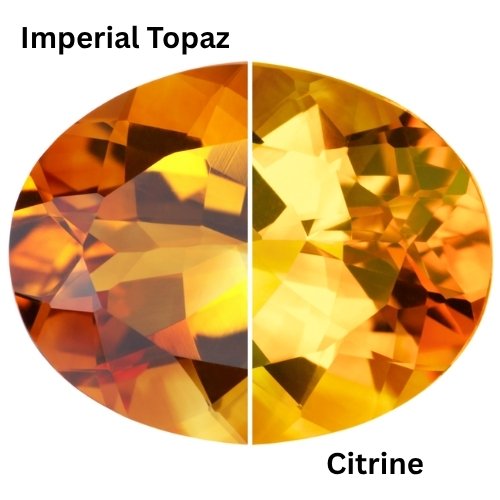
Imperial topaz tends toward rich golden and amber hues, sometimes with peachy or faintly pinkish undertones. Its brilliance is strong and its lustre has a distinctive glassy quality. Citrine sits in a yellow to deep orange range and can sometimes carry a slightly smoky or brownish tinge, though most material on the market today has been heat treated to produce a cleaner, brighter result.
If the stone in front of you has a warm peachy glow and high brilliance, topaz is the more likely candidate. If the colour is a consistent golden yellow or deep orange without much variation in depth, citrine is a strong contender.
Gemmological Tests
| Property | Imperial Topaz | Citrine |
| Refractive Index (RI) | 1.609 to 1.637 | 1.544 to 1.553 |
| Birefringence | 0.008 to 0.010 | 0.009 |
| Pleochroism | Weak to moderate, 2 or 3 colours (light red, orangy red, yellow) | Very weak, 2 colours Shades of orange or yellow |
| UV Fluorescence | Inert to moderate. LW – Orangy yellow to yellowy orange. SW – yellowy orange or greenish white | Inert |
| Optical Character | Doubly refractive, biaxial positive | Doubly refractive, uniaxial positive |
The refractive index difference between these two stones is significant enough to separate them cleanly on a refractometer, which is the quickest and most reliable method of identification.
🔗 Want a deeper dive into working with these gems? Head to their individual guides:
A Jeweller’s Guide to Topaz
A Jeweller’s Guide to Citrine
Colour
Imperial topaz gets it’s colour from chromium and ranges from pale gold through to deep amber, with some stones showing peachy or pinkish warmth in their undertones. Deeper, more saturated colours are rarer and sit at the higher end of the price range.
Citrine, which gets its colour from iron, spans pale lemon yellow through to a rich, deep orange. The most sought-after variety is Madeira citrine, which displays a vivid reddish-orange hue and commands a premium accordingly.
Clarity and Inclusions
Both stones are typically eye-clean, which makes them appealing options for jewellers who want clarity without the premium that eye-clean material commands in other gem types.
Imperial topaz occasionally contains liquid inclusions or growth tubes, but these are not commonly seen in commercial material. Citrine is similarly clean to the eye, though natural stones may show minor inclusions under magnification and can sometimes show quiet strong colour zoning.
Durability and Wearability
Imperial topaz sits at 8 on the Mohs scale, giving it good scratch resistance for everyday jewellery. Citrine comes in at 7, which is still a solid choice for regular wear, though not quiet as scratch resistant as topaz. The meaningful difference between these two stones in practical terms is not hardness but cleavage.
Topaz has perfect cleavage, meaning it can split cleanly, and relatively easily, along a crystal plane if struck at the right angle. Citrine has no cleavage at all, making it more somewhat more forgiving to work with, and more resistant to chipping. This difference doesn’t mean topaz should be avoided, it just means you need a more protective setting when making topaz jewellery that’s likely to be knocked around, such as rings.
Enhancements and Treatments
Imperial topaz is usually left untreated, but that doesn’t mean it’s always treatment free. It’s sometimes heat-treated to improve or stabilise its colour. Heat treatment in imperial topaz isn’t as widely accepted as it is in other topaz colours, such as blue topaz, so it does reduce the value of the gemstone.
Citrine tells a different story. Most citrine on the market is heat-treated amethyst or smoky quartz, a process that produces the warm yellow to orange colours citrine is known for. It is a standard and accepted practice, and the resulting stones are sold as citrine without issue. Naturally occurring citrine of good colour is considerably rarer and may be noted as such by specialist suppliers.
Price Comparison
Imperial topaz is the more expensive of the two, reflecting its relative rarity. Retail prices typically fall between £50 and £500 per carat, depending on size, clarity, colour saturation, and whether the stone is treated or natural.
Citrine is considerably more accessible, ranging from around £5 to £50 per carat. Madeira and mandarin citrine, with their deeper reddish-orange tones, generally sit at the upper end of that range.
Size and Availability
Faceted Imperial topaz is commonly available in sizes from 1 to 5 carats. Stones above that threshold do exist but become progressively rarer and more expensive, which is something to factor in when sourcing for larger statement pieces.
Citrine is much more accommodating in terms of size. Faceted stones from 0.50 to 10 carats are easy to find, and much larger stones are not uncommon given how abundantly the material is supplied. A 20 or 30 carat citrine is a realistic proposition in a way that a topaz of equivalent size simply isn’t.
Cut and Shape
Imperial topaz is often cut into fancy shapes, ovals, and emerald cuts. These shapes are chosen to enhance colour depth and maximise the stone’s natural brilliance, and cutters will take cleavage direction into account to reduce the risk of damage during the cutting process.
Citrine lends itself to rounds, ovals, and cushion cuts, with faceting styles chosen to bring out its warm colour and natural sparkle. Madeira citrine in particular benefits from cuts that draw the eye into its depth of colour.
Rarity and Sourcing
Fine imperial topaz is a genuinely rare material, and larger stones with strong, saturated colour are among the less commonly seen gems in the coloured stone market. Brazil is the primary source, with Russia and Sri Lanka also producing notable material.
Citrine is widely available, partly because heat treatment of amethyst and smoky quartz produces reliable, consistent material in volume. As quartz is one of the most abundant minerals on Earth, deposits are found across multiple continents, with Brazil being the dominant commercial source, alongside Madagascar, Zambia, and Bolivia.
Symbolic and Spiritual Associations
Topaz has long been associated with strength, confidence, and good fortune. Historically it was regarded as a stone of protection and clarity, and its warm golden colour has connected it to solar energy across many cultures.
Citrine carries associations with prosperity, creativity, and abundance. It is sometimes called the merchant’s stone for its traditional link to financial success and positive energy. Its sunny warmth makes it a popular choice for pieces with an optimistic, uplifting intention.
🔗 Discover the deeper meanings behind these gems:
Symbolic and Spiritual Meanings of Topaz
Symbolic and Spiritual Meanings of Citrine
Comparison Summary
| Property | Imperial Topaz | Citrine |
| Hardness | 8 | 7 |
| Cleavage | Perfect | None |
| Colour | Golden, amber, peachy | Yellow to deep orange |
| Commonly Included? | Usually eye-clean | Usually eye-clean |
| Common Treatments | None, but is occasional heat-treated | Often heat-treated amethyst or smoky quartz |
| Typical Retail Price per Carat | £50 to £500+ | £5 to £50 |
| Rarity | Rare | Common |
| Large Sizes (5 ct+) | Available, but costly | Easily available and affordable |
| Associated With | Confidence, strength, fortune | Prosperity, creativity, abundance |
Imperial topaz and citrine may look alike in the display case, but they are quite different gems in character. Topaz brings rarity, high brilliance, and a warm depth that citrine rarely matches. Citrine offers accessibility, generous sizing, and a durability advantage in the absence of cleavage, making it a practical and beautiful choice for everyday jewellery.
For jewellers, understanding these differences helps you match the right stone to the right brief and the right budget. And knowing your topaz from your citrine means you won’t be passing one off as the other, even inadvertently.
🛍️ Looking for a sustainable warm-toned gemstone for your next project? Explore our pre-owned yellow gems
📌 Save this comparison for your bench reference.