Estimated reading time: 4 minutes
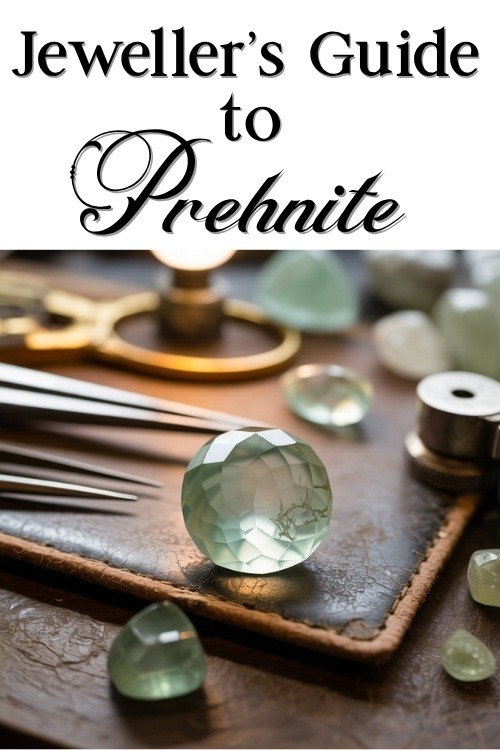
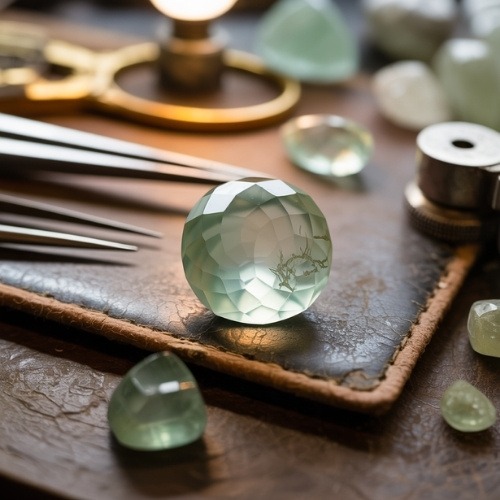
Prehnite has a quiet, serene presence. It often looks like captured mist held inside a softly translucent stone. That subtlety is what makes Prehnite so lovely. It feels like a calming pause in the middle of the gemstone spectrum. It also usually has subtle internal textures that add to its character, especially in Australian and African material.
Jump to:
Basic Identification Information
Name and Synonyms:
Prehnite, historically was sometimes called Cape Emerald or Cape Chrysolite
Species:
Prehnite
Colour Range:
Pale yellow green to soft apple green. Rarely white, or grey
Refractive Index:
1.611 to 1.665
Birefringence:
0.020 to 0.031
Optical Sign:
Biaxial positive
Pleochroism:
Weak
Specific Gravity:
2.85 to 3.00
Fluorescence:
inert to weak brownish yellow glow
Lustre:
Vitreous (glass like) to Greasy
Clarity:
Prehnite doesn’t have an official clarity type, but it’s usually translucent and included.
Gems Often Mistaken For:
Chrysoprase, Jadeite, Nephrite, Serpentine, Peridot
Mohs Hardness:
6 to 6.5
Wearability:
Fair
Birthstone:
Not a traditional or modern birthstone
Spotting Synthetic (Lab-Grown) Prehnite
There are currently no commercially relevant lab grown Prehnites in the mainstream market. Any Prehnite advertised as synthetic or lab grown should be treated with caution and tested thoroughly, since this wording can be used to disguise lookalike materials such as plastics.
Common Treatments
Prehnite is generally untreated. Occasionally it may be coated to improve lustre or surface smoothness, especially in beads, but this is not common in faceted gems.
Durability and Setting Considerations
Prehnite is not as tough as many designers assume thanks to its one directional cleavage. Cabochons do well in pendants and earrings. Rings are possible, but it is wise to give them some protection with a bezel or halo style. The same pearly internal surfaces that give Prehnite its character also make it more vulnerable to sudden direct blows.
🛍️ Explore our selection of pre-owned prehnite gemstones for your next jewellery creation.
Care Instructions
Cleaning:
Use warm water, mild soap, and a soft brush. Avoid ultrasonic and steam cleaners.
Storage:
Store separately or in a soft pouch so harder gems do not scratch it.
Daily Wear:
Avoid wearing during heavy activities, particularly those that risk the gem being knocked, such as gardening or lifting boxes.
Market and Ethical Notes
Prehnite isn’t a scarce gem, but stones with high translucency and an attractive gentle colour are more limited. Value improves with brighter green and finer texture. Excellent material often comes from Australia, South Africa, Mali, the United States, and China.
It is not connected to major conflict zones and is generally considered an ethical and low risk gem to source in terms of human rights issues.
🔗 Learn more about the ethical and environmental story behind Reclaimed and Recycled Gemstones.
Symbolic and Spiritual Meanings
Prehnite is often described as a stone of inner quiet, clarity, and connection to your own intuition. In modern chakra work it is commonly linked to the heart chakra. It is also sometimes associated with restful dream states and gentle self trust.
🔗 Dive deeper into Prehnites Symbolic and Spiritual Meanings
Etymology
Prehnite was named in 1788 after Hendrik von Prehn (1733-1785), a Dutch colonial military officer at the Cape of Good Hope, who brought specimens of the mineral to Europe. It is one of the first minerals to be named after a person.
🔗 Curious about how Prehnite has been viewed throughout history? Explore Prehnite Myths and Legends
📌 Save this jewellers guide to Prehnite for quick reference next time you are working with this gentle green gem.