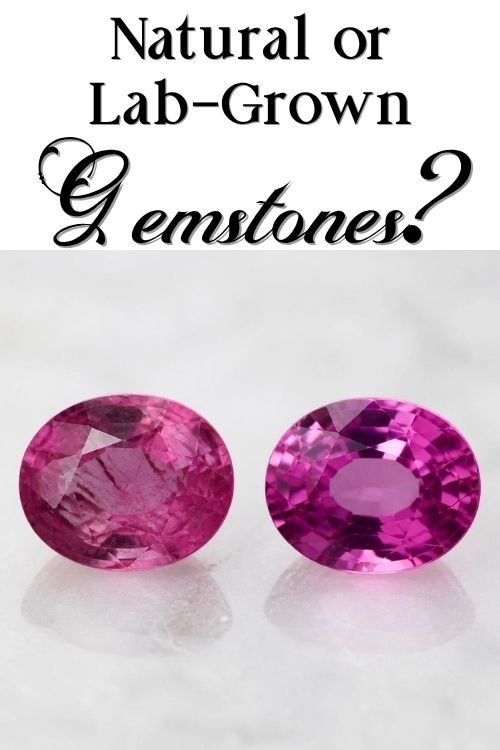
If you sell gemstone jewellery, you’ll get this question sooner or later. A customer picks up a sapphire ring and asks, “is this a real sapphire or fake?”. It’s a fair question, but one that stems from a misunderstanding of what a lab grown gem actually is. It’s also one that trips a lot of sellers up, as they don’t always have the words to confidently explain the difference between natural and lab grown. So let’s untangle it properly, starting with the bit most customers get wrong.
What a lab-grown gemstone actually is
A lab-grown gemstone is a gemstone. Not a fake, not a simulation, not a sciency imitation. Chemically, physically and optically, it’s the same mineral as a stone pulled from the ground. Same crystal structure, same hardness, same way it bends and reflects light.
The only real difference is where and how it formed. A natural gemstone grew slowly inside the earth over thousands or millions of years. A lab-grown one grows in weeks or months, within a controlled environment designed to mimic the conditions inside the earth.
There are a few different ways to grow a gemstone, and it’s worth knowing the basics because they affect quality and price.
- Flux growth. A slow, patient process using molten chemicals to dissolve and regrow the mineral. Can take up to a year, but produces some of the best quality lab stones.
- Hydrothermal growth. Uses hot, high pressure water solutions, similar to how many natural gemstones actually form underground. Commonly used for emeralds and some sapphire.
- Pulled growth (Czochralski). A seed crystal is dipped into molten material and slowly pulled out, growing a column of crystal as it goes. Fast and efficient, but can leave telltale gas bubbles and smoky veils.
- Flame fusion. The cheapest and fastest method. This method can leave curved growth lines and colour bands not seen in nature, and the quality gap between this and the other methods is noticeable.
Worth saying clearly, because it’s the mix up I see most often: glass, cubic zirconia and anything dyed to look like something else are simulants. They’re something pretending to be something else. A lab-grown gem isn’t pretending. Whether a sapphire came from the ground or the lab, it’s still a sapphire.
Natural gems, the pros and cons
The good bits. Every natural stone is one of a kind. No two forms in exactly the same way, so no two ever look quite the same. There’s also the story, millions of years of geology, pressure and heat, all before it ever reached a jeweller’s hands. For a lot of customers, that story is a big part of what they’re paying for.
The trade offs. Natural stones are less predictable. Clarity, colour and size vary hugely, and truly clean, richly coloured stones can carry a serious price tag. Mining also comes with real environmental and ethical questions, though responsible sourcing has come a long way.
Lab-grown gems, the pros and cons
The good bits. Consistency is the big one. If a customer wants a specific colour or an eye clean stone, lab-grown is the more reliable way to get it. Price is friendlier too, so customers can often get a bigger or higher quality looking stone for the same budget. No mining also means no land disturbance from digging up the stone itself.
The trade offs. Some customers feel lab-grown stones lack the story and rarity of a natural one. Resale and long term value is generally lower. And “no mining” doesn’t automatically mean “no environmental impact”, more on that below.
A Closer Look…
Price
This is usually the deciding factor for a lot of customers, so it’s worth being upfront about it. Lab-grown stones are almost always cheaper than natural ones of comparable size and quality, often by a long way. The gap is biggest at the top end. A flawless, richly coloured, large natural ruby or sapphire can cost thousands, whereas a lab-grown equivalent would likely be in the low hundreds at most. This price difference is simply because that level of quality is very rare in nature and very common in the lab.
For budget conscious customers, or anyone who wants a bigger stone without a massive price jump, lab-grown is the way to go.
🔗 Want to learn more about how gemstones are priced? Read Why Are Some Gemstones So Much More Expensive Than Others?
Environmental impact
This is where it gets more nuanced than a lot of marketing lets on.
Lab-grown gems don’t require mining, so they avoid the wildlife and land disturbance, water use and waste that come with extraction. That’s a genuine benefit. But growing a crystal takes energy, sometimes a lot of it, and that energy has to come from somewhere. A lab running on renewable power has a much lighter footprint than one running on a coal fired grid, but no gemstone can be described as having zero impact on the environment.
Natural stones, on the other hand, benefit hugely from responsible sourcing. Small scale and artisanal mining can support entire communities, and a lot of the industry has moved a long way towards better practice.
There’s also a third option worth mentioning, since it sidesteps the question almost entirely. Pre-owned and vintage stones need no new mining and no new lab energy at all. The stone already exists, it’s simply being given a new home. If a customer cares about environmental impact above everything else, that’s often the lowest impact choice on the table.
🛍️ Searching for pre-owned gemstones? Take a look at our selection
Perception
Natural stones tend to carry an emotional weight that’s hard to manufacture. There’s something about knowing a gem formed in the earth long before anyone was around to wear it. That’s part of why natural stones remain the default for meaningful, once in a lifetime pieces.
Lab-grown stones carry a different appeal, more modern, more science forward, and increasingly seen as the smart, forward thinking choice rather than a lesser one. Perception here does seem to be moving in lab-grown’s favour, but plenty of customers will still ask for “a real stone” without quite knowing what that means. Which is exactly why this conversation matters.
Inclusions and clarity
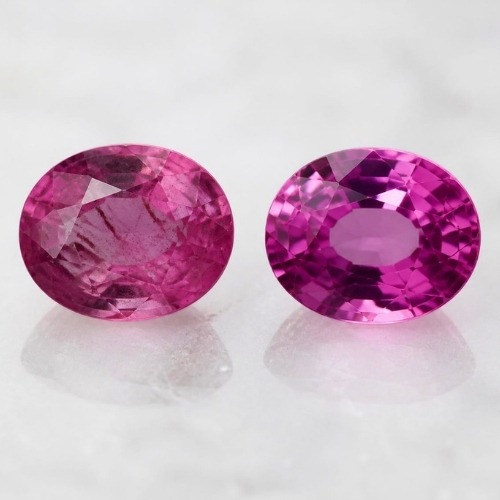
Inclusions are the little internal marks and features found inside most natural gemstones. Because lab-grown stones form quickly under controlled conditions, they usually have very few inclusions, often none at all.
This level of clarity can be seen as both a bonus and a flaw though.
If a customer wants a flawless stone, one with no visible marks at all, lab-grown is the far more reliable way to get that look. Finding a natural stone that clean, especially in emerald, gets difficult and expensive fast.
But inclusions shouldn’t be viewed as a flaw to apologise for. In a natural stone, they’re often seen as proof of origin, a kind of fingerprint that says this stone really did form in the earth. Some customers actively want to see them, as a sign of authenticity rather than imperfection.
Personally I love gemstones with inclusions. Inclusions give a gemstone uniqueness, a visual interest and character that you just don’t get when looking into the depths of a flawless gem, regardless of its origins.
🔗 Interested in discovering more about gemstone clarity? Read Gem Clarity Types Explained
Rarity and resale value
Natural stones, particularly untreated and certified ones, can hold their value well and sometimes appreciate over time. This is especially true when a stone came from a famous, but now depleted mine. For example, a sleeping beauty turquoise is worth more now than when the mine was still active. After all, rarity is part of what makes natural gemstones valuable in the first place.
Lab-grown stones are priced for accessibility, not investment. They won’t carry the same resale value, and that’s worth being honest about with any customer who asks about future worth, especially for larger or heirloom purchases.
Certification’s growing role
As lab-grown quality has improved, the line between “obviously lab” and “obviously natural” has blurred, especially with flux grown corundum (sapphires and rubies). It can now be genuinely difficult, even for experienced eyes, to tell some high quality lab-grown stones apart from natural ones without proper equipment.
Because of that, more high value natural stones are now sold with a lab report confirming natural origin, essentially proof that backs up the claim. It’s a good thing to mention to customers buying anything of real value. A seller who can talk you through how a stone was tested, and by whom (providing it’s a reputable lab), is one worth trusting.
How to talk about it honestly
A quick note on language, since this trips up even well meaning sellers. Terms like “lab-grown”, “man-made”, “created”, and “synthetic” all mean exactly the same thing in trade terms. But customers hear them very differently. “Synthetic” tends to sound fake, even though the stone is entirely genuine, just grown rather than mined.
Clear, honest language does more for customer trust than avoiding the word. Something like “this is a lab-grown sapphire, chemically identical to a mined one, just grown rather than dug up” tends to land far better than tiptoeing around it.
No wrong answer
Neither option is objectively better. They’re just suited to different customers.
Someone chasing a flawless look on a tighter budget will likely be happiest with lab-grown. Someone who wants rarity, story and a stone with real geological history behind it will lean natural. And a customer who cares most about environmental impact might be best served by neither, and instead by a stone that’s already had a life before finding its way to them.
The job isn’t to steer someone towards the “right” choice. It’s to help them understand what they’re actually choosing between, so they can make an informed decision when picking the gemstone that’s right for them.
🔗 Want to know more about how to spot the difference yourself? Read Real vs Fake Ruby: How to Spot the Difference
📌 Don’t forget to save this guide on lab-grown vs natural gemstones so you can find it again!