Estimated reading time: 7 minutes
Sky Blue Topaz and Aquamarine are both soft blue gemstones that are often mistaken for one another. Both share a cool, calming blue that evokes clear skies and tranquil water. At first glance, they can look almost identical, especially once set in jewellery. But they are quite different in composition, rarity, and value.
Let’s take a closer look at what makes these two gems different, from their gemmological traits to their symbolic meanings. By the end, you’ll be able to tell them apart and choose the one that suits your next design best.
Jump to:
Visual & Gemmological Clues

Visual Clues
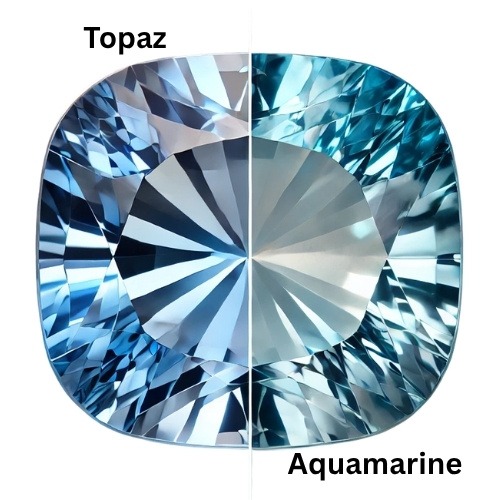
Sky Blue Topaz tends to show a bright, uniform blue with no green undertones. It is usually free of inclusions, and most of the material sold today has been treated to reach this even, pale colour.
Aquamarine, in comparison, leans toward a softer, more natural blue, often with a greenish tint. It is usually inclusion free too, but it is more prone to inclusions than topaz, especially in larger cut gems. Subtle colour zoning can sometimes be present, though skilled cutting keeps this to a minimum.
Gemmological Tests
| Test | Sky Blue Topaz | Aquamarine |
|---|---|---|
| Refractive Index (RI) | 1.609–1.643 | 1.577–1.583 |
| Birefringence | 0.008–0.016 | 0.005–0.009 |
| Pleochroism | Two or Three colours (blue, pale blue, colourless) | Two colours (blue, greenish blue) |
| UV Fluorescence | Sometimes weakly responsive | Always inert |
| Optical Character | Doubly refractive, biaxial positive | Doubly refractive, uniaxial negative |
🔗 Want to take a deeper dive into identifying and working with these gems? Check out their individual guides:
A Jeweller’s Guide to Topaz
A Jeweller’s Guide to Aquamarine
Colour
Sky Blue Topaz shows a bright, uniform, medium light blue with no green or grey undertones. Almost all of the Sky Blue Topaz sold today has been irradiated and heat treated to reach this tone, since naturally coloured material is exceptionally rare.
Aquamarine ranges from pale blue to deep sea blue, sometimes with a slight greenish tint. Deeper blues are rarer and more valuable. Many stones are heat treated to reduce their greenish undertones and bring out a purer, cleaner blue.
Clarity & Inclusions
- Sky Blue Topaz: Typically eye-clean, with very few inclusions due to its formation and treatment.
- Aquamarine: Generally eye-clean but may contain long, hollow tubes or liquid inclusions. Higher quality stones have fewer inclusions.
How They Form
Topaz is a silicate mineral that forms in igneous rocks. It grows in pegmatites, which are coarse grained igneous rocks with large crystals, and in cavities of rhyolite flows, which are silica rich lava. This formation process helps explain why the rough material is so widely available compared to many other coloured gemstones.
Aquamarine is a blue variety of beryl that forms in granitic pegmatites. Its colour comes from trace amounts of iron within the crystal structure. It’s mined in a number of locations worldwide, though fine quality material is far less common than its Topaz counterpart.
Durability & Wearability
On the Mohs hardness scale, Sky Blue Topaz sits at 8, meaning it’s harder than household dust, which comes in at about 7 thanks to its quartz content, and holds up well to everyday wear. Aquamarine measures 7.5 to 8, so it’s almost as hardwearing, though slightly more prone to picking up light scratches over time.
Sky Blue Topaz has perfect cleavage, meaning it can break or chip easily if struck at the wrong angle. Aquamarine, on the other hand, has imperfect cleavage, making it more durable overall, though it still needs care when set or worn.
For jewellery use, both stones work well in earrings, pendants, and rings, but they should be set protectively, especially if worn daily, to guard against knocks.
Enhancements & Treatments
- Sky Blue Topaz: Naturally occurring Sky Blue Topaz is extremely rare. The gemstones sold commercially are almost always irradiated and heat treated to achieve their colour.
- Aquamarine: Often heat treated to remove greenish tones and achieve a purer blue. As fashions are slow changing towards a preference for more natural looks, more aquamarines are being left unheated so there green tones stay intact.
Price Comparison
- Sky Blue Topaz: Affordable, thanks to its abundance and treatment. Retail prices range from £4 to £16 per carat.
- Aquamarine: More expensive, particularly in deeper blues. Retail prices range from £40 to £400 per carat.
Size & Availability
Sky Blue Topaz is typically found in sizes ranging from under 1 carat up to 10 carats or more. Because the rough is so abundant, even 20+ carat stones are easy to find and carry little price premium.
Aquamarine is typically found in sizes ranging from 0.25 to 10 carats, with fine large stones of 25 carats or more also available. Smaller stones under 5 carats often show a paler colour. Though high quality material between 2 and 5 carats with strong, even colour does exist, it’s rarer and significantly more expensive.
Rarity & Sourcing
Sky Blue Topaz is abundant thanks to global deposits and mass treatment. Key sources include Brazil, Russia, Pakistan, Nigeria, and the U.S., and supply is plentiful across all of these regions.
Aquamarine is less common and found in smaller deposits worldwide. Key sources include Brazil, Madagascar, and Pakistan, and even within these counties it isn’t found in anywhere near the same volume as Topaz.
Cut & Shape
Sky Blue Topaz is often cut into standard calibrated shapes, including rounds, ovals, and emerald cuts. These popular shapes make it easy to source calibrated stones for repeating jewellery designs.
Aquamarine is typically cut into emerald cuts and fancy shapes, chosen to enhance its clarity and colour. Cutters often orientate the rough carefully to bring out the richest blue while keeping the finished stone bright rather than washed out.
Symbolic & Spiritual Associations
Sky Blue Topaz is associated with communication, wisdom, and mental clarity. It’s often said to help with clear thinking and honest self-expression.
Aquamarine is linked to calming energy, courage, and protection for travellers. It’s long been associated with the sea, and sailors once carried it as a talisman for safe voyages.
🔗 Discover the deeper meanings of these gems:
Symbolic & Spiritual Meanings of Topaz
Symbolic & Spiritual Meanings of Aquamarine
Comparison Summary
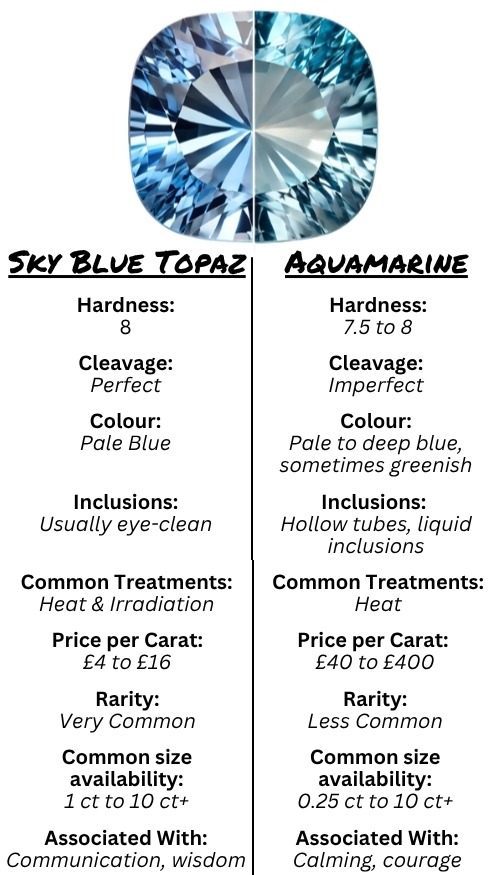
| Feature | Sky Blue Topaz | Aquamarine |
|---|---|---|
| Hardness | 8 | 7.5–8 |
| Cleavage | Perfect | Imperfect |
| Colour | Bright sky blue | Pale to deep blue, sometimes greenish |
| Commonly Included? | Eye-clean | Hollow tubes, liquid inclusions |
| Common Treatments | Irradiated + Heat | Heat |
| Price per Carat | £4–£16 | £40–£400 |
| Rarity | Very common | Less common |
| Large Sizes? | Easily available (10+ ct) | Available but expensive |
| Associated With | Communication, wisdom | Calming, courage |
Sky Blue Topaz and Aquamarine are both stunning blue gemstones in their own right. They may look similar at first glance, but they differ in price, rarity, and durability.
If you’re drawn to an affordable, abundant gem with a bright, uniform blue, Sky Blue Topaz is a great choice. But if you’d prefer a rarer stone with a softer, more natural blue and higher value, Aquamarine is the gem for you.
Either way, both of these gems bring a touch of calm, clear-sky charm to any jewellery design.
🛍️ Looking for the perfect sustainable gemstone for your next jewellery making project? Explore our pre-owned Topaz and Aquamarine
📌 Save this Sky Blue Topaz vs. Aquamarine comparison to come back to whenever you need a quick refresher.