Amethyst and purple sapphire are two captivating gemstones, often chosen for their rich, regal hues and timeless appeal. While they can look similar at first glance (I’ve found purple sapphires mixed into a quartz bundle before), they differ significantly in mineral composition, durability, and even how they’re perceived in the gemstone world.
Amethyst has long been prized as a “semi-precious” gemstone, and was once considered as valuable as ruby or emerald until large deposits were discovered. Purple sapphire, on the other hand, belongs to the corundum family, one of the most durable and precious gemstone families, and is far rarer in its purple form.
Let’s explore the key differences between these two purple gems, from their visual traits right through to their spiritual associations.
How to Tell Them Apart: Visual and Gemmological Clues
Visual Clues
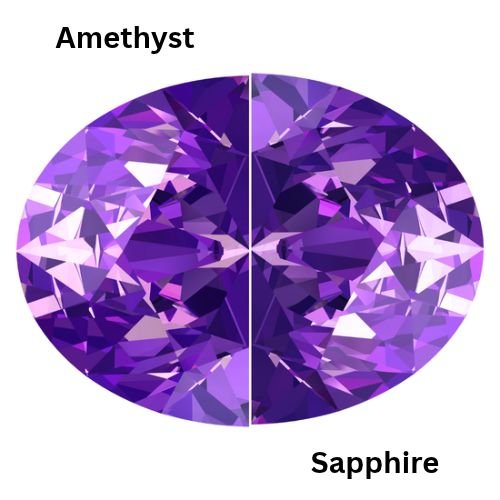
Amethyst typically shows a light to deep violet or purple colour, often with slight zoning or uneven saturation. Some stones may have reddish or bluish undertones, and while it’s normal to find included examples, eye-clean gems are common when it comes to faceted stones.
Purple sapphire displays a more saturated, often darker purple, sometimes with pink or bluish secondary tones. Its brilliance is usually higher due to its higher refractive index, and stones are often cut to maximise brilliance rather than size.
If the stone in front of you is a lighter violet with some colour zoning, amethyst is the more likely candidate. If it’s a deeper, more saturated purple with strong brilliance, purple sapphire is a strong contender.
Gemmological Tests
| Property | Amethyst | Purple Sapphire |
|---|---|---|
| Refractive Index (RI) | 1.544 to 1.553 | 1.757 to 1.779 |
| Birefringence | 0.009 | 0.008 to 0.010 |
| Pleochroism | Weak to moderate 2 Colours – purple/reddish purple | Weak to strong 2 Colours – violet/orange |
| UV Fluorescence | Inert to weak blue (LW and SW) | Inert to strong red (LW) Inert (SW) |
| Optical Character | Doubly refractive, uniaxial positive | Doubly refractive, uniaxial negative |
The refractive index readings for these two stones don’t overlap at all, so a refractometer is the easiest way to separate them.
🔗 Want a deeper dive into working with these gems? Head to their individual guides:
A Jeweller’s Guide to Amethyst
A Jeweller’s Guide to Sapphire
Colour
Amethyst ranges from light lavender to deep royal purple. Some stones exhibit what’s known as “Siberian” colour, a deep purple with flashes of red or blue. Colour zoning is common with amethysts.
Purple sapphire is typically a more intense, saturated purple that may lean slightly pinkish or bluish depending on the trace elements present.
Clarity and Inclusions
Both amethyst and purple sapphire are Type 2 gemstones, meaning it’s normal to see inclusions in them.
Even so, faceted amethyst is often eye-clean, whereas cabbed stones are usually included. That’s not a hard rule, as you’ll still find included faceted stones and clean cabs, but an eye-clean faceted amethyst is far easier to come by than an eye-clean cabochon. When inclusions are present, they’re usually internal fractures, or minor liquid inclusions.
Eye-clean examples of purple sapphire are available, but they are less common than with amethyst and command higher prices than included purple sapphires. The inclusions you’ll usually see in sapphire are silk (rutile needles), fingerprints, or crystals of other minerals.
How They Form
Amethyst is a purple variety of quartz that forms in volcanic rocks and hydrothermal veins. It’s found in Brazil, Uruguay, Africa, and Russia.
Purple sapphire is a variety of corundum, formed under high-pressure and high-temperature conditions in metamorphic or igneous rocks. It’s sourced from Sri Lanka, Madagascar, Myanmar, and parts of East Africa.
Durability and Wearability
Amethyst sits at 7 on the Mohs scale, which is generally considered good for daily wear. Purple sapphire scores 9, making it extremely durable and ideal for everyday jewellery, including engagement rings.
Neither stone has true cleavage, but their toughness differs. Amethyst has moderate toughness and can chip if struck. Purple sapphire has excellent toughness and, while not immune to chipping, it handles wear and tear extremely well.
Amethyst is perfect for pendants, earrings, and rings, but rings should be removed during heavy activity to protect the stone. Purple sapphire is suitable for everyday rings, bracelets, or any jewellery meant to last a lifetime.
Enhancements and Treatments
Amethyst is often heat treated, either to lighten very dark stones or to change their colour to yellow (citrine) or green (prasiolite). Because a stone may have been heated even if the colour change didn’t take, I personally assume all amethyst has been heat treated.
Purple sapphire may be heat treated to improve its colour and/or clarity by melting the silk inclusions. This is common and accepted in the trade, and untreated stones, especially those with vivid colour, command a premium. Some diffusion-treated stones exist, but reputable sellers disclose this clearly.
Price Comparison
Amethyst is readily available and affordable. Retail prices typically range from £5 to £50 per carat, depending on size, clarity, and origin.
Purple sapphire is far more valuable and rare. Prices can range from £50 to £1,600+ per carat, depending on quality, treatment status, and origin.
Size and Availability
Amethyst is widely available in a broad range of sizes, from tiny melee stones of 0.1 carat to impressive centrepieces over 20 carats. Larger amethysts are relatively common and affordable, which makes them a popular choice for statement jewellery designs.
Purple sapphire is far rarer in large sizes. Most faceted stones on the market range from 0.25 carats to around 3 carats.
Cut and Shape
Amethyst is commonly cut into ovals, rounds, emerald cuts, and fantasy shapes, and its affordability makes it popular for creative and oversized cuts.
Purple sapphire is typically cut to maximise brilliance, and is most often seen in oval, cushion, and round cuts. Cutting usually prioritises colour and sparkle over carat retention.
Rarity and Sourcing
Amethyst is abundant and mined globally. It isn’t considered rare, though exceptional specimens from Siberia or Uruguay are more prized.
Purple sapphire is much rarer, especially in untreated form. It’s found in fewer locations, with Madagascar and Sri Lanka being key sources for top-quality material.
Symbolic and Spiritual Associations
Amethyst is associated with spiritual protection, calm, and mental clarity. It’s believed to shield against negative energy, quiet busy thoughts, and clear brain fog, making it a favourite for meditation and spiritual practice.
Purple sapphire is linked to intuition, spiritual wisdom, and transformation. It’s said to enhance focus and inner peace, and to open the mind to divine truths.
🔗 Discover the deeper meanings behind these gems:
Symbolic and Spiritual Meanings of Amethyst
Symbolic and Spiritual Meanings of Sapphire
Comparison Summary
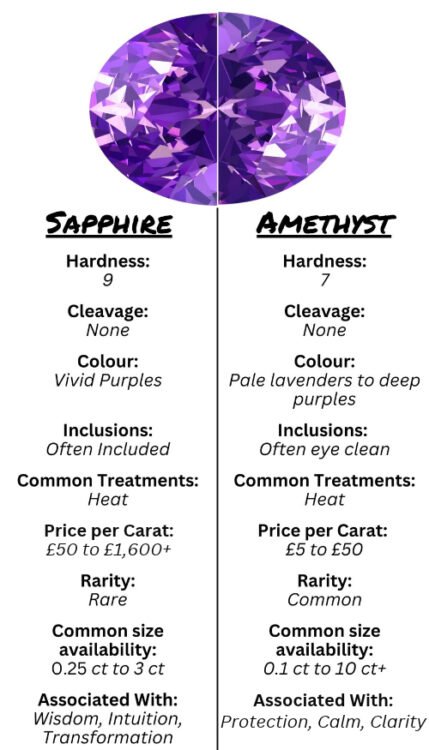
| Property | Amethyst | Purple Sapphire |
|---|---|---|
| Hardness | 7 | 9 |
| Cleavage | None, moderate toughness | No true cleavage, excellent toughness |
| Colour | Lavender to deep purple | Vivid purple with pink or blue tones |
| Commonly Included? | Often eye-clean in faceted stones, included in cabs | Often included |
| Common Treatments | Heat | Heat |
| Typical Retail Price per Carat | £5 to £50 | £50 to £1,600+ |
| Rarity | Common | Rare |
| Large Sizes (5 ct+) | Readily available | Rare and expensive |
| Associated With | Protection, calm, clarity | Wisdom, intuition, transformation |
Amethyst and purple sapphire are both gorgeous purple gemstones, but their uses and values differ dramatically.
If you’re looking for a luxurious, durable, and investment-worthy purple stone, purple sapphire is a top-tier choice. But if you prefer an affordable, widely available gemstone with peaceful energy and rich colour, amethyst is a wonderful option, especially for large statement pieces.
Whichever you choose, each stone brings its own unique look to your jewellery designs.
🛍️ Looking for a sustainable purple gemstone for your next project? Explore our pre-owned purple gems
📌 Don’t forget to save this amethyst vs sapphire gemstone comparison so you can refer back to it when needed.