Estimated reading time: 7 minutes
Blue is one of the most reached for colours in jewellery, and it’s easy to see why. It stretches from the palest, spring skies of aquamarine to the deep, commanding indigo of a fine sapphire, and every shade in between carries its own emotional weight.
Whether you’re designing a piece, choosing a stone for yourself, or writing a description that needs to do some emotional connecting, understanding what blue communicates, at every depth, can help you work and write sales copy with more intention.
Jump to:
What Emotions Are Linked to Blue?
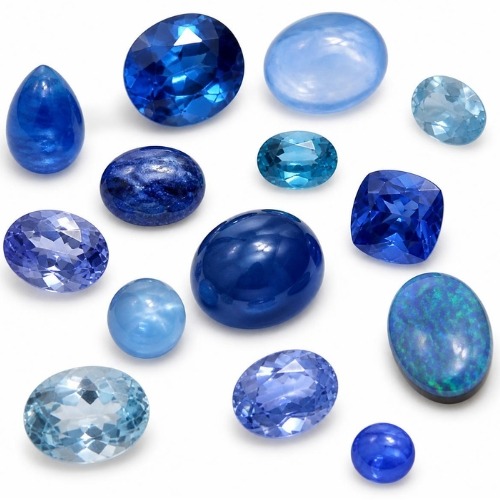
At its lightest, blue is calming and open. Pale aquamarines and sky toned topaz call to mind cloudless days and still water, and they carry associations with clarity, honesty, and gentle trust. It’s a colour that doesn’t demand attention so much as invite it, offering a sense of purity and quiet openness that works beautifully as a counterpoint to bolder palettes.
As blue deepens, that same calm turns inward and gathers weight. Sapphire blues and inky lapis speak to wisdom, loyalty, and emotional depth. Where light blue soothes, dark blue steadies. It’s associated with confidence, dignity, and intuition, the kind of trust and stability that comes from having thought things through.
Both ends of the spectrum have a side that could be seen as slightly negative too. Light blue can tip into coldness, iciness, or emotional distance, while dark blue can read as melancholic, rigid, or overly serious. Neither is actually a flaw, they’re simply the other side of the same coin, and knowing where a stone sits on that line helps you choose language and design details that lean the right way for the piece you’re making.
Using Blue in Jewellery Design
If you’re starting from a feeling rather than a finished design, blue is a flexible place to begin. A piece meant to soothe, something for someone healing or seeking calm, will naturally pull towards the lighter end. Think smooth cabochons, simple bezels, and pale sky tones.
A piece meant to mark a milestone, a new role, a long term commitment, or a spiritual turning point, tends to sit better with deeper blues, with more weight in the setting and richer, more saturated stones.
If the design already exists and you’re choosing a stone to fit it, the same logic applies in reverse. A minimalist stacking ring calls for a clean, pale aquamarine or sky blue topaz. A statement signet or symbolic pendant carries a sapphire or dark kyanite far better.
Because blue covers such emotional ground, how you balance it with other tones depends on where in the spectrum you’re working. At the lighter end, you rarely need to tone anything down, it’s more a case of letting the quiet strength come through without washing out the subtle colour, pairing it with silver or white gold and other cool pastels for a soft, tonal effect that doesn’t steal the show.
The deeper end asks for the opposite approach. Blue this rich is naturally commanding, so it benefits from intentional contrast, warm gold for richness, silver for a bold contrast, and lighter textures or matte finishes to stop a design feeling too heavy.
Across the whole family, blue works well as either the centrepiece or an accent. A pale stone can sit quietly at the heart of a minimalist piece, while a deep one can ground a bolder, more symbolic design. Either way, blue rewards a bit of restraint, it’s a colour that speaks clearly without needing to shout.
Which Customers Are Drawn to Blue?
Blue tends to attract people who value calm, honesty, and depth of feeling, though which end of the spectrum they gravitate to says more about what they’re looking for in that moment than their personality as a whole. Lighter blues appeal to empaths, people in transition, and those after a safe, universally welcome gift. Deeper blues draw in more reflective, composed personalities, professionals, spiritual seekers, and those marking a serious milestone or a long standing loyalty. Across the board, blue is a strong gender neutral choice and a dependable one for gifting, since almost nobody reacts badly to it.
That sense of “something for everyone” runs right through into where blue shows up in birthstone and zodiac traditions too.
Birthstones. Blue appears three times in the birthstone calendar, which says a lot about how loved it is. March belongs to aquamarine, September belongs to sapphire, and December actually offers a choice of three blues: turquoise, tanzanite, or blue zircon.
Zodiac. On the star sign side, the same light and dark split shows up again. The lighter tones suit signs drawn to emotional clarity and communication, such as Pisces, Libra, and Gemini, while the deeper blues resonate with signs that value structure and depth, like Capricorn, Scorpio, and Virgo.
So whether someone’s shopping by birth month or by star sign, there’s a blue stone already waiting for them.
Seven Blue Gemstones for Jewellery Making
- Sapphire. The stone most people picture first when they think of blue jewellery. Durable, classic, and steeped in associations with loyalty, truth, and nobility, sapphire carries social gravitas that few other blue stones can match.
- Aquamarine. The serene, sea-toned favourite and March’s traditional birthstone. Long associated with calm and clear communication, it’s an easy stone to build a whole collection of soft, breathable pieces around.
- Blue Topaz. A clean, affordable brilliance that suits modern and classic settings alike. Often heat-treated to reach its sparkling sky-blue tone, it’s a popular alternative for December’s official birthstones.
- Turquoise. Instantly recognisable even to non-gem people, with its signature matrix and warm history in protective and spiritual jewellery. Paler turquoise varieties blur the line between the light and dark ends of the blue family nicely.
- Lapis Lazuli. A deep inky blue flecked with gold pyrite that carries centuries of association with ancient wisdom and intuition. It brings an immediate sense of history and mysticism to a design.
- Kyanite. Less of a household name, but growing in popularity for its striking indigo tones and links to energetic alignment and clarity. It photographs beautifully and offers something a little different from the expected sapphire blue.
- Larimar. A soft Caribbean blue found only in the Dominican Republic, with cloudy white inclusions that give it a distinctly gentle, watery character. Still a relative unknown outside gem circles, which makes it a lovely stone for a customer wanting something quietly unique.
Talking About Blue: Marketing Language That Resonates
The language you use around a blue stone should match where it sits on the spectrum. Lighter blues respond well to words like tranquil, pure, gentle, and soothing, while deeper blues call for grounded, wise, regal, and reflective. There’s also a quieter register worth knowing how to use deliberately: words like cool, distant, muted, or stoic, which can work beautifully for pieces exploring introspection or emotional distance rather than warmth.
The same necklace described as “quietly elegant” tells a very different story to it being called “emotionally pure,” and neither wording is wrong, they’re just aimed at different customers. The trick is choosing the tone of your language to match both the stone and the person you expect to fall for it.
🔗 Learn more about gemstones and jewellery marketing? read Using Gemstone Knowledge to Boost Your Jewellery Sales
Final Thoughts
Blue, in all its depths, is a colour that people buy with their heart rather than their head, even when they think they’re being purely practical about it. Whether you’re working with a pale or vibrant stone, the real work isn’t describing the colour itself, it’s tapping into what that particular shade of blue makes someone feel.
🔗 Interested in discovering more about colour psychology in jewellery design? Read Colour Psychology and Gemstones
🛍️ Looking for sustainable blue gemstones for your jewellery creations? Browse blue gemstones here
📌 Don’t forget to save this guide to the psychology of blue gemstones so you can find it again when designing your next collection.